
- March 1 Pharmacy Week in Review: Thousands of Lives Saved Due to Improvements in Breast Cancer Treatment, Sesame Allergies Are Increasing (pharmacytimes.com)

Nicole Grassano, PTNN, Pharmacy Week in Review, this weekly video program provides our readers with an in-depth review of the latest news, product approvals, FDA rulings and more.
- FDA oversight of the prescribing of fentanyl products is inadequate, report finds (healthcarefinancenews.com)Assessment of the FDA Risk Evaluation and Mitigation Strategy for Transmucosal Immediate-Release Fentanyl Products (jamanetwork.com)

The Food and Drug Administration and manufacturers did not take action when evidence emerged that potentially lethal fentanyl products were being inappropriately prescribed to patients, new research...shows...even as evidence emerged that as many as half of patients were taking dangerous medications known as TIRFs that should never have been prescribed to them, the FDA and fentanyl makers did not review prescribing records of even a single physician to consider disqualifying them from the program, which would have prevented them from prescribing the products...The study focused on Transmucosal Immediate-Release Fentanyls, or TIRFs, which are more dangerous than most prescription opioids on the market due to their very high potency and rapid onset. TIRFs are designed to get into the bloodstream within seconds, and because of their risks, were approved by FDA only for adult cancer patients "who are already receiving and who are tolerant to opioid therapy for their underlying persistent cancer pain."
- February 22 Pharmacy Week in Review: Blood Glucose Test Strips Prove Accurate, Chronic Inflammatory Diseases Linked to Cancer (pharmacytimes.com)

Nicole Grassano, PTNN, Pharmacy Week in Review, this weekly video program provides our readers with an in-depth review of the latest news, product approvals, FDA rulings and more.
- As medical costs mount, Japan to weigh cost-effectiveness in setting drug prices (reuters.com)

Japanese have easy access to new medicines, whose prices are decided by the government and subsidized by the country’s public health insurance system...But that may change. Japan, confronted with the ballooning cost of caring for an aging population, is introducing a cost-effectiveness test for drugs as a means of capping prices...There are no plans to deny care for patients of any age... Japan should carefully consider an impact on the industry when introducing such analysis to reduce drug prices...If Japan is going to cut prices so much, I think Japan will really run a risk of losing its current position...while drugmakers threaten to pull back from Japan, the government is prepared to call the industry’s bluff, saying Japan is too lucrative a market for companies to ignore... Unlike the United States, where insurers may deny claims, or the UK, where patients can be denied costly drugs, Japan is seen as a relatively predictable market because of its social insurance system...
- Executives from seven major drug companies will be grilled about the high cost of their medications at a Senate panel on Tuesday morning. (ksat.com)
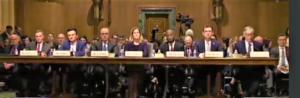
Richard Gonzalez, Pascal Soriot, Giovanni Caforio, Jennifer Taubert, Kenneth Frazier, Albert Bourla, and Olivier Brandicourt
The hearing is the latest volley in Washington's battle against soaring drug prices, which has become a top priority for the Trump administration, as well as many Democratic and some Republican lawmakers...Executives from companies including Pfizer, Johnson & Johnson and AbbVie, will appear before the Senate Finance Committee and likely face tough questions from the panel's new chairman, Republican Sen. Chuck Grassley of Iowa...
- Congressman aims to break pharma’s insulin ‘pricing monopoly’ by legalizing Canadian imports (fiercepharma.com)

U.S. legislators have been introducing bills left and right proposing a variety of methods for bringing down drug prices. Now, Vermont's congressman is zeroing in on a specific class of diabetes medicines that he says have become far too expensive: insulin...Rep. Peter Welch introduced a bill on Wednesday that would make it legal for patients, wholesalers and pharmacists to import insulin from Canada, and eventually from other countries with acceptable safety standards...Welch clearly wants to make an end run around Lilly and its fellow insulin makers. If his bill were to become law, patients with valid prescriptions would be able to import low-cost insulin and have it covered by their insurance plans...
- Legalize Pot? Amid Opioid Crisis, Some New Hampshire Leaders Say No Way (nytimes.com)

But in New Hampshire, Gov. Chris Sununu and some other state leaders are opposed. The problem, they say, is not just about pot. It’s about opioids — drugs that have ripped across this state, devastating thousands of residents and leaving New Hampshire in recent years with one of the highest per capita death rates from opioid-related overdoses. After so many deaths, so much misery and so much state money spent fighting opioids, the opponents say, how could anyone even think about easing access to some other drug?...Mr. Sununu called the debate over marijuana legalization “the next major battle” in the state’s response to the opioid crisis. He urged the commission, which includes medical and drug treatment experts, as well as the heads of various state departments, to take an official position opposing the legislation, which it did at its meeting last month...
- HHS’s Multi-Pronged Approach To Lower Drug Prices: Will It Work? (forbes.com)

...the Department of Health and Human Services has put forward a series of initiatives aimed at lowering prescription drug prices, Medicare expenditures, and patient cost-sharing. The proposals run the gamut from increasing transparency of net pricing, to allowing the use of certain formulary management tools previously off limits to Medicare plans, to direct price controls...But, will they work? The federal government appears to think so. Several weeks ago, Secretary of HHS Alex Azar stated that "the models being announced create new incentives for plans, patients, and providers to choose drugs with lower list prices...[advancing] our priority of using HHS programs to build a value-driven healthcare system."...it's debatable whether HHS will achieve the twin objectives of lower drug spending and decreased patient cost-sharing as a consequence of implementing its series of initiatives. Some may not get implemented as planned, or not at all given the opposition they evoke. Others may result in tempering the growth in drug costs overall, but raising the amount patients must spend out-of-pocket, whether on premiums or patient cost-sharing...
- This Week in Managed Care: February 22, 2019 (ajmc.com)

Samantha DiGrande, Welcome to This Week in Managed Care from the Managed Markets News Network
- Expired drugs may remain effective, safe to use in a pinch (reuters.com)Expired Drugs in the Remote Environment (wemjournal.org)

Even medicines that are years past their expiration date and haven’t always been kept in strict climate-controlled conditions may still retain their original potency, a small study suggests...That is good news for people working in remote areas of the world where sometimes an expired medication is the only one available and the alternative is having no way to treat a serious illness...This date is not necessarily the point at which the drug becomes ineffective or dangerous, and for many medications, this window may be far longer than the usual two-to-three-year expiry date...The study team tested the stability of five expired drugs that had been returned from the British Antarctic Survey...They tested five types of drug, all one to four years past expiration, and compared these to fresh samples of the same medications to see if the expired versions were chemically stable and retained their active ingredient...Researchers found that all of the tested drugs were stable, and would, theoretically, have still been effective...