
- What the FDA Wants Pharmacists to Know About Generic Drugs (drugtopics.com)
Demand for generics and biosimilars is growing. In 2017, generic drugs generated $265 billion in savings. New biosimilars could play a major role in increasing competition and driving down costs...Drug Topics spoke with officials from the FDA’s Office of Generic Drugs (OGD)and from the Therapeutic Biologics and Biosimilars team (TBB) about how the agency is helping accelerate generics to market, and the role pharmacists play in educating patients about the safety, effectiveness, and quality of generics and biosimilars.
- DT: How is the FDA accelerating generics to market? What are some of the obstacles? What does the generic market look like going forward into 2019 in terms of approvals?
- DT: As more generic drugs enter the market, what role can pharmacists play in educating healthcare providers about using generics? How are pharmacists positioned for this task? How does the FDA disseminate information/reports to the pharmacy community on generic drug development and review?
- DT: What is the status of biosimilars in regard to lowering healthcare costs?
- DT: What do you see as the biggest challenge for the healthcare industry as the new forms of drugs are introduced?
- DT: What else might be important for our readers to consider regarding biosimilars?
- WCSD: Board will consider opening health care contract to other providers like St. Mary’s (rgj.com)
The Washoe County school board may open bidding for the district’s multi-million-dollar healthcare contract, school officials confirmed...The contract has been a point of conflict between the district and local healthcare provider Saint Mary’s Medical Group, which has said it was unfairly excluded from the bidding process — potentially at the expense of the district’s employees...The current proposal being weighed by the school board is an exclusive 3-year contract with Renown Health and its insurance arm Hometown Health, the district’s current health care provider. That plan would raise the cost of health insurance premiums by 10 percent in 2019...It's unclear if the move to accept other healthcare proposals comes too late to curb potential premium increases for 2019.
- U.S. appeals court says GSK cannot be sued over generic drug suicide (reuters.com)
U.S. appeals court...tossed a $3 million verdict against GlaxoSmithKline over the suicide of an attorney who took a generic version of the company’s antidepressant Paxil, finding the company could not be held liable for injuries allegedly caused by a generic copy...The case weighing whether brand-name manufacturers can be sued for injuries blamed on generic drug versions was closely watched within the pharmaceutical and legal industries...Under a 2011 ruling by the U.S. Supreme Court, generic drug companies cannot be sued for failing to provide adequate label warnings about potential side effects because federal law requires them to use the brand-name versions’ labels...decision follows a series of state court rulings in similar cases. The top courts of Massachusetts and California ruled brand-name manufacturers could be sued by generic drug users...West Virginia’s Supreme Court...rejected liability claims against brand-name manufacturers for alleged failures to warn over a generic company’s drug.
- The People vs Big Pharma: tackling the industry’s trust issues (pharmaceutical-technology.com)

Price hikes, manipulative patent litigation and a rampant opioid addiction epidemic have steadily soured the public’s view of the pharmaceutical industry. Does Big Pharma has (have) a crisis of public trust on its hands, and if so, how might it restore its credibility in the eyes of patients, policymakers and the rest of the taxpaying public?...“I sort of view Big Pharma, as an industry, as an octopus with many tentacles, and at the end of every tentacle is a wad of cash,” says David Mitchell, president...of...Patients for Affordable Drugs...“It reaches into academic medical centres, professional organisations, patient organisations, state houses, campaigns, Congress – they’re everywhere.”...Mitchell’s description sounds more suited to some sinister political conspiracy than an industry whose business is saving lives and curing diseases. But despite the pharma sector’s noble clinical goals, many of the industry’s business practices – monopoly pricing, blocking generics and biosimilars, spending heavily on political lobbying, an arguably relentless focus on profit – have eroded public trust in its credibility and motives.
- Survey data confirms pharma’s trust issues
- Pharma trust: a varied global picture
- Particular challenges in the US
- Trust exercises: the road to redemption
- State OKs contract to move off federal health insurance exchange platform (lasvegassun.com)Nevada health exchange rates expected to see lowest rise yet (lasvegassun.com)
Nevada is looking to save more than $18 million by transitioning the state’s health insurance exchange from healthcare.gov to its own platform under a newly approved contract...The Board of Examiners...approved contracts...that included a $24.4 million, five-year deal with GetInsured for the platform and a call center. The move will save the exchange $18.9 million through 2023 as costs rise to use healthcare.gov, said Heather Korbulic, executive director of the Silver State Health Insurance Exchange...The GOP tax law’s elimination of the individual mandate — a tax penalty for certain people without insurance intended to encourage healthy people to buy plans, which helps stabilize the marketplace — is expected to raise average premiums about 10 percent almost annually for a decade, according to a November 2017 Congressional Budget Office report...Korbulic said a state-run platform will not only save the state money but help protect Nevada from much of the uncertainty in the market as federal health care policies remain in flux. She has said moving away from healthcare.gov would give the exchange more data to understand demographics that are being reached and those that need more targeted resources
- August 24 Pharmacy Week in Review: Contact Lens Hygiene, New Treatment for OCD (pharmacytimes.com)
Nicole Grassano, PTNN, Pharmacy Week in Review, this weekly video program provides our readers with an in-depth review of the latest news, product approvals, FDA rulings and more.
- CVS adopts ICER metrics in shift to value-based drug pricing (biopharmadive.com)
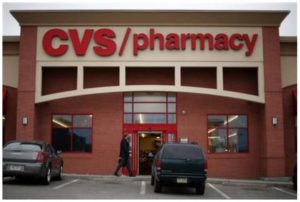
CVS Caremark will use the value-based drug pricing system of the Institute for Clinical and Economic Review to exclude some high-cost drugs from plans...The pharmacy benefit manager will incorporate ICER's quality-adjusted life years measure. If a drug is priced greater than $100,000 per QALY at launch, CVS Caremark will allow its clients to exclude the drug from their plan...CVS is hoping the decision will give PBMs more power in pressuring drug prices lower, especially by targeting their launch prices...PhRMA...supports using "rigorous, objective evidence to guide formulary decision-making”...”At the same time, we strongly oppose misuse of subjective, one-size-fits-all cost effectiveness thresholds to deny patient access to life saving treatment options,"..."As many stakeholders have noted, blunt cost-effectiveness thresholds ignore what individual patient and providers value and conflict with the movement toward personalized, 21st century health care."
- This Week in Managed Care: August 24, 2018 (ajmc.com)
- Exclusive: Pharma sector warns Saudis on German drug curbs (reuters.com)

Crown Prince Mohammed bin Salman
European and U.S. pharmaceutical associations have waded into a diplomatic row between Germany and Saudi Arabia, warning that ongoing restrictions on German-made drugs could hurt Saudi patients and dampen future investment in the kingdom...In a strongly worded letter to Crown Prince Mohammed bin Salman....he associations highlighted the level of concern in Germany and elsewhere about restrictive procurement measures implemented by Riyadh in response to criticism of its policies...Germany’s foreign minister at the time, Sigmar Gabriel, condemned “adventurism” in the Middle East in comments perceived by some as an attack on increasingly assertive Saudi policies. Riyadh dismissed the comments as “shameful” and withdrew its ambassador to Germany...“For the past six months German healthcare companies have been having trouble doing business in Saudi Arabia,” said Oliver Oehms of the German chamber of commerce and industry in Riyadh. “It is not a general boycott, but the healthcare sector is clearly suffering.”...Saudi Arabia is the largest pharmaceuticals market in the Middle East and Africa, with sales of $7.6 billion last year, according to healthcare information company IQVIA...With a growing burden of chronic diseases tied to a more Western lifestyle, Saudi Arabia’s overall drugs market is growing at 10 percent a year and the tender sector is expanding by about 30 percent.
- Trump administration proposes production quota cuts for six opioids (reuters.com)Proposed Aggregate Production Quotas for Schedule I and II Controlled Substances and Assessment of Annual Needs for the List I Chemicals Ephedrine, Pseudoephedrine, and Phenylpropanolamine for 2019 (justice.gov)
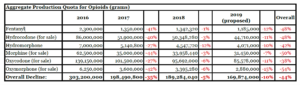
The Trump administration on Thursday proposed that U.S. drugmakers cut production quotas of the six most abused opioids by 10 percent next year to fight a nationwide addiction crisis....the U.S. Justice Department and Drug Enforcement Administration said the proposed cut would be in keeping with President Donald Trump’s effort to cut opioid prescription fills by one-third within three years...