
- Starbucks Offering Frappuccino Drips for a Limited Time (gomerblog.com)

To help mitigate caffeine withdrawal in its hospitalized customers, Starbucks will be partnering with inpatient pharmacies for a limited time to provide Frappuccino drips and infusions to those who need it most...“We were astonished to learn from our friends at Harborview [Medical Center] that patients with alcohol withdrawal are given benzos and patients with tobacco withdrawal are given nicotine patches, but patients with caffeine withdrawal get diddly-squat,” remarked Starbucks President and CEO Kevin Johnson. “We saw this as a huge opportunity.”
- Pharmacy Week in Review: May 11, 2018 (pharmacytimes.com)

Nicole Crisano, PTNN. This weekly video program provides our readers with an in-depth review of the latest news, product approvals, FDA rulings and more.
- NACDS-backed e-prescribing bill to fight opioid abuse passes (chaindrugreview.com)

Legislation backed by the National Association of Chain Drug Stores to help address the opioid abuse epidemic was passed today by the House of Representatives Energy and Commerce Committee. The bill – the Every Prescription Conveyed Securely Act (H.R. 3528) – would require electronic prescribing for Schedule II through V controlled substances prescriptions covered under Medicare Part D to help prevent fraud, abuse and waste...Leveraging the benefits of electronic prescribing to help address the opioid abuse epidemic is one of the priority policy recommendations of NACDS, based on the experiences of pharmacists on the front lines of healthcare delivery.”...The concept of the Every Prescription Conveyed Securely Act maintains strong public support. In a January 2018 national survey conducted by Morning Consult...76% supported rules that all prescriptions must be handled electronically, rather than by paper or fax, as a way to help address the opioid abuse epidemic...The Senate companion legislation of the Every Prescription Conveyed Securely Act is S. 2460, introduced by Sens. Michael Bennet (D, Colo.) and Dean Heller (R, Nev.)...would need to be passed...prior to its proceeding to President Trump for consideration and signature...
- Healthy Nevada Project Adds 5,000 Testing Slots (ktvn.com)

The Healthy Nevada Project is opening up 5,000 more testing slots for people interested in their genetics study...researchers at Renown Health and DRI have partnered with Helix to assess personal health risks of Nevadans and build a demographic profile of our area...Since kicking off the second phase of the Healthy Nevada Project, researchers have collected 10,000 DNA samples.
- This Week in Managed Care: May 11, 2018 (ajmc.com)
Laura Joszt, Managing Editor at The American Journal of Managed Care. Welcome to This Week in Managed Care from the Managed Markets News Network
- Centers for Medicare & Medicaid Services to consider future policies through ‘rural lens’ (fiercehealthcare.com)

The Centers for Medicare & Medicaid Services launched its first "Rural Health Strategy"...an effort, officials said, to better consider the rural impact as part of the of the agency's work...The strategy, which highlights tactics such as improving access to telemedicine, is meant to avoid unintended consequences of policy and program implementation in rural health settings...“Through its implementation and our continued stakeholder engagement, this strategy will enhance the positive impacts CMS policies have on beneficiaries who live in rural areas," said CMS Administrator Seema Verma in a statement...CMS said it is changing access to telehealth services, particularly in rural areas, by paying for additional services and making it easier for providers to bill Medicare..."Something that our organization has been promoting and pushing for quite a while is we just want CMS internally, before they promulgate any rules, to take a look at the impact on rural providers and communities," said Alan Morgan, CEO of the National Rural Health Association...
- As Opioid Liability Rises, Accreditor Seeks Credential For Pharma’s Educators (forbes.com)

The effort to set standards and credentials by the Accreditation Council for Medical Affairs comes during an intense period of scrutiny for those who educate and interact with prescribing physicians. Everybody from federal, state and local lawmakers to plaintiffs’ attorneys are taking aim at the pharmaceutical industry and its marketing practices...Doctors have been accused of overprescribing opioids and critics say pharmaceutical marketing contributed to unnecessary prescriptions...“The opioid crisis is the impetus that sheds the light on pharmaceutical sales practices,” Accreditation Council for Medical Affairs founder and chair William Soliman said. “There are no minimum standards. It’s a crapshoot because nothing’s been uniform.”...Last year...the City of Chicago implemented a new “pharmaceutical representative license” designed to create “greater oversight of prescription marketing...to prevent deceptive drug marketing.”...ACMA has been approved as the provider of continuing education to support license renewal for Chicago’s mandatory pharmaceutical representative credentialing program...ACMA has grown globally to accredit more than 4,000 pharmaceutical reps and medical affairs professionals...
- Major drug distributors downplay contribution to opioid crisis in testimony before Congress (cbsnews.com)
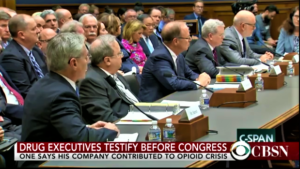
The heads of five major drug distribution companies downplayed their contribution to the opioid crisis...while testifying before a Congressional subcommittee tasked with investigating the epidemic spurred by abuse of opioids. Their testimony drew bipartisan wrath and one Republican suggested prison terms for some company officials...Miami-Luken CEO Joseph Mastandrea told the House panel that his company played a role in the opioid crisis, but executives from the other four drug distributors demurred saying the responsibility lied with prescribers and pharmacists more than it did with distributors...While distributors have been responsible for reporting suspicious orders for more than 40 years, some told members of Congress their screening systems had failed...AmerisourceBergen, Cardinal Health, and McKesson -- often known as the big three drug distributors, shipping 80 percent of prescription drugs in the United States, say their current systems for detecting suspicious orders has been greatly improved in recent years, relying more on algorithms to automatically detect issues...
- U.S. judge blocks DEA from suspending drug distributor over opioid sales (reuters.com)

A federal judge blocked the U.S. Drug Enforcement Administration from suspending a Louisiana drug distributor from selling controlled substances over allegations it failed to identify suspicious orders of opioids that were diverted for illicit uses...U.S. District Judge Elizabeth Foote in Shreveport, Louisiana, on Tuesday entered a temporary restraining order blocking the DEA from enforcing an order issued last week that immediately suspended Morris & Dickson Co’s registration...The DEA’s order marked the first time during President Donald Trump’s administration that it had moved to immediately block narcotic sales by a distributor as the agency attempts to combat a national opioid abuse epidemic...The DEA on Friday announced it was suspending the registration of privately-held Morris & Dickson, saying the distributor failed to properly identify large, suspicious orders of drugs sold to independent pharmacies.
- Supreme Court hears arguments on untested lethal injection method for inmate who’s asking to die (thenevadaindependent.com)Nevada Supreme Court overturns lower court ban on using a paralytic in Scott Dozier execution, citing procedural issues (thenevadaindependent.com)

The Nevada Supreme Court heard oral arguments...in the case of a death row inmate who wants the state to put him to death with a lethal injection method never before used in Nevada or elsewhere...Scott Raymond Dozier, 47, is a death row inmate convicted in Clark County of the 2002 killing and dismemberment of Jeremiah Miller...also...has repeatedly expressed his desire to give up his appeals and be put to death...Dozier’s lawyers are particularly concerned that the execution protocol calls for a paralytic (cisatracurium) in addition to two other drugs (fentanyl and diazepam) meant to kill the defendant...the paralytic doesn’t serve a medical purpose but is only included to mask signs of distress, potentially hiding any indicators of a painful or botched killing...The issue the court must decide is whether the state’s use of the paralytic in the execution violates Dozier’s right, under the Nevada and U.S. constitutions, to avoid any cruel and unusual punishment...