
- DOJ to support lawsuits against companies selling opioids (ktvn.com)
The Justice Department said...it will support local officials in hundreds of lawsuits against manufacturers and distributors of powerful opioid painkillers that are fueling the nation's drug abuse crisis...The move is part of a broader effort to more aggressively target prescription drugmakers for their role in the epidemic, Attorney General Jeff Sessions said. The Justice Department will file a statement of interest in the multidistrict lawsuit, arguing the federal government has borne substantial costs as a result of the crisis that claimed more than 64,000 lives in 2016...the Justice Department...which has also sought to crack down on black market drug peddlers and doctors who negligently prescribe...Targets of the lawsuits include drugmakers such as Allergan, Johnson & Johnson, and Purdue Pharma, and the three large drug distribution companies, Amerisource Bergen, Cardinal Health and McKesson. Drug distributors and manufacturers named in these and other lawsuits have said they don't believe litigation is the answer but have pledged to help solve the crisis.
- Middlemen Play Gatekeeper in Battle to Curb Soaring Drug Costs (bloomberg.com)

Jeff Bezos is teaming up with two fellow billionaires in what could be a prelude to bigger plans to undercut the dominance of intermediaries in the country’s complex health-care system. Pharma companies are trying to shift the blame onto them for soaring drug prices...In response, the middlemen known as pharmacy-benefit managers, or PBMs, are getting more aggressive with the tactics they use to control costs. Express Scripts Holding Co., CVS Health Corp. and UnitedHealth Group Inc.’s OptumRx are increasingly denying coverage of some drugs, negotiating discounts on others or requiring high co-pays for expensive treatments...“It’s becoming more common that we have to play the gatekeeper role,”...The strategy has had some success. Express Scripts said clients’ drug costs rose 1.5 percent last year, the slowest in more than two decades. For 2018, Express Scripts and CVS each refused to cover about 150 drugs -- typically in cases where they negotiated a better deal for alternatives...The tension between PBMs and drugmakers is likely to intensify for two sets of promising drugs coming soon: treatments that help prevent migraines, and drugs for a little-known but widespread liver disease called NASH...
- Benzodiazepines: our other prescription drug epidemic (statnews.com)Perspective: Our Other Prescription Drug Problem (nejm.org)
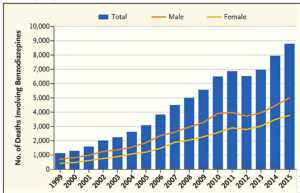
“Benzos” is shorthand for benzodiazepines, a class of drugs often used to treat anxiety and insomnia. The dozen or so different types include Ativan, Klonopin, Valium, and Xanax...More people than you might think are taking them (three benzodiazepines are in the top 10 most commonly prescribed psychotropic medications in the United States). Yet few people realize how many people get addicted to and die from them...Between 1996 and 2013, the number of adults who filled a benzodiazepine prescription increased by 67 percent, from 8.1 million to 13.5 million. Unlike opioid prescribing, which peaked in 2012 and has decreased nearly 20 percent since then, benzodiazepine prescribing continues to rise. The risk of overdose death goes up nearly fourfold when benzodiazepines are combined with opioids, yet rates of co-prescribing benzodiazepines and opioids nearly doubled between 2001 and 2013. Overdose deaths involving benzodiazepines increased more than sevenfold between 1999 and 2015...
- Pot amnesty boxes greet travelers at Las Vegas airport (reviewjournal.com)
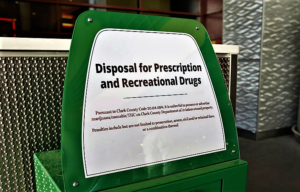
Drug-toting travelers now have a place to trash their stash before boarding a flight at McCarran International Airport...Green metal bins have popped up at the nation’s eighth-busiest airport, creating a safe space for airline passengers to dispose of marijuana before boarding a flight...Even though recreational marijuana is legal in Nevada, the drug is banned inside Clark County’s network of airports and security checkpoints operated by the Transportation Security Administration...About 20 “amnesty boxes” were installed over the past week outside high-traffic areas of McCarran, Henderson Executive and North Las Vegas airports, bearing a sign citing the local law that prohibits pot within airport property...The move comes after Clark County’s Board of Commissioners banned marijuana possession and advertising on airport property as a way to comply with existing federal laws...
- Clarifying regulations could address some doctor concerns with new opioid law (thenevadaindependent.com)Information Regarding AB 474 (bop.nv.gov)Nevada Prescription Drug Abuse Prevention Act is Effective Jan. 1, 2018 (gov.nv.gov)
It’s been nearly two months since a law requiring doctors to take additional steps before writing prescriptions for opioids went into effect, though some of the questions and concerns raised by doctors about the law are only now just starting to be answered...A subcommittee formed specifically to address concerns related to the implementation of the law grappled with some of the areas of uncertainty at a recent meeting with the goal of ultimately clarifying the exact steps doctors must take when writing a prescription for painkillers and figuring out what punishment they should face should they fail to do so. But to what extent that clarification can or should be codified into state regulations will be up to the Board of Pharmacy, which will discuss the matter at a meeting early next month...Though the law, AB474, applies to any prescriber of opioids — from advanced practice registered nurses to dentists — most of the concerns about the law have come from medical doctors, who have lamented the extra time obtaining an informed consent and making a “good faith effort” to obtain a patient’s medical records. Some have even said they won’t write any more prescriptions for painkillers in response to the law and will direct patients instead to pain doctors...The Board of Medical Examiners is responsible for creating any disciplinary regulations they deem appropriate, but the law leaves any other clarifying regulations up to the Board of Pharmacy.
- Cancer research breakthrough shows a better way to predict drugs that will work (cnbc.com)Patient-derived organoids model treatment response of metastatic gastrointestinal cancers (science.sciencemag.org)

Cancer patients need time and drugs that, over time, are effective. They might have more of both according to the results of a new study...The study...showed that the creation of what the researchers are calling microtumors can help predict drug effectiveness in cancer patients better than the current standard method of testing the drugs on rodents. Researchers took biopsies from 71 colorectal cancer patients and made "cancer organoids," or cell culture models of cancerous organs. Researchers then treated these microtumors with drugs and observed the effectiveness in the laboratory...The microtumors grow in a 3-D matrix called a matrigel, and the whole process only takes six to eight weeks...If doctors can more accurately predict what drugs will treat someone's cancer, they can select the right drugs for the right patients. If they know for sure what drugs won't work, they can spare patients the painful side effects..."You can avoid unnecessary toxicity to patients who won't benefit,"..."You can switch to another treatment”...
- Pharmacy Week in Review: February 23, 2018 (pharmacytimes.com)

Nicole Crisano, PTNN. This weekly video program provides our readers with an in-depth review of the latest news, product approvals, FDA rulings and more.
- New FTC rules hurt M&A prospects for hard-hit generics players (fiercepharma.com)

The generics sector has been looking to M&A as a way to combat the pricing pressure crushing top lines around the industry. But that strategy just got a whole lot less attractive...The Federal Trade Commission has suggested it will take steps that could force buyers to hold onto drugs they don't want, a shift that may even be holding up one big deal already...It’s not uncommon that when generics companies combine, the acquirer winds up with two versions of a complex drug—one on the market, and one still in development. In the past, a divestment of the pipeline candidate has solved the issue...Bruce Hoffman, acting director of the FTC’s Bureau of Competition, said earlier this month that the body will no longer allow companies to jettison complex drugs that are still in the works...That’s not a good development for wannabe buyers, as on-the-market drugs are much more valuable than prospects that may or may not ever see any sales. The move “has potential to change valuations and add risk to generic deals in the future,”...
- FDA approves first blood test to help diagnose concussions (statnews.com)

The Food and Drug Administration gave a green light...for the first time to a blood test that doctors can use to help rule out concussions...The Brain Trauma Indicator, marketed by Banyan Biomarkers Inc., measures the levels of two proteins — called UCH-L1 and GFAP — whose elevated presence suggests a certain type of brain damage normally only visible on a CT scan. The test takes three to four hours, and doctors could use it to determine which patients need a CT scan to confirm the damage and which patients can rest easy...FDA Commissioner Scott Gottlieb said that this product could save the health care system money by preventing unnecessary neuroimaging tests. Additionally, by sparing some patients CT scans, it would reduce the radiation exposure associated with those scans.
- This Week in Managed Care: February 23, 2018 (ajmc.com)
Laura Joszt, Managing Editor at The American Journal of Managed Care. Welcome to This Week in Managed Care from the Managed Markets News Network