
- Blame growth for much of Nevada’s poor health care rankings, studies say (reviewjournal.com)Physician Workforce in Nevada - 2016 Edition (medicine.nevada.edu) Health Workforce Supply in Nevada - 2016 Edition (medicine.nevada.edu)
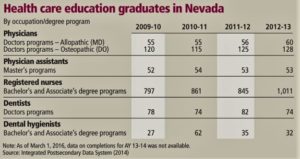
Two recently released reports from the University of Nevada School of Medicine say Nevada has remained near the bottom of many health care rankings partly because of population growth...The 2016 editions of Physician Workforce in Nevada and Health Workforce Supply in Nevada...offer insight into the state’s health care workforce, including what researchers say is the importance of education and training opportunities in meeting the state’s health care needs...Nevada falls well below the national rates of medical doctors per 100,000 members of the population and doctors in patient care per 100,000 population...Nevada has seen increases in the number of health care practitioners in many fields, but that growth isn’t reflected in per capita numbers because of the state’s growth...Per capita, Nevada ranks 48th in the nation in physicians and 50th in primary care physicians...Trying to keep up with the demand is a real challenge, so that’s part of the issue...Another part of the issue is that in order to educate the health care workers of the future, you have to have clerkships and internships for them in the state....
- Wal-Mart Pairs With McKesson to Buy Generic Drugs More Cheaply (bloomberg.com)

Wal-Mart Stores Inc., the world’s biggest retailer, is joining forces with McKesson Corp., the largest U.S. pharmaceutical distributor, to purchase generic drugs, allowing the two companies to use their collective size to get better prices...The move reflects growing consolidation in the pharmaceutical supply chain, as drugstores, drugmakers and the companies that manage pharmacy benefits are collaborating more closely -- in some cases merging -- to wring costs out of the process. Wal-Mart and McKesson, which have a three-decade history of working together, say the move to buy generic medicines together will add efficiency and value to their operations.
- Valeant to increase hospital discounts for two heart drugs (reuters.com)

Valeant Pharmaceuticals International Inc said on Monday it would raise the discounts to hospitals on its heart drugs Nitropress and Isuprel to as much as 40 percent off list prices after shareholder William Ackman pledged to revisit controversial price increases on the treatments...Valeant has been criticized by doctors and is being investigated by the U.S. Senate after having raised the price of Isuprel by about 720 percent and Nitropress by 310 percent...The company said on Monday all hospitals were eligible for a rebate of at least 10 percent, with rebates totaling 20 percent, 30 percent or 40 percent based on the volume purchased during a quarter...Valeant did not cut the list prices of the drugs.
- Walgreens launches online mental health services (chaindrugreview.com)Rediscover Your Reason to Smile (walgreens.com)
Walgreens has rolled out an online mental health platform that offers informational resources, screening tools, a therapist/psychiatrist locator, and live video chats with mental health professionals...The drug chain said...that in tandem with Mental Health America, it has launched Mental Health Answers...visitors can access MHA’s provider locator tool; free online screenings that enable users to assess symptoms for a range of conditions, such as depression, anxiety, bipolar disorder and PTSD; and a library of articles and other content on mental health...MHA also can facilitate follow-up treatment and care through providers and specialists in local communities, as well as via its affiliates nationwide...The mental telehealth service expands Walgreens’ current medical telehealth partnership with MDLIVE...Teletherapy is an excellent option if you’re looking for a more convenient, private, and affordable way to receive behavioral therapy...Through our relationship with Walgreens, we are making it easier for consumers to get help by providing the flexibility to schedule therapy at a time that works best for them, and without the need for travel time, waiting rooms or office visits...
- Dr. Robert Rand does not enter plea during Reno federal court appearance (mynews4.com)Reno prescription drug ring case: What we know now (rgj.com)
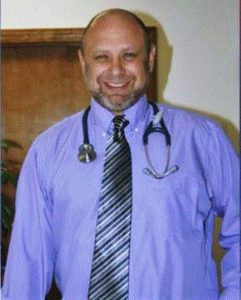
Dr. Robert Rand
Dr. Robert Rand did not enter a plea during his appearance in federal court Monday in Reno...Rand has been indicted and charged with taking part in a criminal prescription drug distribution ring...His attorney, John Arrascada, told News 4 that Rand would plead not guilty to all charges...Eight other people have been indicted by a federal grand jury. All eight have pleaded not guilty to the charges they face individually, though only Richard Winston West II remains detained...Doctor Robert Rand will be arraigned...to enter a plea on charges of conspiracy to distribute and possess with intent to distribute controlled substances...
- Clinical Trials and the Growing Importance of Informatics (fiercepharma.com)

Demonstrating the efficacy, safety and differential benefit of a new drug relies on collecting and analyzing enormous amounts of data generated in a clinical trial. Yet this process of extracting knowledge from data is often the source of many inefficiencies...We recently spoke with Dimitris Agrafiotis, PhD, Vice President and Chief Data Officer at Covance, to hear his thoughts on how informatics has affected drug development and will continue to transform the pharmaceutical industry.
- Why is informatics important in a global context?
- How does informatics support the conduct of efficient clinical trials?
- What role can informatics play in data management, analysis and integration in a clinical trial?
- How is informatics currently being employed to improve clinical trial performance?
- What role does informatics play in increasing patient safety?
- Secret rebates, coupons and exclusions: how the battle over high drug prices is really being fought (washingtonpost.com)Expected Growth in PBM Exclusion Lists Poses a Challenge to Drug Developers (csdd.tufts.edu)

A battle for profits between two arms of the health-care industry has made privately insured patients into pawns, offering them a growing number of discounts on their drug co-pays while ultimately leaving them with fewer drug options overall...The research...Pfizer, found that the number of coupons that drug companies offer to help defray the portion that insured patients pay for their drugs has exploded. At the same time, the companies that provide prescription coverage have increased the number of drugs they refuse to cover, in an effort to gain leverage with drug companies in price negotiations...researchers at the Tufts Center for the Study of Drug Development illustrate how two profitable, behemoth industries — with drug companies that sell and develop treatments on the one side and with companies that negotiate prices and pay for drugs on the other — make shifting alliances with patients to protect their own interests...Each industry has its own seemingly pro-patient move: Drug manufacturers offer coupons to reduce co-pays that people are faced with at the pharmacy counter. Pharmacy benefit-management companies, hired by health-insurance companies to manage drug benefits, negotiate aggressively to secure rebates that lower the cost of drugs...The study shows how these tactics are actually parries and counterattacks in both industries' attempts to make money...
- The deceptive generosity of coupons
- Fighting coupons by playing hardball
- Digital-focused pharmacy Capsule opens in New York (cnbc.com)
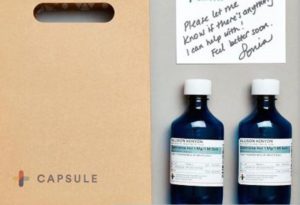
The digital start-up Capsule, which opens for business...in New York City, is looking to compete in the already crowded Big Apple pharmacy market by focusing on home delivery of prescription drugs...At the same time, Capsule is eschewing selling customers candy, soda, shampoo, greeting cards and other nonpharmaceutical items...Capsule aims to solve what its executives call the "existing pain points" of conventional, bricks-and-mortar pharmacies: long wait times to get prescriptions filled; having to return to the store because a drug is out of stock; uncertainty about how much a drug will cost a patient; and getting questions answered about drugs...Instead of walking into a store, most of the start-up's customers will get their medications hand-delivered by couriers dispatched throughout the city — with the temporary exception of Staten Island — via bicycle, buses and subways, and by foot, after their doctors file the prescription electronically...To build its business, Capsule will rely on consumer and doctor awareness. Patients can request the service, or doctors can recommend it...We think eliminating folks going into the store is one way of creating a better experience or energy...Capsule is launching its new way of running a pharmacy in New York City...This would certainly make sense in a number of other markets across the country, if not most everywhere...
- UK cancer charities call for NICE reform (pharmatimes.com)

Leading UK charities have written to Prime Minister David Cameron urging a review of the system for commissioning drugs in England and Wales which, they argue, has put thousands of cancer patients at risk of missing out on the most innovative therapies...In an open letter to the Prime Minister...the heads of leading cancer charities warn that plans to leave the appraisal methodology employed by the National Institute for Health and Care Excellence unchanged will soon lead to effective new cancer medicines struggling to gain approval...Under current government proposals the Cancer Drugs Fund’s assessment of medicines will be handed back to NICE..."We must not forget the CDF was established as an emergency measure to bypass the very NICE appraisal process to which it is now returning because it was not working for cancer patients," the charities said, and called for "a sustainable system, flexible enough to ensure that the best cancer drugs can routinely benefit NHS patients"...With an anachronistic NICE system still unable to engage in price negotiation, it’s inevitable that patients will not be able to access the clinically-proven medicines that could mean so much to them...it is "high time" for a review of the system.
- Would A Wider Variety Of Vial Sizes Reduce The Cost Of Chemotherapy? Not Likely (healthaffairs.org)

The high prices of many patented pharmaceuticals, especially chemotherapy drugs, pose substantial challenges to the budgets of public programs, private insurers, and patients and their families. Addressing this problem in the US context, through changes in drug negotiating rules, reimportation, price controls, or patent reform is pragmatically daunting and politically fraught. It’s natural, then, to seek ways around the problem — options that might reduce the price of drugs while sidestepping that charged territory.
- Vial Size
- Pricing
- Unintended Consequences
Pharmaceutical pricing is a tangled issue, requiring tough tradeoffs that are politically challenging. Unfortunately, we’re not likely to avoid those challenges with a clever shortcut.