
- In China’s tougher drug market, minnows open back door for ‘Big Pharma’ (reuters.com)

Armed with Beijing funds and friends in the right places, Chinese drug minnows are thriving, luring money from 'Big Pharma' majors struggling to restore the strong growth they once enjoyed in the world's second-largest medicine market...Chinese healthcare mergers and acquisitions nearly tripled last year to more than $50 billion, helped by giants like GlaxoSmithKline PLC and Eli Lilly and Co tapping small biotech and research innovators. The targets offer vital regulatory know-how as Beijing builds a domestic drug industry...For Big Pharma, acquisitions, licensing deals and joint ventures offer a back door into a market where Beijing expects healthcare spending to rise to $1.3 trillion by 2020. The majors need the opening: their China growth has stalled to low single-digit pace from over 20 percent just four years ago as branded generics have lost their shine...
- Pfizer to pay $784.6 million to resolve Wyeth false claims lawsuit (reuters.com)
Pfizer Inc has agreed to pay $784.6 million to resolve allegations that Wyeth, which it acquired in 2009, underpaid drug rebates to Medicaid, the federal health insurance program...The settlement resolves claims by the U.S. and states that Wyeth knowingly reported false and fraudulent prices on two of its anti-acid drugs, Protonix Oral (pantoprazole) and Protonix IV...Wyeth offered hospitals deep discounts on bundles that included both drugs when made available to staff and patients...Wyeth wanted to induce hospitals to buy and use Protonix Oral, a drug they would otherwise have little incentive to prescribe because of other drugs that were already on the market and competitively priced...Wyeth hid the bundled discounts from Medicaid...
- Walgreens Agrees to $500K Settlement for Overcharging Customers (pharmacytimes.com)
Walgreens has agreed to pay $500,000 in penalties, fees, and costs related to misleading advertising practices that led to New York customers being overcharged for products..."Businesses are required to ensure that their advertisements are truthful and not misleading..."When consumers purchase products at retail stores in New York, they should be able to rely on the prices displayed in advertisements and on shelf tags and not have to worry about being overcharged when they get to the register."...Walgreens has agreed to reform its advertising and business practices in New York...It must remove expired shelf tags within 36 hours, restrict the use of "Smart Buy" or "Great Buy," and refrain from using "Last Chance" or "Clearance" tags when the item is available at a reduced price for an extended period of time...Walgreens will also conduct internal and external price check audits in stores. If a store fails 2 consecutive external audits, it will have to pay a $2500 penalty.
- J&J continues facilities expansion in South Africa with public health operations (fiercepharma.com)

Just after opening a refurbished manufacturing facility in Cape Town, South Africa earlier this year, pharma giant Johnson & Johnson recently opened the doors to its Global Public Health Africa Operations office there...The company has invested $21 million (300 million rand) in the facilities. The global public health facility will focus on HIV, tuberculosis and maternal, newborn and child health..."This (investment) tells us that South Africa has the capability to provide a facility for world-class manufacturing," Rob Davies, minister of the Department of Trade...
- New implant set to join fight against U.S. painkiller epidemic (reuters.com)
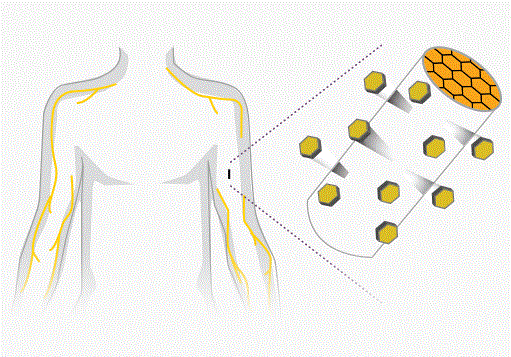
Two companies are on the cusp of taking a new treatment for opioid addiction to the U.S. market at a time when lawmakers are seeking ways to arrest an epidemic of heroin and painkiller abuse...Titan Pharmaceuticals Inc and...Braeburn Pharmaceuticals have together developed a matchstick-sized implant that analysts expect will be approved next month, despite mixed reviews...Implanted into the arm, the treatment is designed to be less vulnerable to abuse or illicit resale than the oral drugs that are currently used to treat opioid addiction...Two drugs are predominantly used to treat opioid addiction: methadone, which is dispensed only in government-endorsed clinics, and the less-addictive buprenorphine, which exists as a pill or strip of film...The implant, known as Probuphine, offers an alternative by administering buprenorphine for up to six months after users have first been stabilized on the oral form of the drug...Food and Drug Administration have raised reservations about possible complications from the insertion and removal of the 26mm long implant...
- The Complex Math Behind Spiraling Prescription Drug Prices (nytimes.com)
The soaring cost of prescription drugs has generated outrage among politicians and patients. Some cancer drugs carry price tags of more than $100,000 a year, and health plans are increasingly asking people to shoulder a greater share of the cost...Americans regularly cite drug prices as a top health care concern...Higher drug prices threaten to raise insurance premiums and patients’ out-of-pocket expenses and can cost taxpayers more because of Medicaid and other government programs. But drug companies say the prices reflect the enormous investment of time and resources that go into bringing a drug to market and argue that many times, their drugs can prevent more expensive medical interventions like surgery and hospitalization...So how much do drugs cost?...A drug’s path from the manufacturer to the patient is circuitous, and many middlemen are paid along the way...The pharmaceutical company sends the drug to a distributor, which takes a fee and then sells the drug to a pharmacy, which pockets its own fee before dispensing the medication to a patient. If a patient is insured, a pharmacy-benefit manager is paid for processing the transaction between the pharmacy and the insurer or employer. The pharmacy-benefit manager also handles the rebates that flow from the drug maker to the insurer or the employer...The good news first: The vast majority of drugs dispensed in the United States...are generics, which are low-cost alternatives to brand-name drugs. If your doctor writes you a prescription, there is a very good chance it will cost you $10 or less...patients who are the sickest and require the most expensive drugs are the most vulnerable to soaring drug prices..."It’s sort of embedded in the health care system that the price is never the price, unless you’re a cash-paying customer,"...
- Nevada ranks below national average in emergency preparedness, health security (reviewjournal.com)Index assesses all 50 states for emergency preparedness and health security (nhspi.org)
Nevada ranks below the national average in emergency preparedness and health security...The Silver State scored a 5.9 overall on a 10-point preparedness scale in the 2016 National Health Security Preparedness Index...The Robert Wood Johnson Foundation, which directs the index and also supports the national County Health Rankings, found the United States is "relatively well-prepared" in the field of emergency management, averaging a 6.7 on a 10-point preparedness scale...Nevada struggled with lower than average marks in all but two of the six fields measured — incident and information management and environmental and occupational health...Nevada may be falling slightly behind other states in its emergency management preparations.
- Pharmacy Week in Review: April 29, 2016 (pharmacytimes.com)
Mike Glaicar, Business Development: Pharmacy Times...(PTNN) This weekly video program provides our readers with an in-depth review of the latest news, product approvals, FDA rulings and more.
- Transitions of care: The next frontier for hospital and community-based pharmacists (pharmacytoday.org)
Transitions of care programs are designed to provide continuity of care to patients as they move from inpatient hospital settings to home or other care settings. Historically, care transitions have been an area in which medication errors and other problems occur. Sometimes patients’ medication lists are a big puzzle, and often there is information that is missing...With a transitions of care program, pharmacists can solve the puzzle by figuring out what is happening by talking to patients about their medications and reconciling their medication lists...Patients who go through multiple transitions of care are often the sickest patients with the most chronic diseases...If you can coordinate care for patients who are going through multiple transitions at multiple points, then you can improve care quality and save money on the Medicare side...it very fulfilling to offer transitions of care pharmacy services to patients...When you have a patient who tells you ‘thank you so much’ for spending the time with them to review medications so they understand, it is very rewarding and demonstrates how important our service is...
- Germany’s drug pricing amnesty reset risks pharma backlash (fiercepharma.com)

Germany’s strict drug pricing controls may be about to get a whole lot harsher as the country’s government is mulling over whether to lift a lucrative pricing amnesty...The current system sees healthcare insurers in the country negotiate discounted prices with pharma companies on their new meds--but the German government has for some time allowed those insurers to pay full price for the latest drugs up to a year from the time they win regulatory approval...following consultations with pharma companies, the health ministry said it would draw up new plans in the coming months to limit prices for new drugs and halt this one-year amnesty...Under this proposal drugmakers could still charge full price for new drugs--but it would mean health insurers would be able to start negotiating discounts once a drug’s sales hit around €250 million ($282 million)--a fairly low limit for blockbuster meds that can easily make two to three times that amount...Germany is struggling to pay its healthcare bills. Despite the efforts of the government to curb pricing, total expenditure in Germany’s statutory health sector rose 19.7% to €202 billion ($228.4 billion) in 2015 from 2011--with prescription-drug spending alone jumping 27.1% over the past 5 years...