
- India’s Supreme Court wants stricter oversight of MSD, GSK HPV clinical trials (fiercepharmaasia.com)

Suggesting that India's chief drug regulator may not be doing enough to protect certain volunteers in clinical trials, the Supreme Court ordered the agency to provide adequate oversight, particularly when drugs to treat the human papillomavirus are concerned…Central to the high court's concerns, it said, were Merck Sharpe & Dohme's Gardasil and GlaxoSmithKline's Cervatrix...The two justices presiding said they were not trying to run the Drugs Controller General of India, but they believed the poverty-stricken and others in trials should be protected at the informed-consent stage when testing HPV vaccines… The court said the procedure should be transparent and patients should be compensated when failures occur.
- Broken Market for Old Drugs Means Price Spikes Are Here to Stay (bloomberg.com)
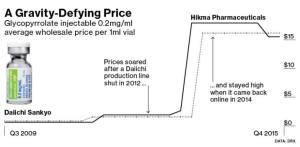
Prices for 50 hospital drugs have risen 10-fold over 8 years…Generic injection meds in short supply as producers drop out…With most products, you’d expect a flood of new supply to quickly drive back down a price spike caused by a temporary shortage. Not so in the topsy-turvy world of hospital pharmaceuticals…All sorts of medications, from treatments for irregular heartbeats to supplies as basic as saline solution, have shot up in price as common hospital drugs are increasingly, and sometimes critically, in short supply. The reasons for the shortages are varied: creaky old factories, an FDA crackdown on quality control, companies exiting the market for more lucrative opportunities and fewer producers in the wake of a wave of mergers and acquisitions…“It’s a broken market," said Stephen Schondelmeyer, a pharmacist and economist at the University of Minnesota who has studied drug prices. "Drug companies know there is going to be an end to this blank check era and they are pushing for whatever they can get."
- Independent Pharmacy Economics: Profits Steady, but Sales Down (Maybe) (drugchannels.net)
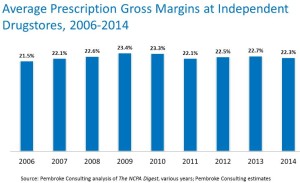
Time for my annual look at independent pharmacy owners’ business economics, drawn from the recently released 2015 National Community Pharmacists Association Digest…The data reveal that independent pharmacy owners are doing better than you might expect…The number of independent pharmacies continues to hold steady…In the NCPA Digest sample, average per-prescription revenue declined, which reduced gross profits and average prescription revenues. On the other hand, IMS Health data imply independents' revenue and prescriptions are growing, not declining. Hmmm.
- Overall independent pharmacy profit margins remain stable.
- An independent pharmacy’s prescription profit margins were also stable.
- An independent pharmacy’s gross profit per prescription declined.
- Brand-to-generic substitution is reducing retail pharmacy revenues.
- The average pharmacist owning a single pharmacy earned about $228,000 in 2014.
- The total number of independent pharmacies continues to hold steady.
- Global drug spending to hit $1.4 trillion in 2020: IMS (reuters.com)
Global spending on medicines will reach $1.4 trillion in 2020, driven by increased healthcare access in emerging markets and high-priced new drugs for cancer and other diseases…That is up from about $1.07 trillion this year, representing a compound annual growth rate of 4 to 7 percent over the next five years…Some 225 new drugs will come to market over the next five years, about a third aimed at cancer, as well as medicines for rare diseases, which can carry ultra-high price tags, and treatments for autoimmune diseases and heart disease…cost will be partially offset by patent expirations expected to reduce spending on branded medicines by $178 billion, including $41 billion from biologic drugs as cheaper biosimilars become more widely adopted…Developed markets will still account for the lion's share of global spending, about 63 percent, due to higher prices and access to the newest, most expensive treatments.
- Feds call on hospitals to review disaster plans after Paris attacks (fiercehealthcare.com)

French hospitals' mass casualty response can be a guide for United States..The horrifying attacks on restaurants, clubs and cafés in Paris last week have resulted in a call by U.S. federal agencies for healthcare providers and hospitals to review their disaster plans and to exercise "enhanced vigilance"…Department of Homeland Security and Health and Human Services urged healthcare providers this week to "review and exercise their security plans" in the wake of the attacks…The notice urged healthcare organizations to:
- Review security plans and conduct drills that incorporate scenarios based on tactics recently used
- Review active shooter, suspicious activity reporting, and counter-IED preparedness in training and awareness initiatives and in organizational safety briefings
- Ensure proper functioning of emergency communications equipment and conduct regular tests
- Cheating On Court-Ordered Drug and Alcohol Tests Just Got A Lot Harder (kolotv.com)
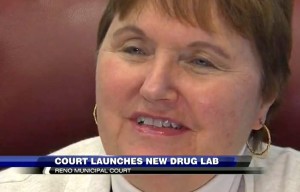
Offenders facing court-ordered drug tests in Reno Municipal Court have often found ways around the system. That just got a lot harder and consequences for cheaters a lot swifter…Their crimes may vary…But the common underlying cause is substance abuse. That makes them potential candidates for one of the specialty courts. Instead of housing them behind bars, they are sentenced to sobriety and a rigorous schedule of random testing… But the court now has a new drug-screening lab. Samples, as many as 54 at a time, can be analyzed for 11 kinds of drug or alcohol content. Accurate results in minutes…The lab is the first of its kind in northern Nevada.
- We have met the enemy, and he is us (drugtopics.modernmedicine.com)
The Cynical Pharmacist lays it on the line..
- Back in the day - Not long ago, pharmacists were respected. We went out of our way to help people in every imaginable situation…What is the upshot of all this kindness today? Patients berate and complain about us unless or until we accede to their every demand.
- Think about what you’re doing…If a prescriber forgets anything on a prescription, what do pharmacists do? We call.
- Whose job is it?...What do we do? What should we do?...What happens when I send prescriptions back with a patient?
- Do the rules apply?...prescribers as well as pharmacists. I believe that both groups of people have to read, understand, and follow the same set of rules…Somehow it has become our job to fill in the blanks for the prescribers…How about a big fat “no”?
- Who ends up on the hook?...But what about the poor patients? Don’t put them in the middle of a pissing contest between you and the prescriber. It’s not their fault their prescriber was in a hurry/forgot/is a moron.”
- Stand up for pharmacy…I’ve done it. It’s amazing how quickly physician offices change their tune when facing legal repercussions.
- Just stop…we are great complainers. We also shy away from conflict. Patients yell at and abuse us all day long and we complain — after they’ve gone…Stop permitting abuse.
Better yet…just send them back.
- Price controls loom for generic drugs in India next year (fiercepharmaasia.com)

India's generic drugs could face new price controls as early as next year, as the prime minister's office pushes for an investigation of what one official in press reports called "astronomical" markups by drugmakers, suppliers and retailers…The office reportedly ordered the Department of Pharmaceuticals to look into the large markups that occur on generics that are sold through distributors…a panel already has been established to include the department, the National Pharmaceutical Pricing Authority and the Competition Commission of India, as well as industry groups…For several years, the government has attempted other ways to make generics more affordable to Indians, including the establishment of its own drug store chain, Jan Aushadhi. By the end of the year, the group expects to have more than 400 generics for sale, compared with the 225 now available. Within two years, the government expects to have 3,000 Jan Aushadhi stores throughout the country.
- Despite rhetoric, new data shows medicines are not primary driver of premium increases (catalyst.phrma.org)
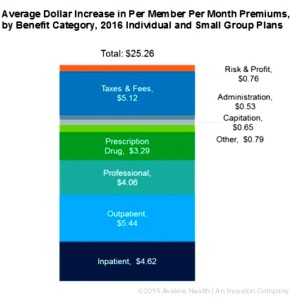
Despite claims from insurers about the impact of medicine costs on premium increases, their own data indicates otherwise. In fact, just $3.29 of the average $25.26 increase in monthly premiums in 2016 is due to prescription drug costs, according to new research released yesterday by Avalere Health. So what is driving premium increases? Avalere found that the largest driver of premium increases was hospital services…analysis is based on actuarially-certified analysis submitted by the plans themselves to justify their premium rate increases. This data shows that prescription drugs dispensed at a pharmacy represent a smaller share of premium increases than inpatient hospitalization, outpatient hospitalization, professional services or taxes and fees. In fact, even if plans did not anticipate any increase in prescription drug spending, the average premium would still increase by more than $20 per month.
- Why FDA Should Oversee Laboratory Developed Tests (blogs.fda.gov)The Public Health Evidence for FDA Oversight of Laboratory Developed Tests: 20 Case Studies (fda.gov)Framework for Regulatory Oversight of Laboratory Developed Tests (LDTs) DRAFT GUIDANCE (fda.gov)Theranos isn’t the only diagnostics company exploiting regulatory loopholes (theverge.com)

Today FDA is issuing a report that illustrates the real and potential harms to patients and to public health from certain laboratory developed tests (LDT) – tests that are designed, manufactured and used in a single laboratory…But times have changed. LDTs have increased in complexity and availability and are now frequently used to diagnose common, serious medical conditions, including cancer and heart disease, with potentially greater impact on patients...LDTs are still under a general policy of enforcement discretion. That means they have rarely undergone FDA review to determine whether they are accurate, reliable, and provide clinically meaningful results...FDA’s own adverse event reporting databases rarely capture problems associated with a faulty LDT...the Agency was able to pull together 20 case studies based on information available in the public domain that show how lack of LDT oversight may be causing or is causing significant harm to patients…FDA has proposed to step up our oversight of LDTs. We issued a draft guidance last year which we’re currently working to finalize, that proposes to phase in enforcement of premarket review requirements for LDTs. FDA oversight would help ensure that tests are supported by rigorous evidence, that patients and health care providers can have confidence in the test results, and that LDTs have more scientifically accurate product labeling.