
- New California governor tackles drug prices in first act (reuters.com)

Hours into his new job, California Governor Gavin Newsom signed an executive order...that could dramatically reshape the way prescription drugs are paid for and acquired...Newsom directed state officials to set up what he said would ultimately be the nation’s largest single-purchaser system for prescription drugs...It directed California’s massive Medicaid system to negotiate prescription drug prices for all of its 13 million recipients, changing their benefits from a managed-care or HMO approach to one that allows the state to handle all the purchases...The state would create a list of drugs to be purchased in bulk or targeted for price negotiations...The executive order also took the first steps to allow private companies and other governmental agencies to participate in the process of negotiating drug prices with pharmaceutical companies.
- Pharma sales rep regulations proposal stalls in Philadelphia, but the battle’s not over yet (fiercepharma.com)

Big Pharma got a reprieve in Philadelphia last month, but only temporarily...city council paused its proposal to regulate pharmaceutical sales reps when the bill’s co-sponsors pulled it at the final meeting of the year, but they committed to taking it up again in 2019...Councilman Bill Greenlee and Councilwoman Cindy Bass announced they were pulling the proposal before a vote could be taken...and blamed new opposition on the fact that Big Pharma "has unleashed its money and reach to cause hysteria and spread false information.”...Greenlee accused the industry of “bullying” local businesses “when pharmaceutical companies threatened to pull any future medical conventions from the city because of the ‘perception’ of the legislation.”...The proposed “Pharmaceutical Sales and Marketing Practices” gifts and conduct ordinance would regulate pharma manufacturer reps in the city with measures such as having to register with the city, which includes a fee, and prohibiting any gifts to healthcare providers and office staff...follows efforts from other cities such as Chicago, which passed an ordinance to require sales rep licensing that went into effect in July 2017. Nevada also requires pharma manufacturers to submit a list of sales reps working in the state, report gifts or freebies over $10 and provide a list of drug samples distributed...
- Rite Aid warned of risk of delisting from NYSE as shares fall below $1 (cnbc.com)

Rite Aid is at risk of being delisted from the New York Stock Exchange and considering a reverse stock split to prop its share price above $1 to comply with the exchange's trading rules...Shares of the drugstore chain have fallen 64 percent over the past year, down to 75 cents a share as of Thursday's close from $2.11 on Jan. 3, 2018 (2019). Rite Aid's stock has hovered under $1 per share over the past month, breaking the NYSE's rule. The exchange notified Rite Aid on Thursday that its average share price was too low and placed its stock at risk of delisting...Rite Aid has six months from the Jan. 3 notice to boost its average share price above $1 for a month.
- This Week in Managed Care: January 4, 2019 (ajmc.com)
Laura Joszt, Managing Editor at The American Journal of Managed Care. Welcome to This Week in Managed Care from the Managed Markets News Network
- Cost, safety main reasons for personal prescription imports from Canada (chaindrugreview.com)

The Campaign for Personal Prescription Importation...released survey results highlighting the reasons Americans continue to purchase their personal prescriptions from licensed and legitimate online pharmacies in Canada, safely, at considerable cost savings, and often at the recommendation of a healthcare provider...The majority of respondents – 94% – cited cost as the main reason they order their medications from licensed, legitimate online pharmacies, which is an increase from last year’s survey in which 79% of respondents cited cost as the main reason. In addition, 97% of survey respondents would recommend ordering prescription medications from an online pharmacy in Canada to their friends and family members...
- Location, location, location: How important is geography when selecting a CMO? (in-pharmatechnologist.com)

An increasing number of pharma companies are opting to outsource the development and manufacturing of small and large molecules...This growing trend has created a contract manufacturing organisation (CMO) market of approximately $5bn over the last 15 years....The decision to either ‘make or buy’ – to manufacture in-house or to outsource responsibility to a contractor – is not an easy one...Nor is the selection process, if the pharma company elects to outsource its manufacturing to a new partner...how should pharma companies select an outsourcing partner? Does geography, and the CMO’s proximity to its client, play a major role in this process?
IP protection
The ‘human factor’
- Give it to us straight, doctors tell pharma advertisers—but being funny is OK, too (fiercepharma.com)

Want to catch doctors’ attention with flashy advertising and intellectual jargon? Don’t bother. A new study finds that physicians prefer simple and clear messages, with more than half (51%) admitting they don’t always understand what’s being communicated in pharma advertising...The survey of primary care physicians...revealed 76% of docs prefer simple language in advertising. Physicians understand how people could be confused by messages they see or read from marketers, because they themselves also get perplexed. More than one-third (39%) of doctors said they are sometimes confused by messaging, and another 35% reported being overwhelmed on occasion by the language used in the ads...That doesn’t mean ads have to be boring, however. Doctors like a good laugh in advertising, with 62% saying they liked funny ads. Another 51% gave the thumbs-up for creative work, and 49% said they liked “unique” ads.
- De Blasio Unveils Health Care Plan for Undocumented and Low-Income New Yorkers (nytimes.com)
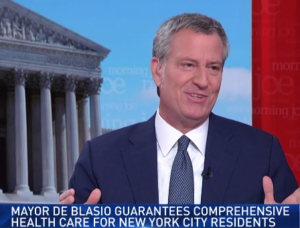
New York City will spend at least $100 million to ensure that undocumented immigrants and others who cannot qualify for insurance can receive medical treatment, Mayor Bill de Blasio announced on Tuesday morning...The mayor’s office was quick to say that its plan, to be called NYC Care, would not be a substitute for any universal health care at the state level or a national single-payer plan. But, aides said, it was something the city could do immediately and on its own, and not require approval from the State Legislature...The NYC Care plan would improve that coverage, which already insures some 516,000 people, and aim to reach more of those who are eligible, such as the young and uninsured, and others who qualify but have not applied...It would also provide direct city spending, about $100 million per year when fully implemented, on those without insurance, including undocumented immigrants, who already can receive care at the emergency rooms of city-run hospitals...Details of how those seeking care could do so under the new plan were not immediately clear...
- Never mind last week’s hikes. Pharma still puts pricing at the top of its worry list: report (fiercepharma.com)

It may not seem as if pharma companies are biting their nails over drug prices. After all, a cohort of drugmakers made headlines last week with an annual round of January hikes. But the issue is on the top of industry worries for 2019, a new report finds...Slightly more than half of respondents to a GlobalData survey tagged pricing and reimbursement as their biggest worry this year...As that pricing pressure rolls on, GlobalData analysts also expect "aggressive negotiation tactics to drive down drug prices."...
- Johns Hopkins, Bristol-Myers must face $1 billion syphilis infections suit (reuters.com)
A federal judge in Maryland said The Johns Hopkins University, Bristol-Myers Squibb Co and the Rockefeller Foundation must face a $1 billion lawsuit over their roles in a 1940s U.S. government experiment that infected hundreds of Guatemalans with syphilis...In a decision on Thursday, U.S. District Judge Theodore Chuang rejected the defendants’ argument that a recent Supreme Court decision shielding foreign corporations from lawsuits in U.S. courts over human rights abuses abroad also applied to domestic corporations absent Congressional authorization...Chuang’s decision is a victory for 444 victims and relatives of victims suing over the experiment, which was aimed at testing the then-new drug penicillin and stopping the spread of sexually-transmitted diseases...