
- FDA lays groundwork for regulating 3D-printed drugs (biopharmadive.com)
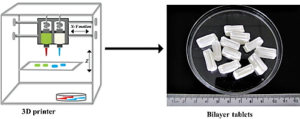
The Food and Drug Administration has issued guidance on 3D printing and the role it plays in manufacturing healthcare products...While the guidance focuses largely on medical devices, Commissioner Scott Gottlieb acknowledged in a Monday statement that the innovative technology also holds the potential to disrupt drug development. Already, the agency has approved one medicine crafted with 3D printers, Aprecia Pharmaceutical Co.’s Spritam..."This is likely just the tip of the iceberg given the exponential growth of innovative research in this field," Gottlieb said, referring to the 3D-printed products on the market. "We envision that burn patients in the near future will be treated with their own new skin cells that are 3D printed directly onto their burn wounds. Further down the road, there is the potential for this same technology to eventually be used to develop replacement organs."...The promise of 3D printing, however, could spark new innovation and invention in how drugs, and the devices that deliver them, are formulated and made. In response, the FDA is moving to stay ahead of the technology's advances....
- Medical plans dangle gift cards and cash to get patients to take healthy steps (beta.latimes.com)

Health plans, medical practices and some Medicaid programs are increasingly offering financial incentives to motivate Medicaid patients to engage in more preventive care and make healthier lifestyle choices...They are following the lead of private insurers and employers that have long rewarded people for healthy behavior such as quitting smoking or maintaining weight loss. Such changes in health-related behavior can lower the cost of care in the long run...“We’ve seen incentive programs be quite popular in the insurance market, and now we are seeing those ramp up in the Medicaid space as well,” said Robert Saunders, research director at the Margolis Center for Health Policy at Duke University...Medicaid patients who agree to be screened for cancer, attend health-related classes or complete health risk surveys can get gift cards, cash, gym memberships, pedometers or other rewards. They may also get discounts on their out-of-pocket health care costs or bonus benefits such as dental care.
- Pharmacy Week in Review: December 15, 2017 (pharmacytimes.com)
Nicole Crisano, PTNN. This weekly video program provides our readers with an in-depth review of the latest news, product approvals, FDA rulings and more.
- Cities, counties and schools sidestep FDA foreign drug crackdown, saving millions (washingtonpost.com)
Schenectady County, N.Y., is on track to pay 20 percent less on prescription drugs for its employees this year than in 2003...Flagler County, Fla., expects to save nearly $200,000 in 2017 on brand-name medicines for its 800 workers, thanks to drug costs that have fallen 10 percent since 2016...dozens of cities, counties and school districts have found a solution they say protects their budgets and saves workers money: They are helping employees buy medicines from Canada and overseas, where prices are up to 80 percent cheaper...“We love it. . . . It’s a win-win,” said Anita Stoker, benefits and wellness manager for Flagler County, which has a program enabling its employees to get drugs from pharmacies in Canada, Britain, Australia and New Zealand...The number of municipalities offering this benefit is growing, even though the Food and Drug Administration considers such drug importation to be illegal and this fall began stepping up enforcement against storefronts advertising the same service. In October it raided nine central Florida locations that helped a mostly senior population order drugs from pharmacies in other countries. Investigators warned the stores’ owners that they were operating illegally and could face fines or jail time...Drugs ordered from overseas often come with the same packaging as in the United States. CanaRx, based in Windsor, Ontario, and ElectRx, based in Detroit, say they vet pharmacies to ensure customers get the real product. Counties, cities and schools, plus an increasing number of private companies, contract with one of these businesses for online service.
- Apotex founder Barry Sherman and wife, Honey Sherman, found dead in North York home (cbc.ca)Autopsies underway for Canadian billionaires found dead (ottawacitizen.com)

Canadian pharmaceutical giant Apotex has confirmed its founder Barry Sherman and his wife, Honey Sherman, are dead, amid reports that two bodies were found in their Toronto home...Deaths deemed 'suspicious'...investigators are still trying to "determine if there is foul play involved or not. And at this point we cannot say 100 per cent with certainty if there is or there is not...
- Medication errors reduced when pharmacy staff take drug histories in ER (healthcarefinancenews.com)

When pharmacy professionals, rather than doctors or nurses, take medication histories of patients in emergency departments, mistakes in drug orders can be reduced by more than 80 percent, according to a study led by Cedars-Sinai...Cedars-Sinai now assigns pharmacy staff members to take medication histories for high-risk patients admitted to the hospital through the emergency department...Injuries resulting from medication use are among the most common types of inpatient injuries at U.S. hospitals, affecting hundreds of thousands of patients every year. Errors in medication histories contribute significantly to such problems, and those errors can lead physicians to order the wrong drug, dose or frequency.
- Bumper crop of new drugs fails to lift big pharma R&D returns (reuters.com)

It is shaping up to be a bumper year for drug approvals, with U.S. officials clearing twice as many novel medicines as in 2016, yet returns on research investment at leading pharmaceutical companies are down...In fact, projected returns at 12 of the world’s top drugmakers have fallen to an eight-year low of only 3.2 percent...The disconnect reflects the rising cost of developing new drugs, meager peak sales expectations for individual products and the fact that younger biotechnology companies are accounting for a growing proportion of new products...So far this year, the Food and Drug Administration...has approved 41 novel drugs compared with 22 for the whole of 2016...It’s been a great year for approvals in 2017...But for the giants of the pharma world...things are not so rosy. This decade has seen shrinking profitability in their research labs, with the average internal rate of return down sharply from 10.1 percent in 2010 to 3.2 percent this year...A separate group of four large biotech companies are projected to enjoy an IRR nearly four times higher at 11.9 percent. The calculations are based on long-term sales forecasts...The biotech companies are seeing more success...biotechs typically had a leaner cost structure...
- This Week in Managed Care: December 15, 2017 (ajmc.com)
Laura Joszt, assistant managing editor at The American Journal of Managed Care. Welcome to This Week in Managed Care from the Managed Markets News Network
- ISMP Names Top Medication Safety Issues of 2017 (pharmacytimes.com)
During a session at the American Society of Health System Pharmacists Midyear Clinical Meeting and Exhibition, Christina Michalek, PharmD, of the ISMP presented the organizations’ annual review of the year’s biggest medication safety issues...From January 2017 to September 2017, the drug classes most often involved medication errors events included:
- Narcotics/Opioids (10%)
- Antimicrobial agents (10%)
- Antihypertensive agents (6%)
- Antithrombotic agents (6%)
- Anticonvulsant agents (4%)
- Insulin and antidiabetic agents (4%)
- Central nervous system stimulants (4%)
Of these, narcotics/opioids, antithrombotic agents, and insulin and antidiabetic agents are listed as “high alert” drugs by the ISMP, indicating that they are associated with a high risk of harm when used in error.
- Artificial Intelligence: will it change the way drugs are discovered? (pharmaceutical-journal.com)

The pharmaceutical industry is beginning to invest in artificial intelligence (AI), with many large pharmaceutical companies partnering with AI start-ups in 2017 in order to develop better diagnostics or biomarkers, to identify drug targets and to design new drugs. But when will the first AI-designed drugs reach the market and will AI permanently change the pharmaceutical industry and the way drugs are discovered?...Harnessing the power of modern supercomputers and machine learning will enable us to develop medicines more quickly, and at a reduced cost...The technology has just taken off recently and primarily that’s due to the advances in deep learning that have demonstrated superhuman accuracy in image recognition and autonomous driving...We are starting to see AI can outperform humans when analysing very complicated datasets for high content, phenotypic drug discovery...The [AI] technology is allowing us to explore a much bigger design space and discover these rare molecules that have properties beyond what we would get if we just ran a traditional high throughput screen...We can benefit from computer modelling but we still need to conduct real experiments and there will still be an element of serendipity...