
- Drug shortages loom from hurricane-impaired manufacturing in Puerto Rico (pharmacist.com)

Damaged Baxter plants on the island make large portion of saline products, already in short supply...hospitals are feeling even more compromised from the shortage ever since production at Baxter facilities in Puerto Rico was hampered...by hurricane Maria...“Clearly this has a huge impact on hospitals as well as home infusion pharmacies and infusion centers since many medications given by the I.V. route are mixed into these bags and given by infusion,” said Matthew Grissinger, RPh, from the Institute for Safe Medication Practices...The most severe shortages are being felt with small-volume parenteral solutions, such as the 50 and 100 milliliter minibags of sodium chloride 0.9%, dextrose 5%, and I.V. nutritional products made by Baxter...the American Society of Health-System Pharmacists had been hearing from both large and small hospitals alike that they only had a 1- to 2-week supply of small-volume parenteral solutions left. ASHP has been working around the clock to identify solutions and strategies for facilities...FDA has also been actively involved, and is monitoring a list of about 30 critical drug products that are either manufactured solely or primarily in Puerto Rico. Of those 30 drugs, 14 are sole-source products, meaning there are no alternatives available...To mitigate the shortage of I.V. solution products, FDA is doing something that it rarely does: import products from overseas plants. In this case, FDA is allowing temporary importation of an alternative supply of sodium chloride 0.9% injection bags, dextrose 5% injection bags, and metronidazole injection into the U.S. from Baxter facilities in Ireland, Australia, Mexico, and Canada...
- DEA cracking down on fake fentanyl traffickers (statnews.com)

The U.S. Drug Enforcement Administration wants to make it easier for federal prosecutors to go after people who peddle illicit versions of the deadly opioid fentanyl that are fueling the nation’s drug abuse crisis...The agency said Thursday it intends to classify drugs that are chemically similar to fentanyl as illegal controlled substances, letting prosecutors avoid the hurdles they often face in bringing charges in such cases...The move aims to stop the flow of fentanyl variants into the U.S. as the opioid abuse crisis rages...The new classification, which would last two years, lets prosecutors bring charges against fake-fentanyl traffickers under the federal Controlled Substances Act. Prosecutors have been able to use the Analogue Act for cases involving variants, but that requires them to call chemists and other experts to prove that, while molecularly different, the drugs are just as potent and dangerous as fentanyl in its true form. Prosecutors often complain of being stymied by the additional hurdles that delay cases and sometimes lead to charges being dropped...Law enforcement officials are frustrated by chemists who frequently alter the chemical compounds in their drugs to create substances that are not expressly illegal. Justice Department and DEA officials say they play a constant game of “whack-a-mole” to keep up with the changes.
- Pharmacy Week in Review: November 10, 2017 (pharmacytimes.com)

Nicole Crisano, PTNN. This weekly video program provides our readers with an in-depth review of the latest news, product approvals, FDA rulings and more.
- Brexit with no deal risks chaos in drug supply, report warns (reuters.com)‘No deal’ Brexit would harm NHS and its patients, Nuffield Trust warns (nuffieldtrust.org.uk)

Crashing out of the European Union without a deal would cause major problems for Britain’s health service and risk “chaotic disruption” to medicine supplies...The Nuffield Trust, an independent health charity, also warned that Brexit without a deal on future relations with the EU would lead to worsening staff shortages in the National Health Service...it could create particular problems for healthcare in Northern Ireland, where treatment programs for some rare and serious diseases are designed to work across the entire island of Ireland...“A scenario where the UK leaves without any deal would cause extensive problems for the NHS. It would risk a chaotic disruption to supplies of medical products, and a rise in prices that would push hospitals deeper into deficit,”…Stringent medicine regulations mean manufacturers face multiple Brexit uncertainties, such as the potential need to retest drugs shipped across borders and transfer product licences to different jurisdictions...
- US transportation workers to face testing for prescription opioids next year (cnbc.com)
Safety-sensitive transportation workers — including flight crew, air traffic controllers, truck drivers and train engineers — will be screened for several common opioid painkillers starting next year, according to a new federal rule...Previous drug tests screened for cocaine and marijuana. The rule adds screening for hydrocodone, hydromorphone, oxymorphone and oxycodone...The broadened testing will take effect Jan. 1, 2018..."The opioid crisis is a threat to public safety when it involves safety-sensitive employees involved in the operation of any kind of vehicle or transport," Transportation Secretary Elaine Chao said in a release. "The ability to test for a broader range of opioids will advance transportation safety significantly and provide another deterrence to opioid abuse, which will better protect the public and ultimately save lives."
- This Week in Managed Care: November 10, 2017 (ajmc.com)
Laura Joszt, assistant managing editor at The American Journal of Managed Care. Welcome to This Week in Managed Care from the Managed Markets News Network
- U.S. states allege broad generic drug price-fixing collusion (reuters.com)

A large group of U.S. states accused key players in the generic drug industry of a broad price-fixing conspiracy, moving...to widen an earlier lawsuit to add many more drugmakers and medicines in an action that sent some company shares tumbling...The lawsuit, brought by the attorneys general of 45 states and the District of Columbia, accused 18 companies and subsidiaries and named 15 medicines. It also targeted two individual executives: Rajiv Malik, president and executive director of Mylan NV, and Satish Mehta, CEO and managing director of India’s Emcure Pharmaceuticals...The states said the drugmakers and executives divided customers for their drugs among themselves, agreeing that each company would have a certain percentage of the market. The companies sometimes agreed on price increases in advance...“It is our belief that price-fixing is systematic, it is pervasive, and that a culture of collusion exists in the industry,” Connecticut Attorney General George Jepsen, who is leading the case...The...Justice Department is conducting a parallel criminal investigation. On Friday, the department asked the Pennsylvania court presiding over the lawsuit to put the lawsuit’s discovery process on hold, saying it could interfere with the criminal probe
- FDA approves first drug in U.S. with digital ingestion tracking (reuters.com)Digital Pills That Talk to Your Doctor Are Here (wsj.com)

The U.S. Food and Drug Administration said...that it had approved Otsuka Pharmaceutical Co Ltd’s Abilify MyCite, the first drug with a digital ingestion tracking system to be approved in the United States...The product, which uses digital tracking to record if the medication was taken, has been approved for the treatment of schizophrenia, acute treatment of manic and mixed episodes associated with bipolar I disorder and for use as an add-on treatment for depression in adults...The system sends a message from the pill’s sensor to a wearable patch, which then transmits the information to a mobile application, so that patients can track the ingestion of the medication on their smartphone.
- Drug bingo: EU readies vote for London-based pharma agency (reuters.com)'Hard' Brexit risks disrupting supply of thousands of drugs (biopharmadive.com)

Nineteen EU governments will slug it out in a series of secret ballots in 10 days’ time for the right to host the European Medicines Agency once it leaves London after Brexit...Confirming that none of the cities, from Porto to Helsinki, has dropped out of the running...those organizing it confessed they had no idea how long the voting would take...The EMA itself has warned that moving to some of the cities on the list -- sources have said notably those like Warsaw or Sofia in eastern Europe -- would see so many of its 900 London staff quit that it would harm Europe’s health. Top choices for employees are Amsterdam, Vienna and Barcelona...States agreed to a number of criteria, including that cities chosen should offer premises ready for a start in March 2019, when Britain leaves the EU, be accessible from across Europe and take account of “geographical spread” -- the fact newer members in the east host fewer agencies than richer neighbors.
- How Doctors Are Getting Rich on Urine Tests for Opioid Patients (bloomberg.com)
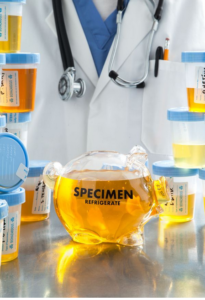
Want to turn that pain clinic into a real moneymaker? Open your own urine-testing lab and start billing Medicare...The cups of urine travel by express mail to the Comprehensive Pain Specialists lab in an industrial park in Brentwood, Tennessee...Most days bring more than 700 of the little sealed cups from clinics across 10 states, wrapped in red-tagged waste bags...The high-tech testing lab’s raw material has become liquid gold for the doctors who own Comprehensive Pain Specialists. This testing process, driven by the nation’s epidemic of painkiller addiction, generates profits across the doctor-owned network of 54 clinics, the largest pain-treatment practice in the Southeast. Medicare paid the company at least $11 million for urine and related tests in 2014...the costly tests are medically justified to monitor patients on pain pills against risks of addiction or even of selling pills on the black market. “I have to know the medicine is safe and you’re taking it,”...As alarm spread about opioid deaths and overdoses in the past decade, doctors who prescribed the pills were looking for ways to prevent abuse and avert liability. Entrepreneurs saw a lucrative business model: persuade doctors that testing would keep them out of trouble with licensing boards or law enforcement and protect their patients from harm. Some companies offered doctors technical help opening up their own labs...“drug testing is not about medicine but about making money, and I am going to show you how to make a lot of money.”...