
- Drug chains tumble on reports Amazon eyeing their pie (reuters.com)

Shares of drug retailers Walgreens Boots Alliance Inc, CVS Health Corp and Rite Aid Corp tumbled on Friday after reports that Amazon.com Inc was looking to make a move into selling drugs online...Amazon is reported to be in discussions with mid-market pharmacy benefit managers and has been hiring talent to assess the drug retailing market for its entry…We are convinced that AMZN will almost certainly enter the drug distribution value chain within 2 years, evolving into a more disruptive offering over time...Amazon’s entry into pharmaceuticals has been long rumored in the media...Shares of drug retailers Walgreens closed down 5.8 percent, Rite Aid 4.9 percent and CVS Health 4.9 percent.
- Specialty Pharmacy Accreditation: To Be or Not to Be, That is the Question (specialtypharmacytimes.com)

Defined in the broadest sense, accreditation means the action of officially recognizing someone as having a particular status or being qualified to perform a particular activity. This definition points to the idea that the act of accreditation provides an individual or organization with an official qualification to perform said duty...The Alphabet Soup of Accreditation...URAC, ACHC, TJC, CPPA: Each of these combinations of letters represent a different accrediting body used by specialty pharmacies. There is not a single authoritative body requesting consistent data reports and patient outcomes that a specialty pharmacy provider (SPP) can utilize. Instead, there is a mix of multiple bodies requesting different kinds and different levels of data...Although the size of the pharmacy and the chosen accrediting body changes the cost for accreditation, it typically costs the pharmacy tens of thousands of dollars each time accreditation is given. And with the growing trend of pharmacies requiring more accreditations, that price is likely to rise...Why is it necessary to have at least 4 major accrediting bodies influencing the behavior of specialty pharmacies?
- Pharmacy Week in Review: October 6, 2017 (pharmacytimes.com)
Nicole Crisano, PTNN. This weekly video program provides our readers with an in-depth review of the latest news, product approvals, FDA rulings and more.
- Medical Technology Is Losing Share Of Venture Investments (forbes.com)

Medical technology continues to lose ground when it comes to all U.S. venture capital investment as value-based care takes hold of the healthcare system and the industry fights to get rid of a device tax...The share of medical technology venture deals dropped to just 4% of total deals last year compared to the industry’s 13% share 25 years ago...There were 420 medical technology venture deals in 2016 out of more than 10,000 total venture deals...medical technology companies had been paying a 2.3% medical device tax on sales under the Affordable Care Act until a two-year moratorium began in January 2016. Before the device tax was put on hiatus, the IRS collected between $1 billion and $2 billion a year in 2013, 2014 and 2015...This move away from fee-for-service medicine to value-based models means insurance companies don't always pay for the medical device a doctor wants to use. Purchasing of devices at large multi-hospital systems has shifted from doctors to “hospital purchasing committees,”.. medtech products...have digital health elements embedded into them...Inherently, digital health solutions are more solution-based...and they have the ability to measure outcomes...Whether medical technology companies can develop products that improve outcomes and measure them will be key...
- This billion-dollar dry eye drug is behind Allergan’s controversial patent deal (marketwatch.com)With new bill, Sen. McCaskill looks to end 'brazen' tribal licensing strategy (fiercepharma.com)

Last month, drugmaker Allergan announced that it has made a deal with a New York state American Indian tribe to help protect Restasis from competition, using the tribe’s sovereign immunity as a shield against patent challenges. The deal—the first such move by Allergan and, in the pharmaceutical industry, an unusual one at best—has unleashed a firestorm of criticism, including from lawmakers...Originally, patents on Restasis were set to expire in 2014. But Allergan filed more patents, covering the “specific formulation and the method of using” the product, that expire in 2024...Lawmakers and patient advocates, meanwhile, are concerned not only about the implications for Restasis but whether this will set a pharmaceutical industry precedent...The House Oversight committee wrote to Allergan Chief Executive Brent Saunders on Tuesday asking for documents and information regarding the deal...The agreement “may impair competition across the pharmaceutical industry and ultimately dissuade companies from pursuing less-costly generic alternatives to brand drugs,” according to the letter...Allergan said in a statement that it plans to comply with the information requests...patient advocates say they’re worried...Allergan’s sham patent transfer is an effort to circumvent the law to prevent a cheaper generic of Restasis to come to market,” said David Mitchell, the co-founder and president of the non-profit Patients for Affordable Drugs. “Patients will be hurt by this. Patients are being hurt by this. And it’s an outrage.”
- Continuous Manufacturing: Pfizer, Vertex, AstraZeneca and Others Weigh FDA Plans (raps.org)
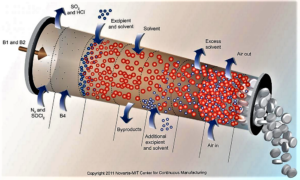
The US Food and Drug Administration has been encouraging the adoption of continuous manufacturing techniques...and several companies recently offered the agency some suggestions to refine its work around the developing technology...continuous manufacturing allows companies to move more seamlessly and efficiently...Last week, FDA finalized guidance on how manufacturers can participate in the agency’s program to advance continuous manufacturing...And in a blog post, Michael Kopcha, director of FDA's Office of Pharmaceutical Quality, pointed to Vertex's cystic fibrosis drug Orkambi (lumacaftor/ivacaftor) and Janssen's HIV treatment Prezista (darunavir) as examples of companies successfully using continuous manufacturing after engaging with FDA's emerging technology team...Vertex Pharmaceuticals...noted several contradictions in how batch size is described in an FDA document and sought further clarity and certainty regarding FDA’s understanding and expectations regarding batch size...AstraZeneca...asked if FDA might consider harmonizing the assessment process of the changes relating to continuous manufacturing, including a mechanism by which there could be some mutual recognition across countries participating in the International Council on Harmonization. AstraZeneca also said it "does not see the need" for a full ICH guideline on continuous manufacturing, which the company says FDA has been supporting. But the European drug industry group known as EFPIA is suggesting a Q&A document based on ICH Q8 and AstraZeneca says it "concurs with that approach."
- Express Scripts: Specialty meds driving up US drug spend (biopharmadive.com)

An estimated three out of every 1,000 Americans ring up a bill of more than $50,000 in annual prescription drug costs last year, according to a new analysis of health plan members published...by Express Scripts... The number of people who meet this threshold for high pharmaceutical expenditures has risen sharply, by 35%, since the PBM's last report on the trend in 2014. While numerically small, this group of patients accounted for more than 20% of total U.S. spending on prescription drugs in 2016...higher utilization of pricey specialty medicines for cancer, multiple sclerosis and rare diseases was the primary driver of spending among patients with annual pharmacy costs over $50,000. Yet that was a change from 2014, when new hepatitis C drugs and compounded medicines goosed spending...Nearly 96% of the plan members who cleared the $50,000 in annual spending threshold used specialty medicines, most notably cancer therapeutics. While the average annual cost of oncology drugs was lower than some other specialty categories, a quarter of all spending by this group was on cancer treatments...
- New Jersey sues Insys as opioid maker settles with Massachusetts (reuters.com)

New Jersey...accused Insys Therapeutics Inc of engaging in a fraudulent scheme to boost sales of a fentanyl-based cancer pain drug, as Massachusetts announced a $500,000 settlement with the drugmaker to resolve similar allegations...The lawsuit by New Jersey Attorney General Christopher Porrino accused Insys of illegally directing its sales force to push prescriptions of Subsys for a broader range of patients than the opioid drug was approved for, and at higher doses...The lawsuit...alleged Insys also paid kickbacks, including sham speaker fees to medical practitioners to prescribe Subsys and defrauded insurers into paying for it...The lawsuit said Insys’ greed put hundreds of lives in jeopardy and led to the 2016 overdose death of a New Jersey woman who was prescribed Subsys to treat fibromyalgia.
- This Week in Managed Care: October 6, 2017 (ajmc.com)
Laura Joszt, assistant managing editor at The American Journal of Managed Care. Welcome to This Week in Managed Care from the Managed Markets News Network
- NCPA-commissioned study: DIR fees could cost CMS $3.4B in next 10 years (drugstorenews.com)

Retroactive pharmacy payment reductions, a portion of direct and indirect remuneration fees, could cost the federal government $3.4 billion between 2018 and 2027. That’s according to a new study from Wakely Consulting...This...study is vitally important in showing that DIR legislation will actually save taxpayers $3.4 billion over 10 years without subtracting any benefits seniors currently receive...For pharmacies, banning these after-the-fact fees is the fair way to achieve predictability in the reimbursement for the medications they buy and dispense...The report evaluates the impact of the Improving Improving Transparency and Accuracy in Medicare Part D Drug Spending Act, which has been introduced in both the Senate and House of Representatives and prohibits retroactive pharmacy payment reductions as claims without any defect, impropriety or fraud in Medicare Part D...The legislation is part of NCPA’s efforts to end DIR Fees, which make up a small amount of overall DIR within Medicare Part D, the majority of which is made up of manufacturer rebates