
- Aetna drops last 2 state markets under Affordable Care Act (hosted.ap.org)

Aetna said...that it won't sell individual coverage next year in its two remaining states - Nebraska and Delaware - after projecting a $200 million loss this year. It had already dropped Iowa and Virginia for next year. The insurer once sold the coverage in 15 states, but slashed that to four after losing about $450 million in 2016...The government-backed marketplaces are a pillar of the Obama-era federal law because they allow millions of people to buy health insurance with help from income-based tax credits. But insurers like Humana, and now Aetna, have been fleeing that market, and the remaining coverage options are growing thin…
- Cancer drug pricing: the truth and the rhetoric (abpi.org.uk)Cancer Drugs Fund 'huge waste of money' (bbc.com)

In the last couple of weeks we’ve seen a number of articles in the press describing the Cancer Drugs Fund a ‘tragedy for patients’ and a ‘waste of money’...In part, this has been sparked by a recently published academic study that also claimed that several the medicines on the fund did not add value to patients – even suggesting that some did more harm than good...Sensationalist headlines about the cost of medicines are rarely a fair reflection of reality…Several of these medicines had been approved early by regulators, who decided that there was an urgency in getting them to the patients who needed them...there was little real world data available on these medicines at the time...The fact is it takes time, even after regulatory approval, to gather longer-term data to form a complete picture of the value of any medicine– the longer a medicine keeps someone alive the longer it takes to collect overall survival data...The trouble is we were – and for the most part still are – pretty far from having a perfect evidence-based way of allocating resources across the NHS…
- Debate Intensifies Over Express Scripts Future As Standalone PBM (forbes.com)

A debate has emerged over the future of the standalone pharmacy benefit manager, putting Express Scripts at the center of an intensifying discussion over how best to manage drug costs for consumers, employers and the government...Pharmacy benefit managers are middlemen between drug makers and consumers when it comes to purchasing drugs and providing prescription coverage...PBM’s role has come under scrutiny lately as high priced drugs bust employer and government budgets for prescriptions. Critics are questioning whether PBMs operate in a transparent way and therefore don’t pass along all of the savings they can to consumers...insurers are closing ranks around a model that brings the PBM closer to the health insurer. UnitedHealth Group owns OptumRx, a rapidly growing PBM and Anthem is seeking requests for proposals from PBMs for a new contract that would begin in 2020. Anthem's current contract with Express Scripts runs out at the end of 2019...Express Scripts, however, says it has a track record of saving Anthem and its employer clients money and is committed to the standalone model...
- This Week in Managed Care: May 5, 2017 (ajmc.com)
Laura Joszt, assistant managing editor at The American Journal of Managed Care. Welcome to This Week in Managed Care from the Managed Markets News Network
- Inside the ‘Scorpion Room’ Where Drug Price Secrets Are Guarded (bloomberg.com)

PBMs occupy a key crossroads of the health system, acting as a nexus among insurers, employers and drug companies. Through a complex web of agreements they help decide what drugs are covered by a patient’s insurance, and how much they’ll cost at the pharmacy counter. The problem, say critics, is that opacity makes it hard for employers to know how much the PBM is paying and profiting on each transaction -- an impression reinforced by restrictions on who can audit them and how.
- Swelling Costs - President Donald Trump has repeatedly complained about high drug prices
- Wrangling Rebates - The most carefully guarded secrets of the PBM industry involve tens of billions of dollars in rebates they collect from drug companies. Those payments help drugmakers secure favorable spots on medication menus that PBMs offer to millions of patients.
- Other Avenues - Rebates are only one way drugmakers pass money to PBMs. Others include fees for care management, administration and inventory procurement.
- J&J discloses U.S. probe related to arthritis drugs (reuters.com)

...Johnson & Johnson said...the U.S. Justice Department has opened an investigation concerning management and advisory services provided to rheumatology and gastroenterology practices that bought two of its drugs...The...company said its Janssen Biotech Inc unit received a civil investigative demand from the Justice Department regarding an investigation under the False Claims Act related to its arthritis drugs Remicade and Simponi Aria...U.S. Attorney's Office...is seeking documents broadly relating to pharmaceutical co-payment support programs for hepatitis C drug Olysiotm, Simponi and Crohn's disease drug Stelara… also seeks documents relating to average manufacturer price and best price reporting to the Center for Medicare and Medicaid services related to those products...
- PhRMA expels 22 members with new R&D rules as it works to burnish its image (fiercepharma.com)

Industry lobbying group PhRMA (Pharmaceutical Research and Manufacturers of America) has cleared its decks of nearly two dozen members as it tries to distance itself from those companies most likely to catch heat over drug pricing practices. While not all of those who were dropped have price-pushing reputations, the practices of some are particularly notorious for their methods...The organization did this with new bylaws that mandate members meet minimum R&D investment requirements, a move that was expected to force out smaller companies whose business model is built more on buying drugs and then jacking up prices significantly. The move comes as the lobbying group works to portray its membership as serious drugmakers that are investing heavily in innovative new medications...PhRMA said under its new criteria, which is “effective immediately,” members must invest at least 10% of their budgets on research and development and spend at least $200 million a year on average over three years on R&D...
- What I Told HHS Secretary Tom Price About the 340B Drug Pricing Program (drugchannels.net)
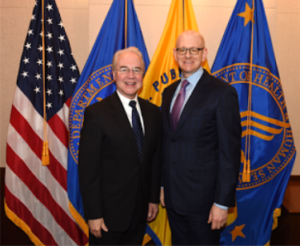
Tom Price and Adam Fein (left to right)
I (Adam Fein) had the privilege of meeting with Secretary of Health and Human Services Tom Price. I was invited to meet with Secretary Price for one of his listening sessions with industry experts and stakeholders. I appreciated the opportunity to share my perspectives...In our meeting, I highlighted four ways that the 340B Drug Pricing Program is raising drug costs. I then offered eight specific recommendations for improving the program by addressing the widespread channel distortions the program has caused.
HOW 340B RAISES DRUG COSTS
- Encouraging a shift in site of care from lower-cost physician offices to higher-cost hospital outpatient settings.
- Reducing manufacturers’ rebates to Medicare Part D and commercial payers.
- Raising out-of-pocket costs for uninsured patients.
- Reducing the generic dispensing rate and slowing the adoption of biosimilars.
HOW TO ADDRESS CHANNEL DISTORTIONS FROM THE 340B DRUG PRICING PROGRAM
- Require that covered entities share financial savings from the 340B program with uninsured and vulnerable patients.
- Revise hospital eligibility for the 340B program to create a clearer patient definition.
- Remove incentives for extraordinary hospital profits and site-of-care consolidations.
- Require HRSA and Apexus (the Prime Vendor) to report the size and scope of the 340B program.
- Mandate that contract pharmacies for 340B hospitals charge no more than the discounted 340B price to uninsured, underinsured, and vulnerable patients.
- Require contract pharmacies to identify 340B prescriptions at the time of adjudication (payer prescription approval).
- Require the disclosure of and transparency into the fees and profits generated by 340B contract pharmacies.
- Limit the number and geographic scope of contract pharmacy arrangements.
- WHO to help bring cheap biosimilar cancer drugs to poor (reuters.com)

The World Health Organization is to launch a pilot project this year to assess cheap copies of expensive biotech cancer drugs in a bid to make such medicines more widely available in poorer countries...The U.N. agency said...it would invite drugmakers in September to submit applications for pre-qualification of so-called biosimilar versions of two such drugs on its essential medicines list, Roche's Rituxan (rituximab) and Herceptin (trastuzumab)...The move is a boost for biosimilars which are expected to account for a growing proportion of treatments, particularly for cancer, as patents on the original branded products expire...The WHO plays a critical role in monitoring drug quality in poorer countries through its pre-qualification program, which ensures that treatments supplied by U.N. agencies such as UNICEF are of acceptable quality...
- Overcoming Opioids: When pills are a hospital’s last resort (ktvn.com)

The nation's opioid crisis is forcing hospitals to begin rolling out non-addictive alternatives to treatments that have long been the mainstay for the severe pain of trauma and surgery, so they don't save patients' lives or limbs only to have them fall under the grip of addiction...Doctors and hospitals around the country are searching for ways to relieve extreme pain while at the same time sharply limiting what was long considered their most effective tool. It's a critical part of the effort to overcome the worst addiction crisis in U.S. history...The new approach: Mixing a variety of different medications, along with techniques like nerve blocks, spinal anesthesia and numbing lidocaine, to attack pain from multiple directions, rather than depending solely on opioids to dampen brain signals that scream "ouch." It's known by the wonky name "multimodal analgesia."...Without the opioid side effects of nausea, vomiting and constipation, patients may find it easier to start eating solid food and walking around hours after surgery...