
- Infection experts warn of more U.S. superbug cases in coming months (reuters.com)

After two confirmed U.S. cases of a superbug that thwarts a last-resort antibiotic, infectious disease experts say they expect more cases in coming months because the bacterial gene (mcr-1) behind it is likely far more widespread than previously believed...Army scientists...reported finding E. coli bacteria that harbor a gene which renders the antibiotic colistin useless...The mcr-1 superbug has been identified over the past six months in farm animals and people in about 20 countries...Health officials fear the mcr-1 gene, carried by a highly mobile piece of DNA called a plasmid, will soon be found in bacteria already resistant to all or virtually all other types of antibiotics, potentially making infections untreatable...Within the next two to three years, it's going to be fairly routine for infections to occur in the United States for which we have no (effective) drugs available...mcr-1 will find its way into carbapenem-resistant bacteria…the resulting virtually impervious bacterium would likely spread slowly inside the United States because CRE themselves are not yet widespread in the country, giving drugmakers some time to create new antibiotics...
- FDA defines the ability of compounders to make approved medicines (statnews.com)

In its latest (to) bid to set parameters around compounding, the US Food and Drug Administration...issued a pair of draft guidelines to clarify when compounding pharmacies are permitted to make versions of commercially available medicines...federal law currently states that a compounder generally shouldn’t make copies of drugs that are approved for sale, the agency is getting more specific and wants to ensure that a true clinical need exists before a compounded version of an approved medicine drug is made for a patient...A key issue has been the extent to which compounders can make medicines for patients in ways that may cross the line into more conventional drug manufacturing. The new law attempts to create boundaries, although the latest guidelines are designed to refine the FDA interpretation... the guidelines would permit compounders to make versions of brand-name drugs when a shortage exists or the brand-name medicine has been discontinued. Another example meeting the threshold of patient need might be a required change in formulation...But safety is not the only issue in play here. For instance, pointing to a lower price...a compounded version would be cheaper than a brand-name drug — is not justification for compounding an FDA-approved medicine...these are only draft guidelines — guidances in regulatory parlance — and are not set in stone.
- China healthcare costs forcing patients into crippling debt (reuters.com)

As China's medical bills rise steeply, outpacing government insurance provision, patients and their families are increasingly turning to loans to pay for healthcare, adding to the country's growing burden of consumer debt...While public health insurance reaches nearly all of China's 1.4 billion people, its coverage is basic, leaving patients liable for about half of total healthcare spending, with the proportion rising further for serious or chronic diseases such as cancer and diabetes...Medical loans are just part of China's debt mountain - consumer borrowing has tripled since 2010 to nearly 21 trillion yuan, and in eight years household debt relative to the economy has doubled to nearly 40 percent...
- Juno cancer study halted after patient deaths, shares slide 30 pct (reuters.com)

A Juno Therapeutics Inc trial of its experimental cancer therapy, known as JCAR015, was put on hold by U.S. regulators after the deaths last week of two leukemia patients…Shares of Juno fell 30 percent...in after-hours trading...A third trial patient died in May...All three patients were in their 20s, and the deaths were linked to swelling in the brain…JCAR015 is a chimeric antigen receptor T-Cell, or CAR-T, therapy, involving a complicated process of extracting immune system T cells from an individual patient, altering their DNA to sharpen their ability to spot and kill cancer cells, and infusing them back into the same patient...Juno said the deaths occurred after the chemotherapy agent fludarabine was added to the trial program. The company said it has proposed to the U.S. Food and Drug Administration that the trial be continued using JCAR015 with just cyclophosphamide as a "pre-conditioning agent."...the FDA asked that the company submit a revised patient consent form, investigator brochure, trial protocol, and a copy of the presentation made to the agency on Wednesday. Juno said it plans to submit the requested information to the FDA...
- More than 1 million OxyContin pills ended up in the hands of criminals and addicts. What the drugmaker knew (latimes.com)

Dr. Eleanor Santiago
In the waning days of summer in 2008, a convicted felon and his business partner leased office space on a seedy block near MacArthur Park. They set up a waiting room, hired an elderly physician and gave the place a name that sounded like an ordinary clinic: Lake Medical...The doctor began prescribing the opioid painkiller OxyContin – in extraordinary quantities. In a single week in September, she issued orders for 1,500 pills, more than entire pharmacies sold in a month. In October, it was 11,000 pills. By December, she had prescribed more than 73,000, with a street value of nearly $6 million...Purdue Pharma, the maker of OxyContin, tracked the surge in prescriptions. A sales manager went to check out the clinic and the company launched an investigation. It eventually concluded that Lake Medical was working with a corrupt pharmacy in Huntington Park to obtain large quantities of OxyContin.
- Sounding the alarm
- What Purdue knew
- Pills prescribed by Santiago
- Following the pills
- The skid row connection
- Pharmacist complaints
- Reports of concern
- ‘I was sitting on a gold mine.’
- ‘It really takes the ‘G’ a long time to catch up with these jokers’
- Drug maker loses battle over Canada’s right to impose a price cap (statnews.com)

A closely watched skirmish over the cost of prescription drugs has ended in defeat for a company that sought to challenge the right of a Canadian agency to impose a price cap on a pricey medicine...Canada’s Federal Court dismissed a constitutional challenge that Alexion Pharmaceuticals filed against the Patented Medicine Prices Review Board, which...sought to keep a lid on the cost of the company’s Soliris (eculizumab) medication...The...agency had asked Alexion to lower its price and repay sales generated by the drug from 2012 through the first half of 2014..."It is far from surprising," said Richard Gold, a professor at McGill University..."Alexion may still appeal in hopes that the Supreme Court of Canada will alter the law. I think the [possibility that the court will find] the provisions unconstitutional are remote. Parliament can create and limit patent rights as it wishes, but pharmaceutical companies have been known for being obstinate in the face of logic."
- Theranos dealt severe blow by CMS (drugstorenews.com)

Theranos Inc founder and CEO Elizabeth Holmes
Less than one month following Walgreens decision to terminate its relationship with Theranos, the blood-testing lab on Thursday announced that the Centers for Medicare & Medicaid Services has revoked the company's CLIA certificate, among other sanctions. The revocation of Theranos' CLIA certificate precludes the owners and operators of Theranos from owning, operating or directing a lab until at least July 2018...In addition to the revocation of Theranos' CLIA certificate, the full list of CMS sanctions include:
- Limitation of the laboratory’s CLIA certificate for the specialty of hematology;
- A civil money penalty;
- A directed portion of a plan of correction;
- Suspension of the laboratory’s approval to receive Medicare and Medicaid payments for any services performed for the specialty of hematology; and
- Cancellation of the laboratory’s approval to receive Medicare and Medicaid payments for all laboratory services.
- IACP’s 2016 Compounders on Capitol Hill Report (iacprx.org)

IACP Members Go to the Hill with Three Actionable Asks
This year, IACP went to the Hill with three Asks, each with a Congressional action item. IACP and its legislative team have worked tirelessly for the past year emphasizing FDA should be implementing DQSA (Drug Quality and Security Act) according to congressional intent!
- Issue #1 Support Pharmacists: Sign the Bipartisan Letter to FDA Led by Representatives Chris Stewart and Henry Cuellar.
- Issue #2 Support Letter to Chairman Chaffetz and Ranking Member Cummings to Request House Oversight and Government Reform Hearings on FDA's Implementation of DQSA.
- Issue #3 Support Pharmacists: Sign the Senate Letter to FDA Regarding Office-use.
- Pharmacy Journal Examines National Trends in Prescription Drug Spending (ashp.org)National trends in prescription drug expenditures and projections for 2016 - Abstract (ajhp.org)
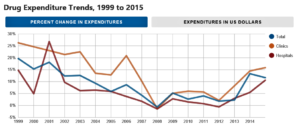
A sharp rise in prescription medication prices — driven by the introduction of new, expensive specialty medications and huge increases in the costs of older drug products with few competitors — drove an 11.7 percent increase in spending on medications in 2015, according to a new report published in AJHP (American Journal of Health-System Pharmacy)...The report projects an 11 to 13 percent increase in total drug expenditures in hospitals and health systems in 2016, which includes a 15 to 17 percent increase in clinic spending and a 10 to 12 percent increase in hospital spending...pharmacists need to be diligent about understanding what factors influence drug spending within their own organizations. "By understanding the key cost drivers, pharmacy leaders can implement programs to target them," he noted, adding that such strategies could include working with prescribers to use equally effective but less expensive medications or developing programs such as antibiotic stewardship to reduce unnecessary use of drugs...
- Doctors turn militant over Venezuela’s health crisis (reuters.com)

A dozen doctors hold a hunger strike in the corridors of an Andean city hospital. In another provincial city, hundreds of protesting medics suspend appointments...With eight out of 10 medicines now scarce, according to the main pharmacy group, protesting doctors are demanding that President Nicolas Maduro's socialist government declare a national health crisis and allow foreign humanitarian aid...In June, Pino (Christian Pino, a surgeon at the Merida hospital) read a list of doctors' demands in Venezuela's National Assembly before the opposition-led legislature declared a state of medical emergency and approved channels for foreign humanitarian aid...But the...Supreme Court shot down the assembly's proposal. Government officials deny Venezuela is facing a humanitarian crisis and say there is no need for humanitarian assistance...Idabelias Arias, the head of the emergency ward at a pediatric hospital in Barquisimeto..."Doctors are doing war medicine here."