
- FDA still seems reluctant to regulate mobile health apps (medcitynews.com)

Remember when the Food and Drug Administration was going to regulate mobile health apps? The year was 2013...There was even a bill from the congressman representing Silicon Valley that aimed to tame the “Wild West” of mobile and wireless health. The House Energy and Commerce Committee even held three...days of hearings...Rep. Mike Burgess asking then-national health IT coordinator Dr. Farzad Mostashari to magically create interoperability...Now, it sounds like the FDA might almost be ready to throw its hands up and walk away...the agency circulated a draft guidance that really didn’t say much...The 2013 final version clarified policy a bit, stating that the FDA generally would focus only on mobile apps that serve as medical devices, and mostly stay away from regulating consumer technology...Earlier this year, an FDA specialist in digital health told Bloomberg that the agency would be “almost hands-off” when it comes to consumer wellness and fitness gadgets...
- Headaches for Reckitt over charges of misleading claims for OTC painkillers (fiercepharmamarketing.com)
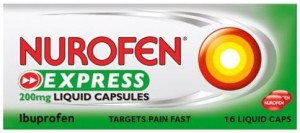
Reckitt Benckiser executives may need some of the company's own pain meds this week. First in Australia and now in the U.K., the drugmaker is being taken to task over misleading claims for its painkiller Nurofen...Australia, a judge ordered four "different" kinds of Nurofen pulled from store shelves. While each product has a different name targeting a different pain--Nurofen Back Pain, Nurofen Period Pain, Nurofen Migraine Pain and Nurofen Tension Headache--each had the exact same active ingredient and at the same strength, 342 mg of ibuprofen lysine...Meanwhile, in the U.K., Reckitt is under investigation for TV advertising for its Nurofen Express, charged with making inaccurate claims that "the product directly targets muscles in the head," and that it works more quickly than standard ibuprofen...This is not the first time Reckitt has been charged with making misleading Nurofen claims; in 2012, the Australian government ordered one of its TV ads withdrawn. The ad included the "misleading" claim that Nurofen "goes straight to the pain" together with "imagery of the medicine ascending from the neck to the head," according to the filed complaint.
- Study: Florida’s Crackdown On ‘Pill Mills’ Is Working (forbes.com)

State officials have been cracking down on Florida’s "pill mills" over the past five year to prevent pain clinics from dispensing large quantities of prescription opioids to residents without following proper protocol–and their efforts seem to be paying off...a new study revealed that approximately 1,029 fewer people in Florida lost their lives to prescription opioid-related overdoses over a 34-month period than would have had the Sunshine State not targeted pill mills beginning in 2010...State officials passed new laws in 2010 and 2011 to curb opioid abuse, misuse and overdose in the state by establishing greater oversight over pain clinics. "These laws prohibited on-site dispensing of most prescription narcotics, prohibited advertising and increased criminal penalties for doctors and clinic owners involved drug diversion,"..."In addition, state and local law enforcement collaborated with the DEA to enforce these new laws, arresting pill mill owners, physicians and other staff, and seizing assets."...The study’s authors believe Floridians are less likely to become addicted to heroin because people are less likely to abuse prescription opioids, mainly due to the fact that they aren’t readily available in the state.
- The Role Of Big Pharma In Neglected Diseases (forbes.com)
Big Pharma has taken its lumps on a number of fronts this year. Election year rhetoric has battered the industry on drug prices. Politicians have also aimed their venom on U.S. companies that seek to move their headquarters to Europe to escape the U.S. high corporate tax rate...has...eroded the public’s trust in this industry...Yet, some recent events, that have gone largely unnoticed, show another side of Big Pharma.
- ...donation of Pfizer 500 millionth dose of Zithromax (azithromycin), an antibiotic that is especially effective in treating trachoma. Trachoma is one of the leading causes of preventable blindness in the world…
- Merck established the Mectizan (ivermectin) Donation Program to eliminate river blindness (onchocerciasis) in Africa and Latin America.
- Novartis recently announced that it had delivered its 300 millionth dose of a pediatric malaria treatment to children in more than 30 malaria-endemic countries.
- Beyond donating its medicines, Big Pharma companies are developing treatments for diseases that are unlikely to turn any profit, such as Merck’s Ebola vaccine and GSK’s malaria vaccine.
…all Big Pharma companies have major philanthropic programs in areas of neglected diseases. There are those who dismiss these efforts and some...are even critical of such altruism. Nevertheless, the resources and manpower devoted by Big Pharma are considerable – efforts for which they receive little credit and zero return on investment...In the coming year, we are likely to see more attacks on Big Pharma...The industry is a big target...not without its flaws. However, the industry does a lot of good beyond providing new treatments to treat the diseases of the world. It would be nice to remember that on occasion.
- Dear Santa: Can you bring me a happier, healthier healthcare industry? Dear Santa, (medcitynews.com)

Dear Santa,
I’m writing to you with my Christmas wish list. I realize that I am a little over the typical age limit for this activity, but I am pretty short so maybe I can still pass for a kid? I also know that, as a venture capitalist, I may automatically default to the "naughty list." But I am an eternal optimist and I’m hoping that the social value inherent in investing in healthcare instead of video games and drones can help me put a few points on the Santa board...Here’s to hoping that my wishes will be fulfilled, for what it’s worth, I will be listening for Rudolph et al on Christmas Eve, cookies at the ready. I make really good cookies. Here’s my list, in no particular order:
- Great companies with rational valuations
- A better IPO market for digital health companies
- A parade of experienced, driven, humble entrepreneurs who can balance their tech and healthcare knowledge for good
- A world where venture capitalists and entrepreneurs recognize that diversity is a plus–
- A medical system that values the active role of the patient aka consumer
- A better work environment for physicians, nurses and others who care for people
- Recognition and reward for the unpaid and overwhelmed caregivers of our nation
- An end to avoidable medical errors
- A pony
Anyway, whatever your holiday of choice—Hanukkah, Christmas, Kwanzaa, New Years Eve, Festivus or other—I hope yours is a great one and that you find love, relaxation and moments of joy before the new year revs up again...Happy Holidays everyone.
- Big Pharma’s steady double-digit price hikes cost Medicare billions (fiercepharma.com)Medicare drug costs rose sharply in 2014 (statnews.com)Medicare Drug Spending Dashboard 2014 (cms.gov)The CMS Blog: Medicare Drug Spending Dashboard (blog.cms.gov)
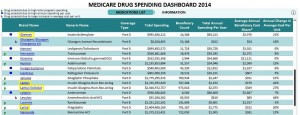
Sanofi, Pfizer, Novartis and peers ratchet up prices on blockbuster meds to reap big sales gains…a new report from the Center for Medicare and Medicaid Services puts some numbers to that claim. They won't resolve the debate over which price increases are "justified," but they do highlight some commonly used meds whose sales growth (grew)--and Medicare spending--depends more on rising prices than on rising demand.
- Vimovo...price hike at 543% for 2014... boost helped send spending on the drug up past $38 million from just over $7 million in 2013…patients using the drug only grew by 8%.
- Targretin...unit cost rose by 123% last year, to $145.65...CMS shelled out $73.5 million, more than double its 2013 spending…increase in patients of just 12%.
- CMS laid out $1.725 billion for Lantus last year, a $400 million increase year-over-year despite a 6% decline in patient count.
- CMS spent another $2.02 billion for Lantus Solostar, an increase of almost $700 million, or about 50% year-over-year...patient growth amounted to 13%.
- Gleevec sent CMS' unit costs up by 21% last year, to $179.93...that pushed spending per user to $69,212. The number of patients using the drug ticked upward by 5%...spending on the drug grew by 28%, to almost $1 billion.
- Lyrica...up in price...about 20%...to $4.28 per pill. Medicare spent $1.4 billion on the drug in 2014, up from just over $1 billion in 2013...patients grew by 7%.
When Sanofi, Pfizer and Novartis were raising their prices...they were fighting to fill patent-cliff sales gaps and scrambling to refill their pipelines of prospective new drugs. They were also spending billions on R&D--and on stock buybacks, dividends and other shareholder-friendly moves. Horizon and Valeant, by contrast, aren't big R&D spenders; Valeant, at least, has defended its price hikes as necessary to deliver returns to shareholders.
- Which Biotechnologies Were Hyped (And Which Went Out Of Favor) In 2015 (forbes.com)
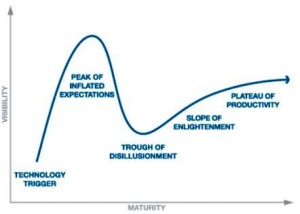
Gartner hype curve
"Don’t Believe the Hype."...It’s good advice for people operating in the R&D side of pharmaceuticals. Many exciting things are happening today in the science, so it’s easy to get carried away. But this year’s market correction–driven in part by systemic concerns about drug pricing, a few clinical trial blowups and shenanigans—should serve as a vivid reminder. No matter how good the fundamentals are, biotech still hasn’t figured out how to carefully calibrate perceptions to keep the steam engine steadily chugging along, without letting things get too hot or too cold...Hype has always been part of biotech because investments must be made on glimmers of promise, otherwise known as incomplete data. Without hype and hope, the industry couldn’t exist...There’s no good way to quantify perceptions, and things change fast in biotech, but I do talk every day to lots of different people with their fingers on the pulse of different things. So I thought it would be fun to try again this year with plotting various biotech platforms and concepts along the Gartner hype curve.
Peak of inflated expectations
- CRISPR/Cas9 genome editing.
- Microbiome everything.
- Genomic wellness.
- Conquering antibiotic resistance.
Trough of Disillusionment
- Digital health.
- Stem cell therapies.
Climbing up the Slope of Enlightenment
- Immuno-oncology.
- Viral Vector Gene Therapy.
- Long-read sequencing.
- Half Of U.S. Doctors ‘Burned Out’ As Obamacare Begins Third Year (forbes.com)
Dr. Curly, Dr. Larry, and Dr. Moe
The number of U.S. physicians who say they are suffering "burnout" has jumped to more than half of doctors as the practice of medicine becomes more complicated and millions more Americans gain health coverage under the Affordable Care Act...An analysis from researchers at the Mayo Clinic and the American Medical Association say doctors’ work-life balance is worsening, with the percentage of physicians who say they are suffering burnout rising to 54% in 2014 from 45% in 2011..."disturbing trend"..."Burnout and satisfaction with work-life balance among U.S. physicians are getting worse,"..."American medicine appears to be at a tipping point with more than half of U.S. physicians experiencing professional burnout...has effects on quality of care, patient satisfaction, turnover, and patient safety, these findings have important implications for society at large."
- Valeant’s big pharmacy deal with Walgreens includes quirky drug-buyback plan (fiercepharma.com)Valeant Taking Titles to Drugs on Walgreens’ Shelves (sub req) (wsj.com)

Valeant Pharmaceuticals' much-ballyhooed agreement with Walgreens includes an unusual inventory provision that helps explain why the pharmacy chain might have been eager to strike a deal...Valeant is buying back its drugs from Walgreens and selling them on consignment to the pharmacy, a provision that triggers an upfront financial hit. Walgreens won't physically return the drugs, just the title to them...It's just one out-of-the-ordinary feature of an out-of-the-ordinary pharmacy deal. Valeant announced last week that it had teamed up with Walgreens to distribute its drugs, discounting key skin and eye brands by 10% and another slate of meds by an average of 50%. Walgreens is taking the Valeant drugs on consignment and collects fees for filling prescriptions…The Walgreens partnership replaces Valeant's relationship with Philidor, a specialty pharmacy that was closely tied to the drugmaker until questions arose about its operations...The drugmaker is expecting a sales hit from the pharmacy shift, partly because of the mechanics of the Walgreens deal and partly because of lower demand for its drugs in the wake of the Philidor allegations.
- DEA eases requirements for natural cannabis-derived drug research (reuters.com)
Drug Enforcement Administration...relaxed some restrictions on research evaluating cannabidiol, an extract of the marijuana plant, for medicinal use...The modifications will ease some requirements imposed by the Controlled Substances Act on possession of cannabidiol (CBD) for a specific Food and Drug Administration approved research protocol...researchers who expanded the scope of their studies and required more CBD than initially approved had to request, in writing... the changes...a previously registered CBD clinical researcher who is granted a waiver can readily modify the protocol and continue research seamlessly. (waiver effectively removes a step from the approval process)...A handful of companies are developing cannabis-derived drugs. Pioneering the effort is Britain's GW Pharmaceuticals, which is slated next year to deliver the results of four late-stage U.S. studies of its botanical pot-based epilepsy treatment...INSYS Therapeutics Inc and Zynerba Pharmaceuticals Inc are working on much earlier stages of development with synthetic cannabis for a number of disorders.