
- Why FDA Should Oversee Laboratory Developed Tests (blogs.fda.gov)The Public Health Evidence for FDA Oversight of Laboratory Developed Tests: 20 Case Studies (fda.gov)Framework for Regulatory Oversight of Laboratory Developed Tests (LDTs) DRAFT GUIDANCE (fda.gov)Theranos isn’t the only diagnostics company exploiting regulatory loopholes (theverge.com)

Today FDA is issuing a report that illustrates the real and potential harms to patients and to public health from certain laboratory developed tests (LDT) – tests that are designed, manufactured and used in a single laboratory…But times have changed. LDTs have increased in complexity and availability and are now frequently used to diagnose common, serious medical conditions, including cancer and heart disease, with potentially greater impact on patients...LDTs are still under a general policy of enforcement discretion. That means they have rarely undergone FDA review to determine whether they are accurate, reliable, and provide clinically meaningful results...FDA’s own adverse event reporting databases rarely capture problems associated with a faulty LDT...the Agency was able to pull together 20 case studies based on information available in the public domain that show how lack of LDT oversight may be causing or is causing significant harm to patients…FDA has proposed to step up our oversight of LDTs. We issued a draft guidance last year which we’re currently working to finalize, that proposes to phase in enforcement of premarket review requirements for LDTs. FDA oversight would help ensure that tests are supported by rigorous evidence, that patients and health care providers can have confidence in the test results, and that LDTs have more scientifically accurate product labeling.
- DEA Announces Release of First Statewide Drug Overdose Assessment for Pennsylvania (dea.gov)Analysis of Drug-Related Overdose Deaths in Pennsylvania, 2014 (dea.gov)

Drug Enforcement Administration…announced today the publication of a statewide Drug Overdose Assessment for Pennsylvania. The report, entitled “Analysis of Drug-Related Overdose Deaths in Pennsylvania, 2014,” is the first comprehensive assessment of deaths caused by drugs for the commonwealth…DEA received information from 62 of the state’s 67 counties on 2,497 deaths caused by the misuse of illicit drugs and diverted pharmaceuticals. Heroin was the most frequently identified drug (more than 51 percent of deaths), and more than 60 percent of the decedents showed the presence of an opioid. Also of note, 12 rural counties were among the 20 counties with the highest rate of drug-related deaths per 100,000 people.
- Suburban Detroit Doctor Receives 7 Year Sentence for Writing Unlawful Prescription for Controlled Substances including Oxycodone (dea.gov)

Hussein “Sam” Arwada also admitted to defrauding the health care system of $2.3 million…physician who practiced in Warren, Michigan, was sentenced to 84 months in prison today for writing prescriptions for oxycodone and other controlled medications without medical justification, and for health care fraud…he conspired with James Lyons, a patient “marketer,” and others, to write prescriptions for 80,000 doses of oxycodone, and other controlled medications. The prescriptions were written in the names of people who were brought to him by Lyons and other marketers, for no legitimate medical purpose. The marketers then bought the pills from the “patients” and re-sold them to street dealers. Awada then used the patient data...to submit bills to Medicare and Blue Cross Blue Shield for services that were either never performed or were medically unjustified. Awada caused these same patients to receive monthly x-rays, and other invasive tests, which were medically unnecessary but helped to conceal his fraud.
- 5 ways OIG checks hospital safety (healthcareitnews.com)
New this year is quality reporting data…The Office of Inspector General in the Department of Health and Human Services is charged with overseeing the agency's programs to make sure they function efficiently and safely…OIG recently released its work plan for 2016…Here, among the vast responsibilities assigned to the office are five items OIG will check to ensure hospitals provide quality care and maintain safety:
- CMS validation of hospital-submitted quality reporting data
- Hospitals' contingency plans for protecting data in the EHR
- Hospital preparedness and response to high-risk infectious diseases
- Long-term-care hospitals – adverse events in post-acute care for Medicare beneficiaries
- Inpatient rehabilitation facilities – adverse events for Medicare beneficiaries
- Global drug spending to hit $1.4 trillion in 2020: IMS (reuters.com)
Global spending on medicines will reach $1.4 trillion in 2020, driven by increased healthcare access in emerging markets and high-priced new drugs for cancer and other diseases…That is up from about $1.07 trillion this year, representing a compound annual growth rate of 4 to 7 percent over the next five years…Some 225 new drugs will come to market over the next five years, about a third aimed at cancer, as well as medicines for rare diseases, which can carry ultra-high price tags, and treatments for autoimmune diseases and heart disease…cost will be partially offset by patent expirations expected to reduce spending on branded medicines by $178 billion, including $41 billion from biologic drugs as cheaper biosimilars become more widely adopted…Developed markets will still account for the lion's share of global spending, about 63 percent, due to higher prices and access to the newest, most expensive treatments.
- Physicians call for fairness in drug prices, availability (ama-assn.org)
In response to increasing drug costs impacting patient access to needed medications, physicians voted...to convene a task force and launch an advocacy campaign to drive solutions and help make prescription drugs more affordable. Physicians also are calling for greater competition in the pharmaceutical industry and transparency in prescription drug prices and costs… The new policy calls for the AMA to generate an advocacy campaign to engage physicians and patients in local and national advocacy initiatives to bring attention to the rising price of prescription drugs and put forth solutions to make them more affordable for all patients…Actions called for in the new policy include:
- Support legislation to shorten the exclusivity period for biologics.
- Encourage actions by federal regulators to limit anticompetitive behavior by pharmaceutical companies attempting to reduce competition from generic manufacturers through manipulation of patent protections and abuse of regulatory exclusivity incentives.
- Encourage prescription drug price and cost transparency among pharmaceutical companies, pharmacy benefit managers and health insurance companies, which will help patients, physicians and other stakeholders understand how drug manufacturers set prices, and the prescription drug tiering and cost-sharing requirements of health plans.
- Monitor pharmaceutical company mergers and acquisitions in the pharmaceutical industry.
- Support a balance between incentives for innovation and efforts to reduce regulatory and statutory barriers to competition as the patent system is evaluated and potentially reformed.
- American Medical Association wants to ban drug ads to consumers (statnews.com)AMA Calls for Ban on Direct to Consumer Advertising of Prescription Drugs and Medical Devices (ama-assn.org)
American Medical Association is calling for a ban on advertising prescription drugs and medical devices directly to consumers. The move…is largely symbolic, because any ban would have to be authorized by Congress…The new AMA policy comes after years of complaints by physicians…some ads too often encourage patients to seek medicines unnecessarily. They also resent the pressure the ads place on them to write prescriptions out of concern patients will switch physicians…Another rationale for the ban, however, is the rising cost of drugs…many of the ads aimed directly at consumers promote more expensive medicines…the Pharmaceutical Research and Manufacturers of America…“Providing scientifically accurate information to patients so that they are better informed about their health care and treatment options is the goal of direct-to-consumer pharmaceutical advertising...“Beyond increasing patient awareness of disease and available treatments, DTC advertising has been found to…encourages patients to visit their doctors’ offices for important doctor-patient conversations about health that might otherwise not take place.”...
- Califf Breezes Through Nomination Hearing for FDA Chief (medscape.com)

Most members of a Senate committee had few reservations yesterday about Robert Califf's qualifications to be the next commissioner of the US Food and Most members of a Senate committee had few reservations yesterday about Robert Califf's qualifications to be the next commissioner of the Food and Drug Administration.. Questions about Dr Califf's ties to the pharmaceutical industry, however, have dogged him since President Obama nominated him…to lead the FDA…Trying to head off those concerns, Chairman Alexander noted at the outset of the hearing that Dr Califf had gone through an extensive vetting process that involved the White House, the FBI, the Office of Government Ethics, and dozens of pages of questions from the HELP committee…Sen. Elizabeth Warren confronted Dr Califf directly about his past relationships with drug companies. "It's no secret that during your time at Duke University you received significant financial support from the pharmaceutical industry both personally and through your research,"...She asked him whether he believed that the FDA should lower its standards for approval…"I've never been a proponent of lowering standards," said Dr Califf. "If anything, I've argued for raising standards."
- Valeant faces new trouble as dermatologists sour on its drugs (statnews.com)

FILE PHOTO. The head offices of Valeant Pharmaceutical is pictured in Montreal on Monday May 27, 2013. THE CANADIAN PRESS/Ryan Remiorz
Yet another sign of trouble for Valeant Pharmaceuticals has emerged. The beleaguered drug maker already faces congressional hearings into its pricing practices. Now, one of its bread-and-butter product lines may not ring the register as often as before…Fewer dermatologists are prescribing Valeant medicines…The change constitutes more fallout from a scandal involving the drug maker’s relationship with a mail-order pharmacy known as Philidor Rx Services. Valeant reportedly hid its ties to the pharmacy in order to inappropriately boost prescriptions and insurance reimbursements...68 percent are writing fewer prescriptions for Valeant’s dermatology products and a similar percentage expect they will not prescribe Valeant drugs in coming months.
- The World’s Biggest Consumers Of Antidepressants (forbes.com)
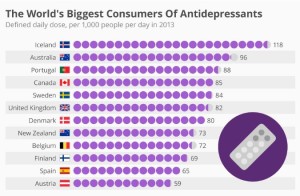
Iceland is the biggest consumer of antidepressants worldwide, according to recent OECD (Organisation for Economic Cooperation and Development) report entitled “Health at a Glance 2015.” Some 118 out of every 1,000 Icelanders now consume these drugs on a daily basis, though the trend certainly isn’t new...Some experts attribute the country’s use of these drugs to a weakening of social taboos, along with a greater tendency to seek treatment. Some also believe there is a link between antidepressant consumption and the failure of all three of Iceland’s main banks during the financial crisis. Australia is in second position with 96 out of every 1,000 people taking antidepressants daily, while Portugal rounds off the top three with 88 per 1,000.