
- Donna Hazel – President of the Pennsylvania Pharmacists Association (pharmacypodcast.com)
OCTOBER is AMERICAN PHARMACISTS MONTH!
In celebration of our Pharmacists – we interview Donna Hazel – President of the Pennsylvania Pharmacists Association...completed her Bachelor of Pharmacy from Duquesne University in 1979. Donna has held many positions with Rite Aid Corporation and currently is a Regional Recruiter. She has been a member of PPA since 2005 when she moved back to Pittsburgh. She is a previous President and Chair of the Allegheny County Association. Previously she served as Southwest Director of PPA...currently the President of Duquesne University School of Pharmacy Alumni and member of Lambda Kappa Sigma Pharmacy fraternity’s Tau Alumni Chapter. Donna has enjoyed serving as Southwest Director of PPA, and is most proud of the affiliation agreement between ACPA and PPA. (podcast 13min)
- 5 reasons to hit pause on Stage 3 meaningful use (healthcareitnews.com)
Senator Lamar Alexander…called on the government to delay Stage 3 final rules – and offered five reasons why…"The whole purpose of this program is to benefit patients, so that they and their health care providers have quicker and better access to their health histories and their doctors and hospitals and pharmacists can provide them with better care,"…"There is no reason not to take time to do it right."
- Stage 2 is so onerous, in fact, that just 12 percent of physicians and 40 percent of hospitals have managed to successfully attest.
- Penalties and bonus payouts under the new Medicare payment system are inextricably tied with meaningful use compliance.
- Many leading medical institutions with the best electronic health records systems also recommend proceeding with caution.
- A recent GAO report that shows that, in many cases, MU mandates are actually hindering electronic health record interoperability.
- The HELP Committee has worked to develop seven areas for legislation to drive interoperability:
- Decreasing unnecessary physician documentation;
- Enabling patients to have easier access to their own health records;
- Making electronic health records more accessible to the entire health care team, such as nurses;
- Stopping information blocking
- Ensuring that EHR certification "means what it says it does"
- Improving standards
- Ensuring the security and privacy of patient records.
- Hurricane Joaquin: Help Prepared for Pharmacies (pharmacytimes.com)Tracking Hurricane Joaquin (healthcareready.org)

Healthcare Ready, which helps strengthen health care supply chains during disasters…trains for disasters such as Category 4 Hurricane Joaquin on an annual basis with a crisis simulation exercise. She said Healthcare Ready would adopt an "alert status" on October 2, 2015, and start response procedures to help communities in case the hurricane touched down on the East Coast...(Executive director Emily Lord).. spoke with Pharmacy Times further about the role Healthcare Ready plays in emergency situations.
- What’s the most common event that Healthcare Ready is called upon to help?
- How does Healthcare Ready advocate for increased participation of pharmacists in public health initiatives?
- How did Healthcare Ready help during Hurricane Sandy?
- How does Healthcare Ready collaborate with government agencies/industry partners?
- A <797> Rewritten with Patient Safety in Mind (qualitymatters.usp.org)

…the 2012 fungal meningitis outbreak connected to the New England Compounding Center…brought to light that standards for safe compounding do exist, but their enforcement may be inconsistent. So…<797> was revised having patient safety in mind, by making the standards for compounding sterile preparations as clear as possible to practitioners… Expert Panel was charged with taking a fresh look at the chapter from beginning to end and making recommendations for improved clarity and responding to stakeholder input…They have…helped tailor its language to make it clearer to users and regulators… As a user of <797>, I encourage you to get involved in USP’s the standard-setting process and comment on the revised chapter, which was pre-posted for public comment on September 25, 2015.
- PharmTalk – Interprofessional Education (pharmacy.arizona.edu)
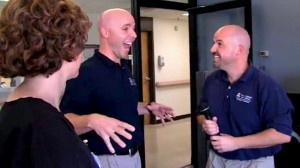
PharmTalk is a special production from the University of Arizona, College of Pharmacy that features Keith and Kevin Boesen.
More and more, student pharmacists, student nurses, student physicians and others learn together about the best ways to make patients' lives better.
- Why Partnerships are Key to the Science of Patient Input (blogs.fda.gov)
We recently announced…Patient Engagement Advisory Committee …The Committee will provide advice to the FDA Commissioner on…issues relating to medical devices, the regulation of devices, and their use by patients…PEAC will bring patients, patient advocacy groups, and experts together for a broader discussion of important patient-related issues, to increase integration of patient perspectives into the regulatory process, and to help drive more patient-centric medical device innovation, development, evaluation, and access.
- ICD-10 Could Challenge Emergency Rooms (pharmacytimes.com)

…changeover to ICD-10 medical diagnosis codes could complicate tasks in emergency departments…researchers...looked at more than 24,000 clinical encounters in the emergency room, they found that nearly a quarter could be assigned incorrect ICD-10 codes…also…27% of 1830 ICD-9 indicator codes commonly used by emergency physicians had convoluted mappings to ICD-10 codes that could pose problems for clinical documentation, reimbursement, disease reporting, and justifying hospital admissions…Depending on the analytic programs that the pharmacies use to predict how much medications to store and how complex the transition to ICD-10 is, pharmacies might have shortages of medications due to inaccurate reports and algorithms..
- In 2016, 85% of Medicare Part D plans have a preferred pharmacy network (drugchannels.net)
Centers for Medicaid & Medicare Services just released data on 2016's Medicare Part D plans…analysis reveals that 85% of Medicare Part D regional prescription drug plans will have a preferred cost sharing network in 2016…Preferred network plans are controversial (and generally disliked) by pharmacy owners. That’s because reduced pharmacy profits are the biggest source of cost savings from these networks. Despite ongoing complaints, it's still full speed ahead for preferred networks.
- Health Law Revision Is Approved (nytimes.com)
Senate passed legislation…intended to protect small and midsize businesses from increases in health insurance premiums…The bill,…eliminates a provision of the law that would have imposed tough, potentially costly new requirements on businesses with 51 to 100 employees…"This bill will make a helpful adjustment to the Affordable Care Act for small and midsize businesses by limiting potential premium increases and letting states determine what’s best for their market,"…
- Pharmacy Week in Review: October 2, 2015 (pharmacytimes.com)
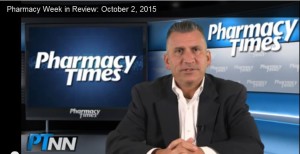
Brian Haug, President of Pharmacy and Managed Markets, Pharmacy Times (PTNN) This weekly video program highlights the latest in pharmacy news, product news, and more. (video)