
- Dried toad and snakeskin: Old-school remedies cool China’s vitamin fever (reuters.com)

China's much-hyped market for vitamins and supplements is facing a steep challenge from traditional remedies…The vitamins market is…being outstripped by a traditional medicine business…and is growing twice as fast…That's prompted vitamins firms from…Amway to…Pfizer Inc to look for inspiration from traditional medicine recipes going back thousands of years to succeed in China's increasingly pivotal healthcare market…"We've tried to learn the heritage and marry it with modern life sciences,"…."Half of the population still believe in traditional ways and still go to traditional doctors or hospitals. This is a way of life and is passed from generation to generation,"…
- New Weapon in Push to Lower U.S. Biotech Drug Prices (wsj.com)
In Europe, uptake of biosimilars has been slowed by safety concerns,low awareness…The introduction of biosimilar drugs in the U.S.,which kicked off this month with Novartis AG ’s version (filgrastim, Zarzio) of an Amgen Inc. blockbuster (filgrastim, Neupogen),hands health-care payers a new weapon against rising drug prices. But it could be a duller blade than they had hoped...
- Price fixing: PBMs push for lower prices of PCSK9 inhibitors (mmm-online.com)
Gilead Sciences' decision to slap Sovaldi,…with an $84,000 price tag was widely considered a turning point for payers and pharmacy benefit managers…the months leading up to the approvals this summer…negotiations were already under way between those drugmakers and Express Scripts,…PBMs are becoming increasingly savvy and hard-nosed about which drugs they will cover and what they are willing to pay for them… PBMs want to position [themselves] so they are advocating on behalf of their customers. Their customers are worried...
- The Vernacular of Risk — Rethinking Direct-to-Consumer Advertising of Pharmaceuticals (nejm.org)
United States is the only country with a strong pharmaceutical regulatory infrastructure that allows direct-to-consumer advertising of prescription drugs in print, broadcast, and electronic media. U.S. consumers are accustomed to full-page ads in newspapers and magazines detailing a drug's benefits… That may soon change, however, as the Food and Drug Administration moves to enact new regulations regarding risk communication in DTCA…. responds to mounting research showing that reprinting highly technical package inserts in print ads does very little to communicate risks to consumers. The goal is to communicate those risks in a new vernacular.
- U.S. drugmaker Turing to roll back 5,000 percent price hike (reuters.com)Controversial drug CEO was accused of serious 'harassment' (cnbc.com)

Turing Pharmaceuticals, a small company that generated outrage over raising the cost of an old anti-infective drug by more than 5,000 percent, said on Tuesday it would roll back that increase to make sure it remains affordable....Chief Executive Officer Martin Shkreli became the new face of the U.S. drug pricing controversy this week, after the New York Times reported that the company had raised the price of Daraprim, a 62-year-old treatment for a dangerous parasitic infection, to $750 a pill from $13.50 after acquiring it. The medicine once sold for $1 a pill.
- Clinton proposes $250 monthly cap on prescription drug costs (news.yahoo.com)Hillary Clinton targets medicine costs in campaign pledge (drugstorenews.com)Here's Why Biotech Stocks Are Set for a Big Decline (thestreet.com)

U.S. Democratic presidential candidate Hillary Clinton proposed on Tuesday a $250 monthly cap on out-of-pocket prescription drug costs and other measures to stop what she called "price gouging" by pharmaceutical companies….Clinton rolled out a plan to encourage the development and use of generic drugs and to end pharmaceutical companies' ability to write off consumer-directed advertising as a business expense….monthly cap would limit what insurance companies could ask patients to pay for drugs that treat chronic or serious medical conditions.
- CEO Martin Shkreli: 4,000 percent drug price hike is ‘altruistic,’ not greedy (washingtonpost.com)

At least that's the main message from his appearances on various TV news shows…In an interview on "CBS This Morning," Shkreli told reporter…Daraprim, was unprofitable at the old price…. Shkreli didn't do himself or his company any favors over the weekend when the news of the price spike went viral online after an HIV/AIDS group complained of the increase and he took to his Twitter account to admonish anyone who dared to question the business decision
- Deals, Say Markets Will Stay Competitive (wsj.com)
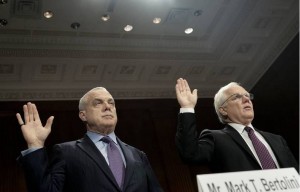
Mergers will benefit consumers, CEOs of both companies tell Senate panel…chief executives of Aetna Inc. and Anthem Inc. defended their merger deals before a Senate subcommittee, facing sharply critical testimony that raised questions about the impact of health-insurance consolidation…Aetna is seeking to acquire Humana Inc.,..focused largely on the private Medicare plans known as Medicare Advantage. Anthem aims to take over Cigna Corp…The two deals together would shrink the top five health insurers to a big three, each with annual revenue of more than $100 billion. The third player would be UnitedHealth Group Inc.
- Missouri attorney general: Walgreen Co. deceiving consumers (washingtonpost.com)
Walgreen Co.’s persisting failure to remove expired sales tags from its shelves deceives customers and violates a 2014 settlement that sought to resolve the matter in Missouri, the state’s attorney general argued…in asking a state court to punish the pharmacy chain…Attorney General Chris Koster filed court documents asking a judge to hold the nation’s largest pharmacy retailer in contempt of the settlement and issue steeper fines, including up to $5,000 for each expired tag. Koster said that since July, undercover investigators have found a total of more than 1,300 shelf tags displaying sales prices that had expired...
- Stanford team re-engineers virus to deliver therapies to cells (news.stanford.edu)

Researchers stripped a virus of its infectious machinery and turned its benign core into a delivery vehicle that can target sick cells while leaving healthy tissue alone….totally redesigned its core to repurpose its infectious capabilities into a safe vehicle for delivering vaccines and therapies directly where they are needed…"We call this a smart particle,"…. "We make it smart by adding molecular tags that act like addresses to send the therapeutic payload where we want it to go." Stanford has patented the technology and different aspects are licensed to a biotechnology company… no timetable for commercial development.