
- Drug makers paid fewer fines for bad behavior in recent years (statnews.com)

After a decade in which drug makers regularly paid huge fines for various fraudulent practices, there was a noticeable drop over the past two years, according to a new analysis by Public Citizen...Pharmaceutical companies paid approximately $2.8 billion to settle federal and state civil and criminal charges in 2014 and 2015, compared with $9.9 billion during 2012 and 2013. The most recent payments also amounted to the lowest two-year total since 2004 and 2005...Among the worst offenders in recent years were Johnson & Johnson, Pfizer, Novartis, and GlaxoSmithKline, although the report noted that nearly every large drug maker has paid fines to resolve some kind of infraction over the past two decades...A spokesman for the Pharmaceutical Research and Manufacturers of America...We are disappointed at the report’s misleading conclusions...Among its many methodological flaws, the report aggregates all settlements involving the pharmaceutical industry, with little regard as to whether the companies actually broke the law. Civil settlements rarely resolve the question of guilt. Yet the report glosses over its own finding that 88 percent of the settlements reported were civil, not criminal...
- Drug makers inconsistently report side effects in the US and Europe (statnews.com)Variation in adverse drug reactions listed in product information for antidepressants and anticonvulsants, between the USA and Europe: a comparison review of paired regulatory documents (bmjopen.bmj.com)
Drug makers must report side effects to regulators, but the amount of useful information can vary depending upon which regulator gets the data, according to a new analysis...A team of researchers examined a dozen brand-name drugs used to treat depression and seizures and found that, on average, the manufacturers filed 77 more side effects reports with the US Food and Drug Administration than with the European Medicines Agency...On average, 71 percent of the side-effect terms listed in the reports submitted to the FDA were not filed with the EMA...86 percent of reports submitted to the FDA, there was more information on the source of the report — such as a spontaneous patient report during treatment or if it occurred during a trial — than what was provided to the EMA...On average, only 29 percent of the side effects were reported to both agencies. Moreover, most of the reports lacked information on duration and seriousness of the side effects, as well as the extent to which the reactions were reversible...that reporting needs to be improved...This study shows that the reporting of drug adverse effects on product information is fragmentary and inconsistent...neither the FDA nor the EMA versions provided much information about the onset, duration, and severity of drug side effects. Instead they provided just lists that were not necessarily in agreement...
- FDA Review Times Steadily Decreasing, Report Finds (raps.org)
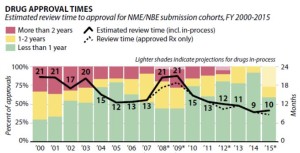
Despite wide variations across therapeutic areas, FDA review times for new drugs have steadily declined since 2009, according to a report released...by the California Life Sciences Association and Boston Consulting Group...Back in 2009, FDA was averaging 21 months for reviewing new molecular and biologic entities, but five years later, that average has been cut by more than half to nine months in 2014. In addition, the number of applicants waiting more than two years for an FDA review has fallen from more than 25% of applicants in 2000 to none by 2013.
- Substances Doubtful for Bulk Drug Substances List Could Be INDs (ashp.org)Individual Patient Expanded Access Applications: Form FDA 3926 (fda.gov)
Pharmacists, physicians, and advocacy groups that want patients to use substances unlikely to be on the upcoming "bulk drug substances list" for compounders should consider submitting "treatment" investigational new drug applications, FDA personnel recently suggested...FDA-cleared treatment IND applications...offer a legal workaround that can benefit many patients...a compounding pharmacy, could submit a treatment IND, which once that was in place could be expanded to treat a large number of patients...ASHP stated, absent "significant" revision, FDA's current expanded-access IND application process will not facilitate access to any drug available only from compounders...Jarow (Jonathan Jarow, from the Center for Drug Evaluation and Research)...acknowledged that submission of an IND application has seemed difficult to many individual healthcare providers seeking a drug for a single patient..."There's now a special form in development that has not been finalized—it's available in draft form—that caters to that specific type of IND rather than the general form that's used for all types of INDs, which looks very complicated," he said...Form FDA 3926, also known as "Individual Patient Expanded Access Investigational New Drug Application," went on display in February 2015 as part of a draft guidance for the pharmaceutical industry....
- Drug firm to pay $4m to settle investor fraud charges (statnews.com)

Aveo Pharmaceuticals agreed to pay $4 million to settle charges that it misled investors about efforts to obtain regulatory approval for its flagship drug, a kidney cancer treatment called Tivozanib, the US Securities and Exchange Commission said today...the agency is still pursuing a case against three former executives...The biotech allegedly concealed concerns that the Food and Drug Administration had about the medicine in public statements to investors. In particular...failed to disclose that FDA staff had recommended...that the company should run a second clinical trial to address issues concerning patient death rates that were seen during an earlier clinical trial...A spokesman for Aveo..."we hope to have this matter behind us and to be able to pursue our new strategy without being distracted by these claims" The new strategy...includes running a second Phase III study for the...drug...
- Novartis is accused of paying bribes in Turkey to boost prescriptions (statnews.com)Turkish prosecutor opens bribery probe into drugmaker Novartis (reuters.com)

An anonymous whistleblower has accused Novartis of paying bribes in Turkey by using a consulting firm to boost the use of its medicines...The alleged bribes reportedly resulted in $85 million in benefits to Novartis...The firm aided the drug maker by getting medicines added to formularies, or list of medicines that were approved for use in government-run hospitals...The consulting firm also helped Novartis avoid price cuts in other countries by winning government approval to change the names of two medicines...The Alp Aydin Consultancy was paid the equivalent of $290,000 plus costs in 2013 and 2014, but the relationship ended after the Turkish Social Security Institution began an investigation...A Novartis spokesman confirmed that an internal investigation is under way...We take any allegation of inappropriate behavior extremely seriously and investigate all allegations thoroughly...Over the past few years, a growing number of companies have been enmeshed in bribery scandals, some of which have resulted in large fines...Whether US authorities will investigate remains unclear...the allegations, which could not be independently confirmed, would also be passed along to the DOJ and the Securities and Exchange Commission...
- Shire gets favorable ruling against Allergan in Lialda patent case (reuters.com)
A U.S. district court...ruled in favor of Shire Plc, preventing Allergan Plc from selling generic versions of Lialda (mesalamine), the ulcerative colitis drug, in the United States until 2020...district court said that Allergan's Watson unit had infringed on two claims of the Lialda drug patent...
- Regulator orders drugmaker Valeant management to cease trading (reuters.com)
Valeant Pharmaceuticals International Inc's directors and key officers have received a cease-trade order by the securities regulator in the Canadian province of Quebec, on the company's request, Valeant said...In a separate statement, the Autorité Des Marches Financiers said the order against trading shares takes effect Thursday and is in place for 15 days...The delay in Valeant filing its annual report poses a risk of debt default, Valeant said March 15, generating new scrutiny of the much-criticized company. Defaulting on debt could prompt lenders to demand faster repayment and place restrictions on Valeant's ability to borrow...The cease-trade order technically applies only to Quebec, but the practical effect of such orders in Canada, which does not have a national securities regulator, is to stop trading across the country...Valeant is not under active investigation by AMF, but has been under "verification"...
- Pfizer, Allergan get request for additional information from FTC (reuters.com)
Pfizer Inc and Allergan Plc said they have received a request for additional information from the U.S. Federal Trade Commission with respect to their merger...The FTC's request for information extends the waiting period required under antitrust rules to 30 days, after the companies have provided the information...The companies said the request was anticipated as part of the regulatory process and they were working with the FTC in connection with the review.
- One year after Zarxio approval, future of biosimilars remains unclear (modernhealthcare.com)Biosimilar drugs could save up to $110 billion by 2020: IMS (reuters.com)
A year ago, providers, plans and pharmacy benefit managers thought they were on the brink of a new era of competitive drug prices. The federal approval of the first biosimilar for sale in the U.S. was supposed to foster new products that offered big discounts on some of the most expensive treatments...But there's been no flood of new drugs and no lower prices since the Food and Drug Administration's approval of Sandoz's drug Zarxio...an alternative to Amgen's cancer therapy Neupogen, remains the only biosimilar for sale in the U.S...Since January, 59 biosimilars...have enrolled in the FDA's Biosimilar Product Development Program...the agency was actively seeking to recruit additional staff to meet the demand...The agency has been struggling with how to address interchangeability, or the ability to switch a patient onto a biosimilar drug from an original biologic, and vice versa, without impacting safety or efficacy...Naming conventions is another hot-button issue...FDA...proposed adding a four-letter suffix to the non-proprietary names shared with brand-name biologics...All of these issues raise questions as to whether the biosimilar market could ever reach its potential...Dan Mendelson, president of Avalere Health, said the biosimilar market will eventually be worth tens of billions, but he expected growth to occur slowly in the U.S., as consumers get more comfortable with choosing such drugs over their originator counterparts...