
- The World’s Biggest Consumers Of Antidepressants (forbes.com)
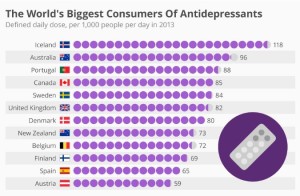
Iceland is the biggest consumer of antidepressants worldwide, according to recent OECD (Organisation for Economic Cooperation and Development) report entitled “Health at a Glance 2015.” Some 118 out of every 1,000 Icelanders now consume these drugs on a daily basis, though the trend certainly isn’t new...Some experts attribute the country’s use of these drugs to a weakening of social taboos, along with a greater tendency to seek treatment. Some also believe there is a link between antidepressant consumption and the failure of all three of Iceland’s main banks during the financial crisis. Australia is in second position with 96 out of every 1,000 people taking antidepressants daily, while Portugal rounds off the top three with 88 per 1,000.
- HHS to end provider agreement with Seattle hospital over ‘multi-systemwide failures’ (fiercehealthcare.com)

In the wake of an inspection that found "multi-systemwide failures" that created a major risk of patient harm, Seattle's Western State Hospital may lose millions in Medicare and Medicaid funding…Department of Health and Human Services will end its relationship with Washington's largest psychiatric hospital on November 28, costing the 842-bed facility a total of more than $15 million a year in federal funds. State officials said the hospital is working to correct the problems that inspectors discovered before the deadline…"Patient and staff safety remain priorities and to that end we are working to recruit more staff, which is key to improving safety and providing quality services to the patients at all of our state psychiatric hospitals," said Kathy Spears, a spokesperson for the state Department of Social and Health Services. "We have not lost federal funding..."
- DEA Announces “360 Strategy” to Address Heroin, Prescription Drugs and Violent Crime (dea.gov)

Drug Enforcement Administration…announced Pittsburgh as the pilot city for a comprehensive law enforcement and prevention “360 Strategy” to help cities dealing with a heroin and prescription drug abuse epidemic, and its associated violent crime…“The work of law enforcement to remove the traffickers and the work of our partner agencies doing treatment and prevention in Pittsburgh has already had an impact on the city’s drug problem,”…“The 360 strategy brings together for the first time, the agencies that have dealt with this problem separately, into a comprehensive and sustained effort to not only fight drug traffickers but also to make communities resilient to their return.”…The DEA 360 Strategy comprises a three-fold approach to fighting drug traffickers:
- Provide DEA leadership
- Have a long-lasting impact
- Change attitudes
- Merck may appeal to Supreme Court after again losing fight to protect Cubicin patents (fiercepharma.com)

Appeals court invalidates 4 of 5 patents, exposing it to generic compeition come June...Merck & Co.is running low on options after a federal appeals court…again declined to back four patents that would have held at bay for 5 more years generics of the antibiotic Cubicin, the drug that was key to its $9.5 billion buyout of Cubist. Next up may be an appeal to the U.S. Supreme Court…In a three-sentence statement...a federal appeals court upheld a fifth patent, but that one expires next June anyway, potentially leaving only months before copies from Hospira and others could launch. The court invalidated four other patents that expire in 2019 and 2020. The company says it is "considering its next steps, which may include seeking further review" at the federal circuit level or the Supreme Court...
- 5 ways OIG checks hospital safety (healthcareitnews.com)
New this year is quality reporting data…The Office of Inspector General in the Department of Health and Human Services is charged with overseeing the agency's programs to make sure they function efficiently and safely…OIG recently released its work plan for 2016…Here, among the vast responsibilities assigned to the office are five items OIG will check to ensure hospitals provide quality care and maintain safety:
- CMS validation of hospital-submitted quality reporting data
- Hospitals' contingency plans for protecting data in the EHR
- Hospital preparedness and response to high-risk infectious diseases
- Long-term-care hospitals – adverse events in post-acute care for Medicare beneficiaries
- Inpatient rehabilitation facilities – adverse events for Medicare beneficiaries
- FDA Amends Liver Warning Labeling Guidance for Some OTC Drugs Containing Acetaminophen (raps.org)Acetaminophen Guidance for Industry (fda.gov)

Food and Drug Administration…unveiled amended guidance on the liver warnings that must be contained in labels of some over-the-counter drugs containing acetaminophen, saying it will allow manufacturers in some cases to warn patients against taking more than 4,000 mg of acetaminophen in 24 hours… helps to clarify certain cases where manufacturers of internal analgesic, antipyretic and antirheumatic OTC drugs would be able to change liver warnings when the product’s directions for use result in a maximum daily dose of acetaminophen that is less than 4,000 mg for adults… FDA says that the optional statement, “for this product,” from the original warning is intended to help consumers understand that the maximum number of daily dosage units for a product might not reflect the maximum daily dose of acetaminophen… in certain circumstances, despite this optional statement, the wording might be interpreted as indicating that severe liver damage is associated with a total daily dose of acetaminophen that is less than 4,000 mg, which “is not the intent of the regulation.”
- Fading Obamacare Gains Put Drag on 16% Hospital Muni-Bond Rally (bloomberg.com)More Than Half of Obamacare's Co-Ops Have Now Failed -- Here's Why You Should Care (fool.com)5 States Where the Affordable Care Act Risks Becoming Unaffordable (fool.com)
For municipal-bond buyers, the boost from Obamacare is waning…municipal bonds have rallied, delivering 16 percent returns in the past two years as the providers were stuck with fewer unpaid bills…“The effect of the Affordable Care Act is fading,”… “We don’t really have any new states adopting Medicaid so you don’t have that expansion.”…The federal law has provided health-care coverage to 17.6 million Americans as a majority of states expanded access to the Medicaid program for the poor and others bought subsidized insurance. The factors that have driven that growth are now weakening…while rising premiums may cause some consumers to go without or lose their policies for not paying their bills…About 9.9 million people were paying for coverage purchased on the exchanges created by the law as of June 30, a decline of 300,000 from March 31…Department of Health & Human Services estimates that about 9.1 million people will be enrolled by the end of the year…“It’s very safe to bet that a lot of hospitals across the country are not going to see as many people getting insurance as they had expected,” The law…has been a boon to investors who hold tax-exempt bonds sold by hospitals: The securities have delivered outsized returns since then, beating a dozen other revenue-bond sectors, including toll roads, airports and utilities…The bonds’ prices have slipped 0.4 percent over the past month amid speculation that the Federal Reserve will raise interest rates as soon as December.
- Keystroke logger detected on hospital’s computers (healthcareitnews.com)

A hospital in Kentucky is notifying patients of a security incident, after it was discovered that some of its computers had been infected with a keystroke logger designed to capture and transmit data as it was typed…Muhlenberg Community Hospital had detected the malware on some of its machines…Affected computers were used to enter patient financial data and health information, potentially including names, addresses, telephone numbers, birth dates, Social Security numbers, driver's license/state identification numbers, medical and health plan information, financial account numbers, payment card information and employment-related information. Additionally, some credentialing-related information for providers may also be impacted…officials did say that they believe the malware could have captured username and password information for accounts or websites that were accessed by employees, contractors or providers using the affected terminals.
- Drug makers beat diabetes lawsuits with an unusual ruling (pharmalot.com)

Several drug makers were handed an unexpected victory this week when a federal judge ruled they weren’t required to update product labels to warn about risks of pancreatic cancer with their diabetes medicines…District Court Judge…explained the labeling changes were not required because the Food and Drug Administration would not have approved those changes. As a result, approximately 750 cases are being tossed…“Right now, it’s a ruling by one district judge in California. So at this point, it doesn’t have huge implications. But there is, potentially, a lot at stake here for the plaintiffs and similar cases,” he tells us. “If the companies were to prevail, it could become an important precedent for companies in similar cases, because it could clarify what a manufacturer has to show to avoid liability.”
- Patient data breaches widespread, beyond healthcare (healthcareitnews.com)

9 in 10 industries report PHI breaches; many unaware protected data exists within company records…It's not just hospitals. Or even payers. Some 392 million health records have been accessed in 1,931 protected health information breaches across a staggering 90 percent of industries, according to preliminary findings from a new Verizon report…These industries, across 25 countries, have seen health insurance information, personnel files or other data outside of traditional healthcare settings or industries stolen…"What makes our findings even more troubling is that many sectors - especially those outside of the healthcare industry - aren't even aware that they hold this type of data,"…Unlike with other data breaches, PHI breaches face an equal number of internal and external hackers…hacker tactics are determined by the type of data they're seeking and its location, rather than the country or company size…"This data can be extremely damaging in the hands of those wanting to commit various types of financial fraud,"...