- Hollywood Presbyterian hack signals more ransomware attacks to come (healthcareitnews.com)Hollywood Presbyterian Medical Center Pays Hackers $17K Ransom (nbcnews.com)

As hackers hold Hollywood Presbyterian Medical Center’s data and demand $3.4 million Bitcoin to give it back, experts say the "hostage situation" likely signals more ransomware attacks to come...There is no style to this attack...it was likely messaging-based, whether a malicious link in an email or perpetrated via a social network and, basically, an employee fell for it...Such attacks are particularly alluring to cybercriminals...because they are reasonably easy to pull off and have a big impact...the cybercriminals are demanding the hospital pay a $3.4 million ransom if they want their data back...In the meantime, executives declared the hospital in a state of emergency and employees are reverting to paper and faxes to communicate..."This incident really sheds light how weak the core of many providers' internal infrastructure is...It's very common for hospitals to have a large number of outdated and vulnerable systems on the network...
- Yale-New Haven Hospital picks smartphone app to streamline clinical staff communications (healthcareitnews.com)
Hospital says MH-CURE offers care teams secure, access to all clinical communications, pertinent patient information and lab data...Patient care teams at Yale-New Haven Hospital, looking for a faster, more efficient and more secure way to communicate with each other in the emergency room, have adopted smartphone applications to speed up workflows. Eventually, the hospital bucked its traditional methods, which included a public address system and a VOIP wireless phone system, turned to MH-CURE – for Clinical Urgent Response – a smartphone application from Waltham, Massachusetts-based Mobile Heartbeat...MH-CURE offers care teams secure, single smartphone access to all clinical communications, pertinent patient information and lab data. Care team members have a choice of using their own smartphone or sharing hospital-supplied devices. It consolidates clinical communications, including alarms and notifications, pertinent patient information, lab data, texting, voice and photography...Results revealed that the amount of time required for clinicians to locate and transmit information to one another was greatly reduced, allowing staff to spend more time with patients and thus provide better patient care...
- Connecting the CPOE dots: Where do we go from here? (pharmacist.com)

Over the past several years, there has been a monumental push for hospitals to transition to electronic health records and computerized physician order entry, with the hope of standardizing and streamlining care, improving medication safety, and reducing errors. In fact, some studies estimate that more than 70% of prescriptions are now written electronically. Although CPOE has come a long way in a short period of time, is the technology living up to its potential?...CPOE systems are very fragmented both within hospital systems and between the hospital and the outpatient universe...CPOE in terms of safer medication prescribing is still a work in progress...We found several areas where CPOE systems fall short in terms of medication safety, and hospital pharmacists can play an important role in resolving some of these issues...
- CPOE and medication prescribing
- Interoperability
- CPOE aggravation
- The next frontier
- Room for improvement
- Hospital pharmacists’ role
When you have systems between inpatient and outpatient that don’t communicate, important information can get lost in translation…CPOE isn’t just a hospital pharmacy issue; it’s an issue for the profession at large...Pharmacy has a significant stake in the matter of CPOE, but we really are learning as we go along...that is why you see so much frustration between prescribers and the hospital systems. To solve the problem, multiple professions beyond just health care professionals, with different thought processes, will need to work together...
- 10 trends in cyberattacks in healthcare, other industries, new survey shows (healthcareitnews.com)SPECIAL REPORT Worldwide Infrastructure Security Report (arbornetworks.com)
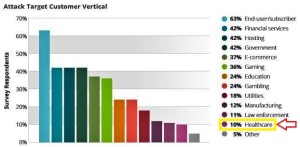
This year the top motivation wasn’t hacktivism or vandalism, but 'criminals demonstrating attack capabilities,' Arbor Networks report claims....Cyberattacks around the world are growing in size and complexity, according to Arbor Networks 11th Annual Worldwide Infrastructure Security Report...For the first time, nearly half of the respondents were from enterprise, government and educational organizations, with service providers at 52 percent. Healthcare is one of the verticals included in the enterprise category...This report provides broad insight into the issues network operators around the world are grappling with on a daily basis...The findings from this report underscore that technology is only part of the true story since security is a human endeavor and there are skilled adversaries on both sides.
Distributed Denial of Service trends:
- Change in attack motivation
- Attack size continues to grow
- Complex attacks on the rise
- Cloud under attack
- Firewalls continue to fail during DDoS attacks
Advanced threat trends:
- Focus on better response
- Better planning
- Insiders in focus
- Staffing quagmire
- Increasing reliance on outside support
- Cardinal Health bullish on medication synchronization (chaindrugreview.com)

Cardinal Health Inc. said its new medication synchronization program...offers manifold benefits for community pharmacies in terms of patient care and efficiency...MedSync Advantage enables pharmacists to coordinate a patient’s prescriptions to be picked up on the same day each month…the program not only simplifies the process for patients and caregivers who must fill multiple prescriptions, but it also improves patient medication adherence by helping to ensure they fill all scripts each month...the number of prescriptions that a patient fills each month sharpens inventory management for the pharmacy and opens up more time for the pharmacy staff to focus on interacting with patients…We believe medication synchronization is a core competency for medication therapy management expansion in the pharmacy, and we want to prepare our pharmacies to move toward a value-based pharmacy model for payment in the future...It’s a win for the patient, and it’s a win for us because it evens out our workflow and helps us operate more efficiently...The most visible thing you get from medication synchronization is your time back…
- The Startup Tracking ‘Valuable’ Doctors for Big Pharma (bloomberg.com)

Physicians are worth billions of dollars to drugmakers, who see the prescription pad as a path to profits. But it’s growing harder for Big Pharma to get doctors’ appointments. Since 2010, Obamacare has slowly curbed the mass travel junkets and fancy meals that drug companies once used to sway the doctors most valuable to their efforts to sell products...Pharmaceutical companies are now searching for ways to refine their marketing efforts, to target the doctors most compatible with the medications they’re pitching. "You’re desperate for data to make those key decisions,"..."But while there’s lots of data out there, it’s really challenging to bring it together."...Zephyr Health...promising to help drugmakers identify key medical personnel and find ways to approach them…Zephyr builds digital dossiers on individual doctors. It starts with basic information on prescription patterns from data clearinghouses...Then its software...scours the Web for more details...Zephyr generates profiles that score each doctor’s influence and ability to drive sales on a scale of 1 to 10. The software’s slick, mobile-friendly interface lets a drug company search in broad or specialized disciplines and ranks each person’s influence in the chosen field. It also specifies whether a doctor appears to influence colleagues or simply writes a lot of scripts..."There’s nothing private anymore,"...While doctors may not be exactly psyched about Zephyr tracking their every move...even they should appreciate the company’s ability to narrow marketing campaigns. For a physician, "working with Pharma is akin to getting pecked to death by a flock of ducks," he says. "Do you want nine salespeople queued up to call on you?"
- Key to predictive analytics in population health: planning and flexibility (healthcareitnews.com)

Curation and quality are essential, because if the data isn’t right it can wreak more harm than good…While the development of accurate predictive analytics has the potential to head off debilitating and costly conditions among patients...it’s important not to rush in without the proper planning...The first thing to understand is you need to have the right technical infrastructure components in place and it has to address what you are looking to do with it...Is the data you have good enough to even do predictive analytics? Because if it isn't, that prediction may actually harm you more than it helps...other factors, including the presence or absence of skilled data scientists; a thorough understanding of how to localize predictive models from other health systems; and how to best integrate existing investments in electronic health records with analytics technology, must be carefully considered...even a platform that offers great analytics capabilities...may not be popular with either clinicians or financial executives if the caregivers need to toggle back and forth between an EHR and an analytics platform...If I'm looking at a patient in front of me right now, I don't have time to go somewhere else, and when I've gone somewhere else I've already lost the advantage of this massive investment in my EHR...So it has to be part of your system's ecosystem...
- QS/1 receives PA-DSS data security certification (drugstorenews.com)

Healthcare software solutions company QS/1 this week announced that it had received a certification for the data security of its point-of-sale system. The company was certified under version 3.1 of the Payment Data Security Standard...Companies that receive PA-DSS certification have to create an application that doesn’t store such information as a credit card’s magnetic stripe, CVV or PIN. QS/1’s certification covers processing new EMV chip cards as well as end-to-end encryption of credit card data and tokenizing card data for customers who store it for recurring charges...Too many times we heard about retailers dealing with massive security breaches that compromise credit card data...Taking the steps to certify on the new 3.1 standard puts QS/1’s point-of-sale system at the forefront of credit card security.
- Mercy Health saves $42 million by tying list of approved medications to EHR (healthcareitnews.com)

...Mercy Health has saved more than $42 million on drugs since 2010 by building a formulary within its electronic health record platform...The move...makes it easier for the system’s network of providers to order medications that are on its list and compliant with Mercy’s pharmaceutical contracts...It took Mercy Health’s pharmacy and therapeutics committee three years to create the formulary -- a comprehensive list of medicines that Mercy Health would prescribe...Mercy places drugs in one of four categories:
- on the formulary and available from order sets;
- on the formulary but not available from order sets;
- restricted to a specific disease state or provider type;
- neither on the formulary nor in order sets.
These categories correspond to Mercy’s “bullseye” -- a visual representation of each medication class that committee members use to review their decisions...We generate reports on non-formulary drugs -- how many times they were ordered, and what the cost savings would be if we were to use a formulary drug instead...Mercy Health now has an average formulary compliance of more than 98 percent...The formulary management is most effective with a single EHR across the health system because it enables the health system to make modifications as their contracts change and to monitor compliance...
- McKesson introduces clinical programs platform (chaindrugreview.com)

McKesson Pharmacy Systems & Automation has released the McKesson Clinical Programs Solution, a new platform that enables pharmacists to build customized wellness programs...the Clinical Programs Solution also allows pharmacists to maintain vendor programs for patients with specific medical conditions and saves time and labor costs by automatically synchronizing the data of patients enrolled in a clinical program with McKesson’s EnterpriseRx pharmacy management system...The Clinical Programs Solution offers a wide range of program management capabilities, including a patient-centric view of a patient’s programs and information, real-time notification if a patient is eligible for a clinical program when a prescription is being filled with EnterpriseRx, and a central platform for pharmacies with multiple locations to manage all of their clinical programs.