
- Big Pharma’s bet on Big Data creates opportunities and risks (reuters.com)

Novartis wants every puff of its emphysema drug Onbrez to go into the cloud...The Swiss drugmaker has teamed up with U.S. technology firm Qualcomm to develop an internet-connected inhaler that can send information about how often it is used to remote computer servers known as the cloud...This kind of new medical technology is designed to allow patients to keep track of their drug usage on their smartphones or tablets and for their doctors to instantly access the data over the web to monitor their condition...It also creates a host of "Big Data" opportunities for the companies involved - with huge amounts of information about a medical condition and the efficacy of a drug or device being wirelessly transmitted to a database from potentially thousands, even millions, of patients...Wireless interfaces are a great benefit to certain patient groups...But...connectivity also means vulnerability...
- CIOs celebrate end to meaningful use, want more details on future programs (healthcareitnews.com)Andy Slavitt puts meaningful use on ice; Read his J.P. Morgan speech transcript (healthcareitnews.com)
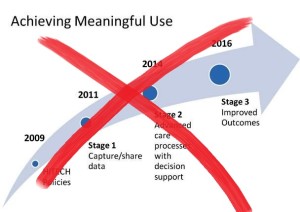
Some execs say easing off of the requirements will allow providers to focus more on innovation...Healthcare chief information officers breathed a sigh of relief on Tuesday when Andy Slavitt said the end of the meaningful use program was near. But many are waiting on the details before celebrating too much...The acting administrator of the Centers for Medicare and Medicaid Services Andy Slavitt said in a speech at the J.P. Morgan Healthcare Conference that meaningful use would be replaced with a more streamlined regulatory approach in line with the merit-based alternative payment models of the Medicare Access and CHIP Reauthorization Act of 2015...“The early stages of meaningful use took the country from ‘zero to 60' in five years, a remarkable achievement that would not have been possible without HITECH,”...“Now, it's time for the new payment model that rewards providers for achieving better health outcomes to be the driver of innovation, using the new electronic infrastructure that is now in place. That was the vision for ‘Phase 3’ from the very beginning.”..."It's truly unfortunate, but I'm not surprised,”...“The lack of alignment in Washington, varied interpretations by our industry and its vendors, and the resulting and inefficient ‘MU clicks,’ as termed and borne by our physicians have led down this path."...“The sad part of it all is that MU was designed with best intentions yet fated by regulation and political interests,”...
- Docket Alarm Launches Suite of Tools for Orange Book Litigators (prweb.com)Orange Book (fda.gov)

Docket Alarm’s new suite of tools has components that help give Orange Book litigators a competitive edge…the first legal research platform to provide Orange Book litigators a suite of tools for their practice. The features include the ability to track changes to the Orange Book and related litigation, search correspondence between drug companies and the FDA, and analytics on Orange Book cases in the Patent Trial and Appeal Board…The "Orange Book,"…is the authoritative resource on FDA approved drugs for patent litigators. When a drug company wins FDA approval for a new drug, they submit an Orange Book listing detailing applicable patents covering the new drug and the drug’s labeling. Generic drug manufacturers engage in patent litigation with the branded company over whether the patents listed in the Orange Book are valid and properly cover the corresponding drug.
- Your health records are supposed to be private. They aren’t. (washingtonpost.com)
The federal law that protects health information is violated often and easily, and it's hardly ever enforced...After spending the past year reporting on loopholes and lax enforcement of the Health Insurance Portability and Accountability Act, the federal patient-privacy law known as HIPAA, I’ve come to realize that it’s not just celebrity patients who are at risk. We all are...I’ve talked to hundreds of people who say their medical records were hacked, snooped in, shared or stolen...In each story, a common theme emerged: HIPAA wasn’t working the way we expect. And the agency charged with enforcing it, the HHS office for civil rights, wasn’t taking aggressive action against those who violated the law...We all know HIPAA... It’s what requires us to stand behind a line, away from other customers, at the pharmacy counter or when checking in at the doctor’s office...It is used to scare health-care workers, telling them that if they improperly disclose others’ information, they could pay a steep fine or even go to jail...But in reality, it is a toothless tiger...And even though the civil rights office can impose large fines, it rarely does: It received nearly 18,000 complaints in 2014 but took only six formal actions that year. A recent report from the HHS inspector general said the office wasn’t keeping track of repeat offenders, much less doing anything about them...Making matters worse, HIPAA does not allow patients to sue health providers for damages if they violate the law. So if the federal government doesn’t enforce the law, there are often no consequences for breaking it...Moreover, the government needs to write regulations to implement provisions of a 2009 law that would give patients whose privacy has been violated a share of the money HHS recovers. Finally, the government has yet to submit to Congress a report due in 2010 with recommendations for how to deal with the privacy of health information not covered by HIPAA.
- Medical publishers eye new ad viewability rules (mmm-online.com)
The Association of Medical Media plans to hold a meeting to establish an industrywide viewability standard...A group of medical publishers will attempt to develop a new industry standard for digital advertising viewability, a much debated topic that has vexed the broader advertising industry...Viewability—how long is long enough for a user to have viewed a digital ad successfully—has cropped up in recent years as one of the more challenging media issues, and one that needs to be addressed as the business of digital advertising matures. In healthcare, experts say, it's no different..."There's more pressure to account for dollars,"...The group's perspective is that professional medical content differs from other online advertisers..."It is distinguished from general web content in many ways, including in its scarcity and its value to the end reader...industry experts have been saying that drugmakers will likely put more emphasis on digital advertising as brand marketing becomes more targeted to certain patient populations and manufacturers lose direct access to physicians and other prescribers. That could expose more advertisers to the vagueness of viewability and highlight the need to find a solution that makes sense given the nuances of medical advertising, notably content aimed at healthcare providers.
- HHS And CVS Health Partner To Promote Consumer-Centered Preventive Services (healthaffairs.org)

The Department of Health and Human Services’ Office of Disease Prevention and Health Promotion and CVS Health recently formed a public-private partnership. This partnership aims to increase awareness of the availability of convenient, consumer-centered, recommended preventive services using healthfinder.gov. Healthfinder.gov is a source of easy-to-use prevention and wellness information, designed using health literacy and usability principles...CVS Health, recognizing the important role of informing and engaging patients about preventive care...integrated the myhealthfinder API into the MinuteClinic website in a pilot project conducted jointly with the healthfinder.gov team at the ODPHP...we expect individuals to become more informed and active consumers of clinical preventive services...To extend the reach of federal programs that improve health literacy, and encourage prevention and healthy behaviors...the HHS and CVS Health collaboration could be a model for other retail clinics…Because of retail pharmacies’ consumer and convenience focus, and their important role in connecting patients to and sustaining their relationships with primary physicians, retail pharmacies add valuable perspective and insight to the assessment of preventive care.
- Online Tool Compares Healthcare Stats Across Nevada (kunr.org)Nevada Instant Atlas, Nevada's County-Level Health Database (medicine.nevada.edu)

A new online tool is offering healthcare data that's broken down for each Nevada county. Reno Public Radio's Michelle Billman reports the database provides snapshots on how different counties compare on everything from their healthcare workforce to how many of their residents have health insurance…The project is called the Nevada Instant Atlas and it looks at healthcare indicators, including population demographics like income. It also profiles the overall health of people in a given area, along with their access, or lack of access, to medical specialists.
- FDA Takes Action Against Medical Device Hacking (newsmax.com)Postmarket Management of Cybersecurity in Medical Devices (fda.gov)

Food and Drug Administration on Friday issued draft guidelines to medical device makers on how to protect patients from cybersecurity vulnerabilities in the devices...Cybersecurity threats to medical devices are a growing concern...The exploitation of cybersecurity vulnerabilities presents a potential risk to the safety and effectiveness of medical devices...The draft guidance, which is not legally binding, recommends companies take a number of actions, including monitoring and assessing risk, adopting a coordinated vulnerability disclosure policy, and taking measures to address cybersecurity risk early.
- IBM’s Watson scores deals in fitness, medical and robotics (news.investors.com)

Virginia Rometty, IBM (left), Kenichi Yoshida, SoftBank Robotics, and Pepper the humanoid robot
IBM's cognitive computing system, Watson, has graduated from winning "Jeopardy" to predicting hypoglycemic events for diabetes patients and providing the brains for a customer service robot…IBM CEO Ginni Rometty discussed three partnerships involving IBM's Watson during her keynote speech at CES 2016 (Consumer Electronics Show ) on Wednesday in Las Vegas…Rometty talked about how Medtronic, Under Armour and SoftBank Robotics are using Watson's big data analytics capabilities in vastly different ways.
- Medtronic…is using Watson technology for diabetes management. In a new app rolling out this summer, medical technology firm Medtronic will track a diabetes patient's blood-sugar levels and predict life-threatening hypoglycemic events up to three hours in advance of symptoms.
- Under Armour…hooked up to IBM's Watson because he wanted his customers to get more meaningful data-backed health and fitness insights…The company's UA Record app will provide athletes with timely, evidence-based coaching around their sleep, fitness, activity and nutrition, including outcomes achieved based on others "like you."
- Watson also is providing artificial intelligence for a social humanoid robot called Pepper from SoftBank Robotics. Pepper currently is being used as a customer service robot in a limited number of Mizuho Financial Group's bank branches and Nestle coffee shops in Japan.
- Pathway Genomics unveiled a test version of the Pathway Genomics OME app, powered by Watson. The app merges cognitive computing and deep learning with precision medicine and genetics to enable Pathway Genomics to provide consumers with personalized wellness information...
- Data Breaches In Healthcare Totaled Over 112 Million Records In 2015 (forbes.com)Top Pharmacy Chains Revealed as Repeat HIPAA Violators (pharmacytimes.com)
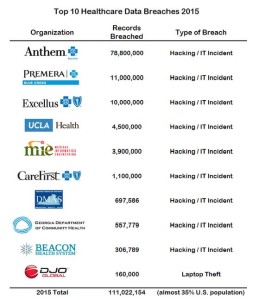
Healthcare’s “wall-of-shame” for 2015 officially ends tonight at midnight. It’s not really a “wall,” it’s just a website, but it’s the online mechanism for the Office of Civil Rights under Health and Human Services to publish data breaches as reported to them and required by HIPAA. The numbers this year are just staggering...According to OCR, there were 253 healthcare breaches that affected 500 individuals or more with a combined loss of over 112 million records...The Top 10 data breaches alone accounted for just over 111 million records that were lost, stolen or inappropriately disclosed...A recent data breach study estimates that breaches cost the healthcare industry about $5.6 billion annually. As healthcare moves toward connected care, the amount of data exchanged between organizations will only grow. So what does this mean? It means that in 2016, we’re going to see a huge movement towards encryption in hospitals and other healthcare facilities in order to protect EHRs and other vulnerable PHI...Healthcare IT security will continue to fall further and further behind the rest of the industry verticals despite the increase in spending on technology and human resources. The industry is focusing on functionality for patient care and security is an afterthought. Many organizations are also overly dependent on antiquated hardware and software...I wish we could look back on 2015 as the year that healthcare took data security and patient privacy more seriously...In a data-driven world, medical information is just too lucrative and too easy to steal at scale. As long as that’s the case...we should reasonably expect more of the same for 2016.