
- 3 people to watch in biotech and drug pricing in 2016 (statnews.com)

Big valuations, big investments, and big price tags drove lots of the news in health care in 2015 — and you can bet they’ll do the same in the new year. For signs of where things are headed, keep an eye on these three influencers:
- Jeffrey Marrazzo, chief executive of Spark Therapeutics - Can gene therapy work — and can the system afford to pay for it?...The idea that a one-time treatment could replace a broken gene has generated plenty of scientific and commercial interest.
- Deborah DiSanzo, general manager of Watson Health - IBM’s big bet on health care analytics...use high-powered computing to sift through massive amounts of data to find useful and cost-saving nuggets for medical researchers, doctors, and insurers.
- Vivek Ramaswamy, chief executive of Axovant Sciences - has recruited some top Alzheimer’s researchers to join his...company...they initiated a late-stage clinical trial testing the GSK reject in combination with another Alzheimer’s drug.
- Push Is On for Medical Records Transparency (realclearhealth.com)Foundations Unite to Support Access to Clinical Notes for 50 Million Patients Nationwide (opennotes.org)

Perched on an exam table at the doctor’s office watching the clinician type details about their medical problems into their file, what patient hasn’t wondered exactly what the doctor is writing? As many as 50 million patients may have a chance to find out in the next few years, following the announcement this week of $10 million in new grants to expand the OpenNotes project, which works with medical providers to expand patient access to clinician notes...OpenNotes started in 2010 as a research project to examine what would happen if patients had easy access to their doctor’s visit notes, which may include a summary of their conversation, the symptoms patients describe and their doctor’s findings from a physical exam. Although patients have a legal right to their medical records, getting those documents is often difficult and expensive...Our goal is basically to make fully transparent medical records the standard of care across the country...The project works with providers, patient groups and electronic health record vendors, among others, to encourage the use of OpenNotes, and evaluates the impact of OpenNotes on health outcomes and costs...In addition to improving communication between patients and their providers, some research suggests OpenNotes may improve patients’ ability to stick with their medication regimens...
- FDA launches Web-based precision medicine platform for next-generation sequencing (healthcareitnews.com)FDA Launches precisionFDA to Harness the Power of Scientific Collaboration (blogs.fda.gov)

Food and Drug Administration...launched the beta version of precisionFDA, its new collaborative platform for the exploration of next-generation gene sequencing...First announced in August, the platform features more than 20 public and private sector participants…Next-generation sequencing enables researchers to compile a vast amount of data on a person's exact order or sequence of DNA...scientists can look for meaningful differences in DNA that can be used to suggest a person's risk of disease, possible response to treatment and assess their current state of health. Ultimately, what we learn about these differences could be used to design a treatment tailored to a specific individual...The hope is to grow this community and improve the usability of precisionFDA in the coming months and years...One way we'll achieve that is by placing the code for the precisionFDA portal on the world's largest open source software repository, GitHub, so the community can further enhance precisionFDA's features...
- 5 things to know about CMS’ mandatory bundled payment program (healthcareitnews.com)
CMS announced the first mandatory test of shared-risk, outcomes-based payment model and the first initiative to make hospitals financially-responsible for patient recovery, 90-days after a knee or hip replacement surgery…The landmark program, Comprehensive Care for Joint Replacement, goes into effect April 1, 2016. Patient engagement and care coordination technology will be key to helping hospitals meet cost containment requirements…can lead to lower costs and increased healthcare quality…Healthcare institutions and leaders should know five items to move forward into the coordinated care initiative:
- 789 hospitals will be impacted
- 500,000 patients can participate, annually
- Quality matters. Hospitals must adhere to strict quality metrics and keep down care costs from admissions to 90 days after discharge
- Hospitals can donate $1,000 per Medicare beneficiary for patient engagement IT and services
- CMS will provide incentives for Patient Reported Outcomes
- FDA still seems reluctant to regulate mobile health apps (medcitynews.com)
Remember when the Food and Drug Administration was going to regulate mobile health apps? The year was 2013...There was even a bill from the congressman representing Silicon Valley that aimed to tame the “Wild West” of mobile and wireless health. The House Energy and Commerce Committee even held three...days of hearings...Rep. Mike Burgess asking then-national health IT coordinator Dr. Farzad Mostashari to magically create interoperability...Now, it sounds like the FDA might almost be ready to throw its hands up and walk away...the agency circulated a draft guidance that really didn’t say much...The 2013 final version clarified policy a bit, stating that the FDA generally would focus only on mobile apps that serve as medical devices, and mostly stay away from regulating consumer technology...Earlier this year, an FDA specialist in digital health told Bloomberg that the agency would be “almost hands-off” when it comes to consumer wellness and fitness gadgets...
- EHR use a ‘frustrating’ time suck, physicians tell American Medical Association (healthcareitnews.com)Providers press for delay, flexibility in EHR rule (modernhealthcare.com)

...more physician groups are making the case that stringent regulations and suboptimal technology have left physicians spending too much time grappling with their electronic health records...It's not that physicians are against health IT. In fact, most have adopted technology "at a blistering pace,"...But unrealistic and uncoordinated requirements are overburdening physicians' time and affecting the quality of patient care...AMA published a list titled "How EHRs tied up physician time in 2015."...EHR technology continues to underwhelm...Meaningful use is outliving its usefulness...Physicians are talking back -- and being heard...the Association of American Physicians and Surgeons also put out a strongly worded complaint this week, charging that EHRs could "crash" the U.S. healthcare system..."EHRs are supposed to be a cure-all for inefficiency and medical errors,"..."But the costly, clunky systems the government demands are worsening the problems and even driving some software experts back to paper."..."It's a major distraction from face-to-face patient care and interaction, thereby increasing the chance of missing important information, and in the end, increasing the probability of clinical and treatment errors,"..."The federal government should have no role in telling how physicians how to keep their records,"...
- Make Doctor’s Licenses Like Driver’s Licenses? Medical Groups Say No (realclearhealth.com)

A doctor licensed in one state who wants to practice in another still needs a license from the other state. That’s a costly and time-consuming process, especially in an era when many health plans and their employees operate across state lines and the use of telemedicine, in which patients and their providers interact from a distance, is growing...But the state licensing situation for doctors...is starting to change...Doctors...are creating their own multistate compact...it will provide an expedited application process to get licenses in other states...The main obstacle to portability for all the professions is that they are regulated by the states, each of which is free to demand its own qualifications — and collect its own fees — for licensing. To achieve portability, states either have to standardize their licensing requirements or agree to live with the differences, so long as there are some baseline qualifications accepted by all...doctors have created a compact that the Federation of State Medical Boards says will offer an expedited and cheaper process for getting a license to practice in member states. So far, 11 states have joined the compact, with nearly an equal number expected to join next year. Telemedicine advocates and doctors who use telemedicine say the doctors’ portability model, which still requires full licensure in every state, will impede the spread of telemedicine, particularly in rural areas that have a shortage of doctors.
- New FDA policy gives its staff wide latitude on social media. Could pharma freedom follow? (fiercepharmamarketing.com)

Tweet at will, FDA employees. One of the most liberal social media policies in the federal government now belongs to the FDA. Just last month, the FDA finally set out its own departmental policy that encourages its scientists and other employees to use "social media technologies to enhance communication, collaboration, and information exchange in support of FDA's mission to protect and promote public health."...While many would argue that the guidelines for pharma and other medical regulated products on social media outlined so far by the FDA have had a chilling effect on the industry's social media use, especially Twitter, its own FDA employee guidelines should have quite the opposite effect...
- Lack of cyber security draws hackers to hospital devices (ft.com)

Imagine if simply typing “password123” into a computer did not open your email account, but an internet-connected medical device responsible for feeding you drugs or monitoring your blood oxygen or insulin levels...It may sound like the nightmare stuff of fiction, but the lack of basic cyber security on hospital equipment is attracting hackers who want to use them as a way to enter medical networks...Experts say that while they have not yet seen someone die as a result of hacking, the risks are growing...Motives for attacks could range from wanting to harvest patient information or stealing intellectual property from medical trials to simply wanting to create chaos...Devices with default passwords that are left unchanged, and outdated operating systems that are connected to the network, such as medical databases, are all too common in healthcare...Each provider needs to carefully examine for themselves what types of risk are being brought in by new devices. They will have to give careful consideration to making sure they are kept up to date, behind firewalls and in networks segmented off from key medical and personnel data…
- 9 organizations urge Congress to oppose delay of Stage 3 (healthcareitnews.com)
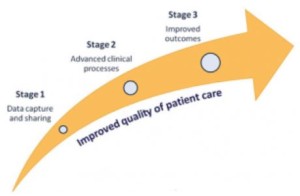
Health IT Now, along with eight other organizations…are calling on Congress to stay the course on Stage 3 of the Meaningful Use EHR Incentive Program…Health IT Now describes itself as a broad-based coalition of patient groups, provider organizations, employers and payers…The coalition, along with eight other organizations made their pleas in a…letter…"We write to urge you to oppose any legislative changes to the meaningful use program, including delays in the timing of Stage 3, that do not also include reforms to improve the interoperable use of health information technology,"…"Delay without reform would rob taxpayers and patients of cost savings while doing absolutely nothing to make the program work well for overburdened doctors and hospitals."…The American Medical Association and 111 other national and state medical societies called for delay of Stage 3 in an earlier letter to leadership...