
- Two-factor authentication on the rise, small hospitals fall short, ONC says (healthcareitnews.com)
Only half of small urban hospitals have two-factor authentication capability…Fewer than half of U.S. hospitals support an infrastructure capable of two-factor authentication, The Office of the National Coordinator for Health IT reported…while 35 percent of critical access hospitals and 40 percent of small rural hospitals report the lowest levels of capability…Two-factor authentication requires users to give at least one other form of identification beyond username and password to get access to electronically protected information, such as a PIN and fingerprint or voice recognition…The process is a low-cost, effective way to meet HIPAA standards, but not enough hospitals have implemented it into their cybersecurity plans…cybersecurity experts assert reported levels of adoption are still drastically low, given the steady rise in healthcare data breaches and the increase in hackers targeting the healthcare industry…Some states are above the bar on establishing two-factor authentication. Ohio raked at the top with 93 percent adoption..Vermont, with 83 percent…Delaware, with 81 percent…On the other hand, Montana, with 19 percent, North Dakota, with 23 percent, and Maine, with 26 percent, saw the lowest percentages…
- Doctors’ use of computers during appointments leaves patients less satisfied (reuters.com)
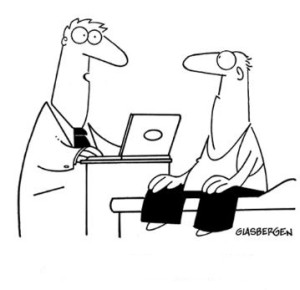
"Doctor and physician are outdated terms. I'm your biological tech support specialist."
Doctors who entered data into computerized health records during patients' appointments did less positive communicating, and patients rated their care excellent less often…Many clinicians worry that electronic health records keep them from connecting with their patients…doctors who used the computer more also spent more time correcting or disagreeing with patients…Doctors who spent more time using the computer spent less time making eye contact with patients and tended to engage in more “negative rapport building,” correcting patients about their medical history or drugs they’ve taken based on information in the electronic record…That’s not necessarily a bad thing…Doctors who spend most of the time looking at the computer may miss out on an emotional connection with the patient…When people are paying attention to the same thing at the same time, you get the best transmission of information… Electronic health records need to be more usable so clinicians with varying computer proficiency can use them without struggling and diverting focus from patients…
- How Pharmacists Can Encourage Prescribers to Adopt E-Prescribing (pharmacytimes.com)Getting Started with EPCS (getepcs.com)

Ken Whittemore Jr, Surescript's senior vice president of professional and regulatory affairs, talks about some ways independent pharmacists could encourage local prescribers to adopt e-prescribing of controlled substances.
- Want to win on pricing? Take a closer look at the numbers (fiercepharmamarketing.com)

Controversy surrounding drug pricing has reached an all-time high…So what's a drugmaker to do? Take a hard look at the data…Higher prices often attract lower-cost competitors and eliminate the short-term price increase benefit…public backlash to price hikes can trigger executive firings and other actions that impact the market…"While price hikes often represent both the recouping of historical investments and funding investments in new research to develop better treatments, companies should not descend into opportunistic 'price gouging,"…Leveraging pricing data can make a big difference in helping drugmakers stay abreast of the competition, especially for companies with off-patent products…Companies can use pricing data to gauge threats from generics or biosimilars, and identify trends in therapeutic areas or even specific indications. They can borrow from rivals' price-negotiation strategies to make the best case for their own meds. "If companies are able to actively and effectively analyze the trends and see how the market reacts, they'll be in a lot better position moving forward,"…
- Google’s next big idea: Mining health data to prevent disease (statnews.com)

Dr. Jessica Mega, Medical Director of Google Life Sciences
Dr. Jessica Mega…medical director of Google Life Sciences…to lead the new firm’s ambitious quest to analyze genomic, molecular, and imaging big data from 10,000 volunteers to figure out what it means to be healthy — the so-called baseline study…Its experts try to turn blue-sky ideas into products by cross-pollinating medicine, engineering, and data science…I’m normally around physicians and patients. Now I spend my days with amazing engineers. The things you hear around here are “try to fail fast,” and “let’s just try ideas.” What I’ve taught myself to do is first say “yes” and try to be very open, then get analytical and move to a point where we’re being strategic and tactical…The way I think about it is trying to understand more about a given individual so they get the right treatment, get the right medications, and avoid the side effects. We’re trying to figure out ways to help empower people so that they don’t need to spend as much time in hospitals…People don’t want a lot of unnecessary, expensive, cumbersome, inaccurate tests. But we’re working to come up with things that provide actionable information.
- Easy on those apps: Mobile medical apps gain support, but many lack clinical evidence (modernhealthcare.com)
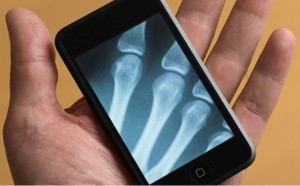
Mobile medical applications increasingly are being used by patients and consumers. Now healthcare providers are evaluating whether and how to work with their patients in tapping these apps. But they're proceeding cautiously because of the dearth of clinical evidence for many consumer apps, and because some developers may be misleading consumers by overstating their products' capabilities…I think we will be seeing an increase in scrutiny and enforcement by the FDA and the FTC…medical devices treading in the areas of diagnosis and treatment, for those I think we'll see increased enforcement...healthcare providers, a major factor driving that adoption is the shift to value-based payment, which creates a powerful incentive to keep patients healthier and reduce costs by avoiding unnecessary hospitalizations and emergency department use…As with the introduction of any new clinical-care process, there are safety issues…We're going from a situation where we had no data to one where we probably have more data than we need…mobile apps can offer clinical benefits, particularly when used in a structured healthcare program…Healthcare lawyers caution that providers run a variety of legal risks in using mobile apps with patients. “If the patient brings in a bunch of stuff, if you rely on it and it's wrong, it's a problem”…“But if you ignore it and it's right, it's a problem. You're damned if you do and damned if you don't.”
- Pharmacy Podcast – Pharmacy Cloud Accounting Technology – Sykes & Company (pharmacypodcast.com)
We are joined by independent pharmacy business accounting expert – Ollin Sykes founder of Sykes & Company, P.A. (podcast 21:45 min)
- 7 cyber threats worse than PHI breaches (healthcareitnews.com)

Healthcare IT security: you have a bad reputation. When it gets down to healthcare there’s always a little chuckle about how bad they are…This year was among the worst in cybersecurity across the healthcare sector…On average, companies that got breached did not know it for 270 days and some had even been breached for seven years without knowing it…that two-thirds of those entities did not even discover the breach internally; it was pointed out to them, either by someone outside the organization or by the federal government...As bad as breaches are, however, there are other worse threats emerging that hospital CIOs, CISOs and IT departments should understand and prepare for.
- Ransomware
- DDoS (Distributed Denial of Services)
- Wiper attacks
- Intellectual property theft
- Straight theft of money
- Data manipulation
- Data destruction
- Apple Watch used to study epileptic seizures (baltimoresun.com)Johns Hopkins EpiWatch: App and Research Study (hopkinsmedicine.org)

For the 2.5 million people living with epilepsy… medications can help control their seizures — most of the time. But some suffer unpleasant side effects from the drugs. And a few remain at risk of death…Researchers at the Johns Hopkins University hope to help those with the neurological condition by collecting information about their seizures through their…Apple Watches…"Physicians often ask patients to record their seizures, but that can be hard, especially when a patient loses consciousness," said Dr. Gregory Krauss…who is working on the program, named EpiWatch…collects data that help researchers better understand epilepsy, while helping patients keep a more complete history of their seizures," he said…The data could not only help doctors adjust an individual's treatment to make it more effective and less burdensome, but could also help...counter sudden unexpected death, a danger some face from seizures.
- Apixio launches cognitive computing platform (healthcareitnews.com)

Apixio announced…the release of its new cognitive computing platform, Iris, which it says will bring advanced data insights to healthcare by extracting and analyzing medical data previously trapped in electronic health records…The U.S. annually produces 1.2 billion clinical care documents, but about 80 percent of the data is unstructured and difficult to access…"Making sense of unstructured healthcare data is extremely challenging and requires sophisticated technology like cognitive computing to make the information useful,"…Iris is meant to give healthcare institutions access to patient data to create a more accurate care profile, thus improving the quality and efficiency...