
- Boston Children’s, IBM Watson take on rare diseases (healthcareitnews.com)

‘Watson can help us ensure we’ve left no stone unturned in our search to diagnose and cure these rare diseases.’…IBM Watson and Boston Children's Hospital are taking on rare children's diseases that are hard to diagnose and treat. First up is a rare form of kidney disease…Their first project will focus on kidney disease. Watson will analyze the massive volumes of scientific literature and clinical databases on the Watson Health Cloud to match genetic mutations to diseases and help uncover insights that could help clinicians identify treatment options…IBM has been developing Watson's ability to analyze genomic data in collaboration with leading cancer centers around the world. The new project with Boston Children's represents the first time this technology will be applied to help clinicians efficiently identify possible options for rare disease diagnosis and treatment.
- OpenNotes shows success with medication adherence (healthcareitnews.com)OpenNotes patients and clinicians on the same page (myopennotes.org)

This is the first large-scale study to reveal how doctors' notes affect patients when it comes to taking their prescriptions…the OpenNotes initiative, first conceived at Beth Israel Deaconess Medical Center in Boston…The program directly connects patients to their physician's notes through an online portal…Encouraging patients to utilize a Web portal to view their doctors' notes is a cost-effective and efficient way to influence medication-taking behavior…reminding them to read them before visiting their doctor is key to reinforcing the doctors' rationale for prescribing specific medications and dosage…increasing patient access to fully transparent doctors' notes should be on the radar screen of all healthcare providers…
- A Tech Revolution Is Quietly Taking Place In Healthcare (realclearmarkets.com)

While policymakers, and the country, struggle over challenges facing and created by the Affordable Care Act, real healthcare reform is happening almost completely outside of that loop, driven by technology and innovators, many of whom are from outside the healthcare industry…Health IT or Digital Health-the generic terms used to describe these disruptions that include the use of mobile devices and telemedicine, among other changes-are breaking almost every standard healthcare paradigm. It's that "creative destruction" that economists frequently refer to, transforming how care is delivered, received, tracked, paid for and even understood…And unlike traditional healthcare, where the more money you have the more healthcare your get, the health IT revolution largely ignores those barriers. That's because the poor have mobile devices in almost similar numbers to the rich.
- Surescripts taps Kno2 platform for clinical info exchange (drugstorenews.com)

Kno2…announced that Surescripts had selected the company’s platform to connect health technology vendors and their users, allowing them to exchange information through Surescripts’ Clinical Direct Messaging…Kno2's platform makes any documents interoperable, allowing clinical documents move between different health care professionals and vendors. Additionally, the company makes APIs available to vendors who want to connect to Surescripts’ network, which can reduce costs associated with implementing direct messaging and getting Electronic Health Record certification. Kno2 also streamlines the process of verifying identities for providers, which takes that responsibility off of vendors.
- Current and Future Estimates of E-Prescribing Use (pharmacytimes.com)
Ken Whittemore Jr, Surescript's senior vice president of professional and regulatory affairs, shares information on the current and future estimates of e-prescribing use.
- Blog: Texas docs plead for relief from ‘meaningless abuse’ (modernhealthcare.com)EHR State of Mind - ZDoggMD (letdoctorsbedoctors.com)

Texas Medical Association wants Congress to intervene and make changes to the federal electronic health-record incentive payment program it's calling "meaningless abuse."…The group says Stage 3 of the program meant to get physicians using EHRs could jeopardize Medicare doc payment rules… wants Congress to lift what it's describing as the $31.6 billion program's “convoluted and tedious” meaningful-use requirements…TMA President Dr. Tom Garcia asked legislators to co-sponsor two bills to alter the meaningful-use landscape…One is the Flex-IT 2 Act...which would delay Stage 3 meaningful-use rules until at least Jan. 1, 2017. The other is the Transparent Ratings on Usability and Security to Transform Information Technology, or TRUST IT Act which is aimed at ensuring health IT systems perform better in the field.
- Benefits of E-Prescribing Over Traditional Prescriptions (pharmacytimes.com)
Ken Whittemore Jr, Surescript's senior vice president of professional and regulatory affairs, discusses some of the ways in which e-prescribing trumps traditional prescriptions. (video)
- Walgreens goes to Epic for EHR (healthcareitnews.com)

Work to begin in early 2016…Walgreens is poised to roll out Epic EHRs (Care Everywhere) in its more than 400 healthcare clinics across the country…The Epic platform will replace Walgreens' own proprietary EHR…The goal…is to...enable more seamless communication with health systems and local providers, and gives us enhanced capabilities to deliver better health outcomes through greater care coordination and interoperability…our clinics play an increasingly important role in healthcare, supporting the healthcare system, provider practices and patients' medical homes, care coordination can be critical. This will benefit our patients, clinic providers and partners, and serves as an instrumental part of our strategic growth plan…
- The Current State of Electronic Prior Authorization in the US (ajmc.com)National adoption Scorecard Electronic Prior Authorization (ePA) (epascorecard.covermymeds.com)
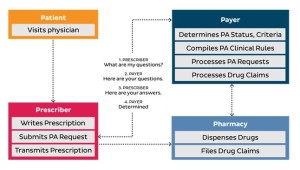
A majority of pharmacies have publicly announced that they are committed to implementing an electronic prior authorization solution that sends prior authorization requests electronically to the prescriber…70% of EHR systems…are committed to ePA. Eighty-seven percent of payers…are committed to ePA…CVS/pharmacy is the last major chain not yet committed to an ePA…many independent pharmacies have access to ePA functionality through pharmacy systems, most of which have live, integrated ePA capabilities…Prior authorization legislation has been considered, and in some states is in effect…Currently, 23 states have passed legislation pertaining to PA, and 4 additional states have pending legislation. The legislation seeks to make the PA submission process faster and easier for providers to prevent the delay of patient treatment…there is no federal direction on PA, so each state is on its own with respect to creating and enacting PA legislation...
- Technology leads hospital expenditures (healthcareitnews.com)
Hospitals are continuing to make big investments in technology as they recognize the need to effectively manage population health, according to C-suite execs polled for Premier's Fall 2015 Economic Outlook survey…More than 64 percent of respondents reported an increase to capital budgets this year, reflecting the need for investments in advanced technology to meet value-based care goals…39 percent of these respondents increased their budgets by at least 10 percent…The biggest investment for hospital expenditures is on health information technology, according to 72.2 percent of respondents to the survey…"Investments in HIT, data analytics and modern clinical infrastructure are foundational for providers to seamlessly deliver population health services across their inpatient, outpatient and alternative care sites,"…