
- Four Takeaways on Drug Spending Realities from the New 2015 Express Scripts Drug Trend Report (drugchannels.net)Express Scripts 2015 Drug Trend Report (lwlink3.linkwithin.com)
Last week, Express Scripts released its new 2015 Drug Trend Report...For the first time, the Express Scripts data account for rebates—a meaningful and welcome improvement in reporting methodology. After accounting for rebates, the 2015 report reveals that drug spending growth is comparable to growth in other parts of the healthcare system. For some payers, utilization (script growth) was a bigger driver of spending than drug prices...So much for the myth of exploding drug costs! Our politicians may not believe it, but Martin Shkreli et al. are the exception in the pharmaceutical industry. Below, I review the four key highlights about traditional and specialty drug spending, trend patterns for different payers, and a red flag from upcoming biosimilar launches.
FOUR TAKEAWAYS
- Commercial payers were better able to control costs.
- More people are getting access, which is “good” spending.
- Specialty growth continues.
- Hunker down for the biosimilar formulary wars.
- WHO suspends TB drugs from big India supplier on quality fears (reuters.com)

World Health Organization has suspended the approval of tuberculosis drugs made by India's Svizera Labs, a major supplier to developing countries, following an investigation into standards...The United Nations agency, which acts as a drug watchdog in markets lacking robust local regulation, said on Friday it had suspended all TB products made at Svizera's Mumbai site because manufacturing standards and quality management were unreliable...It also said independent experts should retest batches of medicine already on the market and it might be necessary to recall supplies, depending on the outcome of those tests...The move is a fresh blow for India's pharmaceuticals industry, which supplies cheap generic medicines to countries worldwide but has been tarnished by a series of quality problems in recent years, denting confidence in its products...The WHO plays a critical role in monitoring drug quality in poorer countries through its Prequalification of Medicines Program, which ensures that treatments supplied by U.N. agencies such as UNICEF are of acceptable quality.
- How Medicare Part B ‘Value-Based Pricing’ Would Work (realclearhealth.com)Obama proposal to revamp Medicare Part B faces more opposition (statnews.com)
...Centers for Medicare & Medicaid Services spends $20 billion a year for drugs under Part B, which are those given in doctors’ offices and hospital outpatient centers. Many cancer treatments are provided that way, as are some treatments for rheumatoid arthritis, macular degeneration...Under a proposed rule, different methods would be tried in selected geographic areas over a five-year test period. Some of these experiments would begin this year, with others added in 2017...Dubbed "value-based pricing," such largely unproven ideas are the latest tactics being tried to slow growth in prescription drug spending amid rising public alarm about drug prices...The goal is to test whether alternative approaches will lead to better value...There is no perfect payment system, they all have upsides and downsides...What we don’t want to do is create a world where doctors only prescribe the cheapest stuff even if not in the interest of the patient...Here are four concepts the government is investigating:
- Cut drug reimbursements for doctors and outpatient hospital centers.
- Level payments.
- Tie payments to effectiveness.
- Cut patients’ out-of-pocket costs.
- FDA warns India’s Emcure Pharma, cites repeated data fudging at plant (reuters.com)

Food and Drug Administration has warned Indian generic drugmaker Emcure Pharmaceuticals, saying it repeatedly fudged test records at its plant in western India, in another case of a pharmaceutical firm in the country facing such action...the FDA...found "significant violations" of standard manufacturing practices...The agency had already banned imports from the plant...except for some drugs...It is one of 42 drug-making factories in India that the FDA has banned in recent years as it stepped up inspections of foreign suppliers. The increased scrutiny has hit growth at Indian companies the hardest, as the country supplies nearly 40 percent of the medicines sold in the United Stares...We observed multiple examples of incomplete, inaccurate, or falsified laboratory records...The fabricated records were of tests that Emcure was required to conduct to ensure proper environmental control was maintained while aseptic filling of drug batches, so that the products wouldn't become contaminated...The company has 15 days to respond to the FDA's letter on the corrective actions it will take on the concerns raised.
- Health insurer Anthem sues Express Scripts over drug pricing (reuters.com)
...Anthem Inc said it had sued pharmacy benefit manager Express Scripts Holding Co to recover damages from drug pricing it believes was too high...latest development in a months-long dispute over Anthem's contract with Express Scripts...The lawsuit also seeks to recover damages from operational issues and for a declaration of Anthem's right to terminate its contract with Express Scripts…Anthem, which has been seeking $3 billion in annual cost savings through a repricing provision in its 10-year contract with Express Scripts, said it had not yet decided whether to end the contract...The latest news has taken a very unhealthy turn and we see it unlikely that Anthem renews its contract with Express Scripts past 2019, and is likely to leave sooner to the extent it can manage the transition for consumers smoothly...Express Scripts...said in a statement that it believed the lawsuit to be without merit. The company has consistently acted in good faith and in accordance with the terms of its agreement with Anthem…
- Doctors taking a shine to biosimilars as they get experience with them (fiercepharma.com)

Three years ago, doctors in Europe displayed grave doubts about using biosimilars instead of branded biologics on their patients. But after a couple of years of experience with a biosimilar of Merck's Remicade (infliximab) from Hospira and Celltrion, a new report finds doctors are much more responsive to the biologic copies...The survey of European Crohn's and Colitis Organization members was released Friday at ECCO's 11th Congress in Amsterdam. It found that 44.4% of physicians taking the survey considered the Remicade biosimilar, a mAb, interchangeable with the original product...The key advantage of using biosimilars is to save money...while...their key concern with using them is immunogenicity...The survey results are potentially promising for drugmakers taking biosimilars to the U.S. market which is just now opening up but offers the biggest payoff. Citigroup analysts estimate innovative biologics will lose $110 billion in sales to copycats by 2025.
- Bearish case for Valeant (video.cnbc.com)Five Lessons Big Pharma Should Learn From Valeant's Collapse (forbes.com)The Trouble With Female Libido Pill Is a Symptom of Valeant Woes (bloomberg.com)
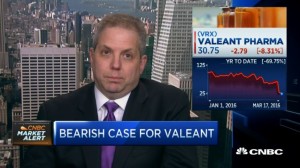
Les Funtleyder, Asset Management Portfolio Manager at ESquared, gives his take on Valeant Pharmaceuticals and the pharma and health care sectors.
- Illicit drugs? How Brexit risks legal limbo for medicines (reuters.com)
A British vote to leave the European Union would threaten some prescription medicines with regulatory limbo, posing a legal headache for drugmakers, according to lawyers and industry officials...The highly regulated pharmaceutical sector has more at stake than most from a so-called Brexit, prompting top manufacturers GlaxoSmithKline and AstraZeneca, both of which oppose exit, to draw up detailed contingency plans...Currently, under EU rules, drugmakers launching a medicine get a single marketing approval that allows them to tap the entire European market of 500 million potential patients...In the event of a British exit, UK firms could no longer apply for or hold EU marketing authorizations, unless or until the UK negotiated to be part of the EEA. Licences would have to be transferred to businesses inside remaining member states..."The potential complexities around such issues as marketing authorization simply highlight the problems that could be faced by companies and patients alike in the event of exiting the EU,"...GlaxoSmithKline said leaving the EU would create uncertainty, add complexity and making some short-term disruption likely...
- Pricing Power – Big pharmacies are dismantling the industry that keeps US drug costs even sort-of under control (qz.com)
When US lawmakers convened a hearing last month to discuss the pricing of prescription drugs, it was the testimony of Martin Shkreli...that garnered the headlines. But the hearing also looked at an issue that...could make drugs more expensive for far more people…The impetus was October’s announcement from Walgreens...that it was buying Rite Aid...Critics said that would create a drugstore duopoly with CVS, the market leader. They didn’t, however, look as hard at another effect of the deal, which likely will bring about the final collapse of the industry tasked with keeping prescription-drug costs under control...Buried inside Rite Aid is a bundle of pharmacy benefit managers...Walgreens says that acquiring Rite Aid’s PBMs would help it compete with arch-rival CVS, which controls a large and extremely profitable PBM called Caremark...combining pharmacies and PBMs under one roof creates a conflict of interest. It can restrict patients’ access to certain prescription drugs, and can prevent independent drugstores from competing fairly for new customers...As "competition decreases,"..."prices are going to increase. That’s what we’re finding now." If Walgreens successfully acquires Rite Aid and its PBMs, one of the industry’s last remaining constraints on drug prices will disappear.
- Amgen Bests Regeneron in Patent Fight Over Cholesterol Drugs (bloomberg.com)

Amgen Inc. won a legal victory over Regeneron Pharmaceuticals Inc. in an intellectual property battle over their cholesterol-reducing drugs. Regeneron said it would appeal the decision...A federal jury...rejected Regeneron’s challenges and ruled in Amgen’s favor that two of its patents on its drug, Repatha (evolocumab), were valid...Sanofi and Regeneron said after the verdict that they plan to appeal, reiterating their position that Amgen’s patent claims are invalid. They had claimed that Amgen hasn’t fulfilled requirements to describe clearly what it had invented in a way that others could understand...Amgen...is thankful that the jury weighed the evidence carefully and recognized the validity of Amgen’s patents on Repatha...With the decision, Regeneron and Sanofi are liable for royalties...The companies may reach a settlement with Amgen...