
- The Vernacular of Risk — Rethinking Direct-to-Consumer Advertising of Pharmaceuticals (nejm.org)
United States is the only country with a strong pharmaceutical regulatory infrastructure that allows direct-to-consumer advertising of prescription drugs in print, broadcast, and electronic media. U.S. consumers are accustomed to full-page ads in newspapers and magazines detailing a drug's benefits… That may soon change, however, as the Food and Drug Administration moves to enact new regulations regarding risk communication in DTCA…. responds to mounting research showing that reprinting highly technical package inserts in print ads does very little to communicate risks to consumers. The goal is to communicate those risks in a new vernacular.
- Drug Goes From $13.50 a Tablet to $750, Overnight (cnbc.com)
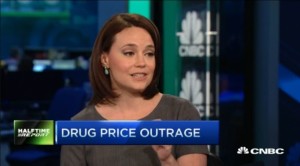
Specialists in infectious disease are protesting a gigantic overnight increase in the price of a…drug that is the standard of care for treating a life-threatening parasitic infection…Daraprim, was acquired in August by Turing Pharmaceuticals, a start-up run by a former hedge fund manager (Martin Shkreli). Turing immediately raised the price to $750 a tablet from $13.50,…price increase is not an isolated example… most of the attention on pharmaceutical prices has been on new drugs… there is also growing concern about huge price increases on older drugs, some of them generic,… some price increases…have resulted from a business strategy of buying old neglected drugs and turning them into high-priced specialty drugs.
- Who Falls Into the Medicare Donut Hole? (fool.com)

Medicare donut hole forces participants to face an expensive gap in coverage in their Part D prescription drug plans… the costs of prescription drugs covered by a plan get split up in various ways, depending on your total prescription costs for a given year… donut hole simply forced participants to pay these additional drug costs entirely on their own, causing huge financial stress… Affordable Care Act,…started to fill in the donut hole… Over time,..discounts will gradually rise…by 2020, participants will pay only 25% of the net cost of brand-name and generic prescription drugs.
- Australia’s new PM looks to biotech for a boom as mining-led growth wanes, WSJ says (fiercepharmaasia.com)
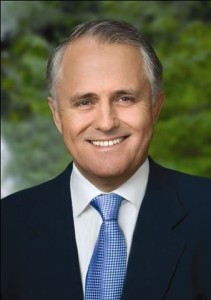
R&D tax incentives combined with a former investment banker as the country's new prime minister could see steady growth in biotech in Australia gain momentum,…Australia was ranked fourth globally for biotechnology innovation last year,..lags top player in biotech the U.S. by a wide margin…former Goldman Sachs banker Malcolm Turnbull as premier…portends a new push in the sector…I can see biotech and medical tech really transforming Australia..
- Bloomberg BNA Interviews IACP’s David Miller on DQSA (c.ymcdn.com)

In an extensive interview with Bloomberg BNA, IACP's (International Academy of Compounding Pharmacists)David G. Miller, RPh, Executive Vice President & CEO, discusses concerns over the Drug Quality & Security Act (DQSA), emphasizing the need for clarification over which regulatory authority is responsible for the oversight of compounding pharmacy.
- Why would Martin Shkreli hike an old drug price by 5000%? Only a ‘moron’ would ask (fiercebiotech.com)

Back when Martin Shkreli was CEO of Retrophin, he managed to grab a few headlines by buying an old rare-disease drug, Thiola, and raising the price 2000%. Now that he's on to his next company, Turing Pharmaceuticals, he's done himself one better, by buying another old drug and boosting the price 5000%....The drug is Daraprim, which Shkreli's Turing Pharmaceuticals bought a few weeks ago from Impax Laboratories…immediately hiked the price from $13.50 per pill to $750…. Shkreli's extreme sticker shock strategy on an ancient therapy, though, has become the kind of lightning rod for the controversial pricing issue that the industry will find it hard to defend against in the lead-up to a presidential election.
- Pharmacy, Digital Health, and Big-Pharma (pharmacypodcast.com)
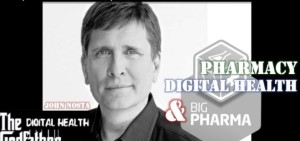
John Nosta – Digital Health Philosopher, with Nosta Lab returns to the Pharmacy Podcast Show to discuss Pharmacy, Digital Health, and Big Pharma. (32:55 minutes)
- SA police shut down three counterfeit drug making facilities in INTERPOL swoop (in-pharmatechnologist.com)
South African Police shut down three counterfeit drug making plants last weekend in an INTERPOL-co-ordinated operation that seized 150 tonnes of fake medicines…involved thousands of police and customs officials in Angola, Malawi, South Africa, Swaziland, Tanzania, Zambia and Zimbabwe who raided markets, shops, pharmacies and warehouses in addition to the three illicit plants…seized products were illicit and counterfeit antibiotics, painkillers, erectile dysfunction medicines, birth control and anti-malarial medication...Authorities arrested 550 people…also closed 20 illegal pharmacies where the fake drugs were sold.
- Biotech gets slammed (video.cnbc.com)
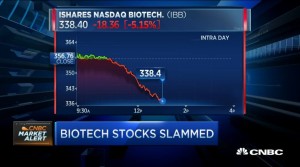
CNBC's Bertha Coombs reports on the hit to biotech stocks after Hillary Clinton's tweet criticizing drug price gouging.
- Data finally looks at antibiotics resistance in developing countries, and figures for India are scary (indianexpress.com)
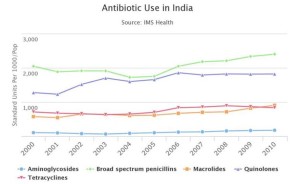
Researchers map dangerous trends in antibiotic resistance on a global scale for the first time; online mapping tool and new CDDEP report show perilous rise in drug-resistant infections and antibiotic use…the Center for Disease Dynamics, Economics & Policy have released new data documenting alarming rates of bacteria resistant to last-resort antibiotics that can lead to life-threatening infections…high rates in the low and middle-income countries like India, Kenya and Vietnam...In many countries, antibiotics are easily purchased in pharmacies and shops without prescription.