
- Eli Lilly clinical test results affect several pharma firms (cnbc.com)Eli Lilly's Good Cholesterol Drug Went Bad. Here's What That Means For Pharma (forbes.com)

Eli Lilly's plans to discontinue development of a cholesterol drug is likely to have ramifications that stretch beyond…to include several of its competitors, as well…Lilly shares dropped…after it said that its drug evacetrapib, one of a class of cholesterol drugs known as CETP inhibitors, showed a lack of effectiveness in clinical testing. Shares of Merck, another company that's developing a CETP cholesterol treatment, were also lower…"The fact that Lilly's drug today failed essentially on an efficacy issue suggests that the CETP class overall are not going to deliver the benefit…from an efficacy standpoint,"…"PCSK9 inhibitors are much more likely to generate much more upside."
- Sky-high price of new stem cell therapies is a growing concern (latimes.com)

…public uproar about high drug prices has focused on outlandish cases…Biotech companies have launched late-stage clinical trials that could lead to federal approval of two marketable treatments backed by CIRM (California Institute for Regenerative Medicine), the state's $6-billion stem cell program…they may also put CIRM smack in the middle of a burgeoning debate over how to ensure access for all patients to life-enhancing or life-saving cures…stem cell and other advanced biologic treatments will be among the most expensive therapies...Proposition 71, the 2004 ballot initiative…was pitched to the voting public as an economic bounty waiting to be reaped…healthcare cost savings to the state government of as much as $6.9 billion, and up to $18.4 billion in savings for private insurers and other payers. Such savings haven't materialized. CIRM also requires companies to share their income from drugs developed with the program's backing on a sliding scale based in part on the magnitude of the profits.
- Ohio prisons officials challenge FDA stand on execution drug (washingtonpost.com)
With two dozen scheduled executions in limbo, Ohio sent a forceful letter to Washington… asserting that the state believes it can obtain a lethal-injection drug from overseas without violating any laws…stopped short of suggesting Ohio is moving forward to obtain the powerful sedative sodium thiopental…the state asked to begin discussing with federal officials about acquiring the substance legally…FDA had warned Ohio in June that importing the restricted drug could be illegal…setting up the latest roadblock that Ohio and several other states have faced in carrying out the death penalty…States have struggled to obtain lethal injection drugs since pharmaceutical companies discontinued the medications they traditionally used or put them off limits for executions…"My sense is that the Food and Drug Administration…was never designed to create an additional impediment to states trying to carry out lawful sentences,"…
- F.D.A. Approval of OxyContin Use for Children Continues to Draw Scrutiny (nytimes.com)
Ever since the Food and Drug Administration approved the use of ...OxyContin for certain children…it has faced unabated criticism from lawmakers and public officials who are wrestling with devastating rates of prescription opioid abuse in their communities…. The crux of the issue is whether the agency’s approval will lead to more prescriptions for OxyContin in young patients. For years, the powerful long-acting drug has been prescribed off-label to…children in severe pain… agency’s approval means those doctors will finally have "information about how to do it appropriately," like dosage recommendations…"This approval allows Purdue Pharma to market and promote this product for use in children, and the obvious concern is this approval will change the pattern of use.".. postmarketing data could prove revelatory and useful..."It’s not a given, but it could help us better address the problem of prescription drug abuse in adolescents....
- More M&As expected to shake up retail Rx (chaindrugreview.com)

As much as the chain drug industry has consolidated, there is room for more mergers and acquisitions. That’s evident from the M&A speculation swirling about the sector in the U.S. and Canada...I believe that the American markets will go through a substantial wave of consolidation horizontally and vertically…we want to be part of this, at the right time with the right partner. We are open to any kind of combination which could improve the value of our company, and we are looking actively around us to understand which is the best option for us.
- Novartis buys another 2.5 percent in Israel’s Gamida Cell (reuters.com)

Swiss drugmaker Novartis will invest up to an extra $15 million in Gamida Cell, an Israeli developer of stem cell therapies…Novartis last year invested $35 million in the company for a 15 percent stake…$15 million investment will be used to advance Gamida Cell's clinical programs, including the development of NiCord, an experimental treatment for patients with high risk hematological malignancies, or blood cancers such as leukemia and lymphoma and sickle cell disease…Gamida plans to initiate a Phase III clinical trial with NiCord in mid-2016.
- California adopts tough rules for antibiotic use in farm animals (reuters.com)

California Governor…Brown…signed a bill that sets the strictest government standards in the United States for the use of antibiotics in livestock production…. comes amid growing concern that the overuse of such drugs is contributing to rising numbers of life-threatening human infections from antibiotic-resistant bacteria known as "superbugs."… Veterinary use of antibiotics is legal…consumer advocates, public health experts and investors have become more critical of the practice of routinely feeding antibiotics to chickens, cattle and pigs…The bill…will restrict the regular use of antibiotics for disease prevention and bans antibiotic use to fatten up animals…aims to stop over-the-counter sale of antibiotics for livestock use…antibiotics would have to be ordered by a licensed veterinarian…California's Department of Food and Agriculture will be required to monitor antibiotic sales and use.
- Time to phase out physician office visits? (healthcareitnews.com)
'We have this visit-based system that developed 100 years ago. That doesn’t make sense in a world of chronic conditions.'..It's time to stop thinking about healthcare in terms of the doctor's visit…Healthcare takes place in between the visits, and away from the doctor's office. And once the healthcare community realizes this, it can move beyond that time-honored tradition of delivering "epistrophic care" and do something useful for the patient…We have a shifting paradigm in healthcare..
- Transatlantic divide: how U.S. pays three times more for drugs (reuters.com)Transatlantic drug price divide graphic (pdf.reuters.com)
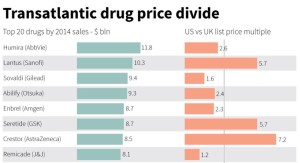
U.S. prices for the world's 20 top-selling medicines are…three times higher than in Britain… Researchers…also found U.S. prices were consistently higher than in other European markets…The United States, which leaves pricing to market competition, has higher drug prices than other countries where governments directly or indirectly control medicine costs…That makes it by far the most profitable market for pharmaceutical companies, leading to complaints that Americans are effectively subsidizing health systems elsewhere…Manufacturers say decent returns are needed to reward high-risk research…also point to higher U.S. survival rates for diseases such as cancer and the availability of industry-backed access schemes for poorer citizens…Pharmaceutical Research and Manufacturers of America says international comparisons are misleading because list prices do not take into account discounts available as a result of "aggressive negotiation" by U.S. insurers.
- The Quest for a Vaccine Against a Killer Bug (bloomberg.com)A New York Giants player is in danger of having his foot amputated (news.yahoo.com)

Pfizer is targeting a deadly bacterium that thrives in hospitals…Staphylococcus aureus can strike healthy, young people with no known risk factors, survive a barrage of antibiotics, and sometimes be fatal…One antibiotic-resistant strain frequently found in hospitals (MRSA) is responsible for about 75,000 serious infections and 10,000 deaths…a year…The pharmaceutical giant has spent more than 15 years working on a vaccine…and is in the midst of testing it on patients…Staph is a very difficult organism to make a vaccine against...Pfizer’s researchers are trying a multipronged approach. Two of the vaccine’s components go after a capsule that cloaks the bacterium and prevents the immune system from recognizing it. Another deprives the organism of manganese…A fourth targets the mechanism staph uses to lodge itself in the body…