
- More than 1 million OxyContin pills ended up in the hands of criminals and addicts. What the drugmaker knew (latimes.com)

Dr. Eleanor Santiago
In the waning days of summer in 2008, a convicted felon and his business partner leased office space on a seedy block near MacArthur Park. They set up a waiting room, hired an elderly physician and gave the place a name that sounded like an ordinary clinic: Lake Medical...The doctor began prescribing the opioid painkiller OxyContin – in extraordinary quantities. In a single week in September, she issued orders for 1,500 pills, more than entire pharmacies sold in a month. In October, it was 11,000 pills. By December, she had prescribed more than 73,000, with a street value of nearly $6 million...Purdue Pharma, the maker of OxyContin, tracked the surge in prescriptions. A sales manager went to check out the clinic and the company launched an investigation. It eventually concluded that Lake Medical was working with a corrupt pharmacy in Huntington Park to obtain large quantities of OxyContin.
- Sounding the alarm
- What Purdue knew
- Pills prescribed by Santiago
- Following the pills
- The skid row connection
- Pharmacist complaints
- Reports of concern
- ‘I was sitting on a gold mine.’
- ‘It really takes the ‘G’ a long time to catch up with these jokers’
- Pharmacy Journal Examines National Trends in Prescription Drug Spending (ashp.org)National trends in prescription drug expenditures and projections for 2016 - Abstract (ajhp.org)
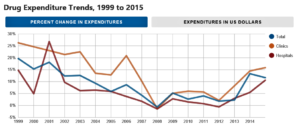
A sharp rise in prescription medication prices — driven by the introduction of new, expensive specialty medications and huge increases in the costs of older drug products with few competitors — drove an 11.7 percent increase in spending on medications in 2015, according to a new report published in AJHP (American Journal of Health-System Pharmacy)...The report projects an 11 to 13 percent increase in total drug expenditures in hospitals and health systems in 2016, which includes a 15 to 17 percent increase in clinic spending and a 10 to 12 percent increase in hospital spending...pharmacists need to be diligent about understanding what factors influence drug spending within their own organizations. "By understanding the key cost drivers, pharmacy leaders can implement programs to target them," he noted, adding that such strategies could include working with prescribers to use equally effective but less expensive medications or developing programs such as antibiotic stewardship to reduce unnecessary use of drugs...
- CVS to Pay $3.5M Over Allegations of Forged Prescriptions (dddmag.com)

CVS Pharmacy has agreed to pay $3.5 million to settle allegations that dozens of its Massachusetts pharmacies violated federal law by filling forged prescriptions for addictive painkillers and other controlled substances...Attorney Carmen Ortiz announced the settlement...CVS says it entered into the agreement to avoid the expense and uncertainty of further legal proceedings...settlement resolves two investigations by the Drug Enforcement Administration after reports of forged oxycodone prescriptions. One involved hundreds of forged prescriptions at 40 CVS stores in Massachusetts and New Hampshire. The other involved 120 forged prescriptions at 10 CVS stores in and around Boston.
- Compounding Pharmacists Imprisoned for Dispensing Adulterated Drugs (pharmacytimes.com)Two Pharmacists Sentenced to Prison for Adulteration of Drugs in Connection with Alabama-Based Compounding Pharmacy (justice.gov)

Two compounding pharmacists from Alabama will spend a year in prison for distributing tainted drugs... The adulterated drugs were compounded at Advanced Specialty Pharmacy, which did business as Meds IV... David Allen...and William Timothy Rogers...pleaded guilty...to 2 misdemeanor violations of the Federal Food, Drug and Cosmetic Act...the 2...were sentenced to 12 months and 10 months in prison, respectively...also...1 year of supervised release after they get out of prison, and they’ll each have to pay a $5000 fine...Meds IV compounded...its own amino acid solution, then mixed it with other ingredients to create TPN (Total Parenteral Nutrition)...The amino acid solution happened to be contaminated with Serratia marcescens, and the TPN was prepared, packed, or held in insanitary conditions...the amino acid was prepared by Meds IV outside a laminar airflow workbench and was kept unrefrigerated, in a room that was not sterile, in a large pot sitting on the floor, sometimes overnight, before it was sterilized and used...Nine patients developed bloodstream infections and died, while others developed S. marcescens bloodstream infections but survived.
- IACP’s 2016 Compounders on Capitol Hill Report (iacprx.org)

IACP Members Go to the Hill with Three Actionable Asks
This year, IACP went to the Hill with three Asks, each with a Congressional action item. IACP and its legislative team have worked tirelessly for the past year emphasizing FDA should be implementing DQSA (Drug Quality and Security Act) according to congressional intent!
- Issue #1 Support Pharmacists: Sign the Bipartisan Letter to FDA Led by Representatives Chris Stewart and Henry Cuellar.
- Issue #2 Support Letter to Chairman Chaffetz and Ranking Member Cummings to Request House Oversight and Government Reform Hearings on FDA's Implementation of DQSA.
- Issue #3 Support Pharmacists: Sign the Senate Letter to FDA Regarding Office-use.
- Theranos dealt severe blow by CMS (drugstorenews.com)

Theranos Inc founder and CEO Elizabeth Holmes
Less than one month following Walgreens decision to terminate its relationship with Theranos, the blood-testing lab on Thursday announced that the Centers for Medicare & Medicaid Services has revoked the company's CLIA certificate, among other sanctions. The revocation of Theranos' CLIA certificate precludes the owners and operators of Theranos from owning, operating or directing a lab until at least July 2018...In addition to the revocation of Theranos' CLIA certificate, the full list of CMS sanctions include:
- Limitation of the laboratory’s CLIA certificate for the specialty of hematology;
- A civil money penalty;
- A directed portion of a plan of correction;
- Suspension of the laboratory’s approval to receive Medicare and Medicaid payments for any services performed for the specialty of hematology; and
- Cancellation of the laboratory’s approval to receive Medicare and Medicaid payments for all laboratory services.
- This Week in Managed Care: July 2, 2016 (ajmc.com)
Justin Gallagher, associate publisher of The American Journal of Managed Care. Welcome to This Week in Managed Care, from the Managed Markets News Network.
- FDA defines the ability of compounders to make approved medicines (statnews.com)

In its latest (to) bid to set parameters around compounding, the US Food and Drug Administration...issued a pair of draft guidelines to clarify when compounding pharmacies are permitted to make versions of commercially available medicines...federal law currently states that a compounder generally shouldn’t make copies of drugs that are approved for sale, the agency is getting more specific and wants to ensure that a true clinical need exists before a compounded version of an approved medicine drug is made for a patient...A key issue has been the extent to which compounders can make medicines for patients in ways that may cross the line into more conventional drug manufacturing. The new law attempts to create boundaries, although the latest guidelines are designed to refine the FDA interpretation... the guidelines would permit compounders to make versions of brand-name drugs when a shortage exists or the brand-name medicine has been discontinued. Another example meeting the threshold of patient need might be a required change in formulation...But safety is not the only issue in play here. For instance, pointing to a lower price...a compounded version would be cheaper than a brand-name drug — is not justification for compounding an FDA-approved medicine...these are only draft guidelines — guidances in regulatory parlance — and are not set in stone.
- Pharmacy Week in Review: July 8, 2016 (pharmacytimes.com)

Mike Glaicar, Business Development: Pharmacy Times...(PTNN) This weekly video program provides our readers with an in-depth review of the latest news, product approvals, FDA rulings and more.
- Anthem, Express Scripts Face Legal Challenge Over Prescription Drug Prices (realclearhealth.com)Anthem sues Express Scripts for $15 billion over drug pricing (modernhealthcare.com)
Anthem and its pharmacy manager Express Scripts overcharged patients with job-based insurance for prescription drugs, alleges a lawsuit that seeks class action status for what could be tens of thousands of Americans...the latest wrinkle in a battle that has already pitted the major national insurer and its pharmacy benefit manager against each other in dueling legal actions...The case alleges that insured workers paid too much because Express Scripts charged "above competitive pricing levels" and Anthem, in effect, allowed those higher prices...Those actions...violate the firms’ responsibilities under a 1974 federal benefits law called the Employee Retirement Income Security Act...This action seeks to recover losses suffered by the plaintiffs…who overpaid and continue to overpay for the portions of the costs of prescription drugs…they are responsible for paying as plan participants," says the lawsuit, filed as Burnett v. Express Scripts and Anthem.