
- Pharmacy Week in Review: February 19, 2016 (pharmacytimes.com)
Mike Glaicar, Business Development: Pharmacy Times...(PTNN) This weekly video program provides our readers with an in-depth review of the latest news, product approvals, FDA rulings and more.
- Improving Data Analytics for Payers in Specialty Pharmacy (specialtypharmacytimes.com)
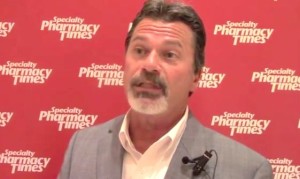
David D'Altorio, PharmD, senior vice president of health services at MedImpact Healthcare Systems, discusses the benefits of MedImpact's iRx program.
- Retail Pharmacy Clinics: Top Players and the Coming 2016 Pause (drugchannels.net)
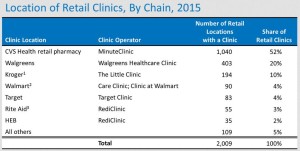
As low-cost generics come to dominate retail dispensing activity, clinics have emerged as a way for drugstores and other retail pharmacy outlets to diversify into non-dispensing revenues...There are now about 2,000 retail clinics. Below, I examine the chains with the biggest market share: CVS Health, HEB, Kroger, Rite Aid, Target, Walgreens, and Walmart...In 2015, the number of clinics grew slowly. In 2016, I project another year of slow growth as the big players retrench...
- CVS Health’s MinuteClinic remains the largest and fastest-growing retail clinic business, now operating more than half of all retail clinics.
- Walgreens is the second-largest retail clinic operator, with more than 400 Healthcare Clinics (formerly Take Care clinics). The number of clinics in Walgreens retail stores declined in 2015.
- Kroger has emerged as the third-largest retail clinic operator with its Little Clinic business, which operates inside nearly 200 Kroger, Dillon’s, Fry's, JayC, and King Soopers stores.
- Rite Aid changed its clinic strategy with the 2014 acquisition of RediClinic. As of January 2016, Rite Aid operated 41 RediClinics....a further 35 retail locations.. in HEB grocery stores...At 14 Rite Aid locations, the company leases space to other clinic operators...
- Walmart launched its own Care Clinics in 2014. There are now 17 Care Clinics in Walmart stores...Walmart also leases space to independently owned and operated Clinic at Walmart operators...operate inside 73 Walmart stores.
- Express Scripts Giving ‘Extra Scrutiny’ to Valeant Prescriptions (bloomberg.com)

Express Scripts Holding Co. is carefully scrutinizing prescriptions for products made by Valeant Pharmaceuticals International Inc., making sure the pharmacy manager’s rules are being followed...We are looking at every single claim for their products...They are getting extra scrutiny...Valeant last year was accused of working with a network of pharmacies to boost sales of its drugs and get them reimbursed by health insurers and pharmacy benefit managers like Express Scripts, even when there were cheaper generics available...Express Scripts reviews prescription claims to ensure that the manufacturer and pharmacies are operating in a manner consistent with its contracts and in the best interests of its clients and patients...The reviews ensure that patients and payers aren’t spending more on the products than necessary...
- Community pharmacy reforms (rpharms.com)
Changes to community pharmacy in 2016/17 and beyond...In a letter to the Pharmaceutical Services Negotiating Committee...the Department of Health and NHS England announced there would be a...reduction in funding through the community pharmacy contractual framework...this reduction in funding will have a substantial impact on pharmacy business owners, their employees and locums...it was announced that funding...would be cut by at least 6%, equating to £170 million ($242 million); lowering the funding available through the community pharmacy contractual framework from £2.8 billion ($4 billion) to £2.63 billion (3.75 billion). It is anticipated these changes will take effect in October 2016...Alongside the cut in funding...further changes that the Government would like to see, including:
- To better integrate pharmacy into the wider primary care and community health system – such as closer working with GP surgeries, care homes and urgent and emergency care departments - so that patients can benefit from pharmacists’ clinical skills through a "Pharmacy Integration Fund".
- A "Pharmacy Access Fund", which would provide more NHS funds to certain pharmacies compared to others, considering factors such as location and the health needs of the local population.
- The potential for automation and centralising dispensing to provide efficiencies. Also, in some areas, the distribution and number of pharmacies does not match local patients' needs.
- The view of the Government that patients would like to order prescriptions online and that "click and collect" and delivery options would be easier to arrange.
- More College Students Misusing ADHD Med as Study Aid (realclearhealth.com)
College students aiming for an academic edge may explain a surge in the misuse of a stimulant commonly prescribed for attention-deficit hyperactivity disorder...Among U.S. adults, the number of Adderall prescriptions stayed stable from 2006 to 2011, but misuse of the drug jumped 67 percent and related visits to emergency rooms went up by 156 percent...The majority of adults who are using Adderall nonmedically are in the age range of 18 to 25...The researchers speculate that college students may prefer Adderall over the other stimulants because it increases two brain chemicals linked with better cognitive functioning and has a reputation for making people smarter...Many students mistakenly believe these drugs will make them smarter and more efficient at studying, so in their view the risk is worth the reward...because Adderall can improve focus, it may also give some students an unfair advantage, thus constituting academic dishonesty...
- Solving the Puzzle of High Cost Specialty Drugs (specialtypharmacytimes.com)
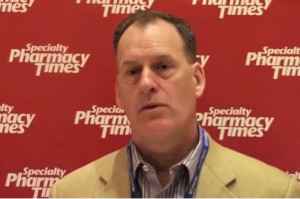
Jon Hamrick, executive vice president, Biotech and Specialty Services at Therigy LLC, discusses the implications of rising drug costs on specialty pharmacy.
- Moving Away from Pharmacist Efficacy and Toward Pharmacist Effectiveness: Refocusing Research that Generates Knowledge about Pharmacist-Provided Services (pharmacytimes.com)
Despite a significant body of evidence supporting pharmacist-provided services, gaps remaining in the evidence base need to be addressed to accelerate the adoption of pharmacy services into evolving health care delivery models. Understanding these gaps is important in targeting research efforts...we have reached a critical time in the evolution of pharmacy and pharmacist-provided services...we must carefully consider the research questions that are most relevant to advance pharmacy practice...As health care transitions toward value-based care, it is important that we demonstrate the role of the pharmacist as an integral member of the health care team in optimizing medication use and improving patient care. We need to rethink our...research and shift some of our efforts to the translation and implementation of research findings...Efforts to demonstrate that pharmacist-provided services work...should continue; however, we must place more emphasis on how to integrate best practices in pharmacy-provided services into value-based care delivery and payment models.
- VTE Guideline Weighs in on Newer Oral Anticoagulants (ashp.org)Antithrombotic Therapy for VTE Disease: CHEST Guideline and Expert Panel Report (journal.publications.chestnet.org)

A revised guideline from the American College of Chest Physicians favors the use of dabigatran, rivaroxaban, apixaban, or edoxaban over traditional vitamin K antagonist or low-molecular-weight heparin therapy for the long-term treatment of venous thromboembolism in patients without cancer..."Antithrombotic Therapy for VTE Disease," released online in December by the publishers of Chest, is the 10th published version of the guideline, which updates a guideline released in early 2012. In that version of the guideline, VKA or LMWH therapy was preferred over the two available "new oral anticoagulant drugs" for the long-term treatment of pulmonary embolism or deep vein thrombosis...
- The Elective Rotation with Pharmacy Joe – Pharmacy Podcast (pharmacypodcast.com)
"Pharmacy Joe", is the host of The Elective Rotation – A Critical Care Pharmacy Podcast. He is a Critical Care Pharmacist, Preceptor, and Board Certified Pharmacotherapy Specialist who has been in practice for over 15 years. (podcast 20:20)