
- Global Fund rushes HIV drugs to Uganda amid shortage (reuters.com)

The Global Fund, a partnership that sends HIV drugs to poor countries, says it plans to send an advance supply of antiretroviral therapy to Uganda, after the East African country ran out three months before the end of last year...Health activists say the shortage, which began last September, hit about 240,000 patients on publicly funded treatment programs, forcing them to modify their treatment or stop altogether. Private-sector clinics were not affected...The government said a weak currency and insufficient foreign exchange had hampered its ability to finance drug imports...Some activists said they suspected runaway election spending was behind the shortfall, but officials denied the charge...The government needs to mobilize resources to fill the gaps and find a long-term solution...
- Pharmapreneurs – the Pharmacist Entrepreneur – Pharmacy Podcast (pharmacypodcast.com)
Dr. Blair Thielemier interviews pharmacist & entrepreneur – Simone Sloan about what drives entrepreneurship, leadership, and transforming our pharmacy industry. (23:19 min)
- Pharmacy Week in Review: January 22, 2016 (pharmacytimes.com)
Mike Glaicar, Business Development: Pharmacy Times...(PTNN) This weekly video program highlights the latest in pharmacy news, product news, and more.
- Patent Expirations Of Crestor And Zetia And The Impact On Other Cholesterol Drugs (forbes.com)
...2016 will see a number of drugs going off patent...most notable are the patent expiries for two major LDL-cholesterol lowering drugs: the statin, Crestor...and the cholesterol absorption inhibitor, Zetia...However, the availability of generic ezetimibe and rosuvastatin could have other impacts. There are a number of people who cannot tolerate statins because of side-effects such as muscle pain. Statin intolerance, in fact, is a driver for companies seeking novel LDL-c lowering drugs in order to provide patients with alternatives. But that road has gotten harder...the most compelling new LDL-c drugs are the PCSK-9 inhibitors...These medicines have the ability to lower LDL-c to levels unattainable by statins alone...PCSK-9 inhibitors are expensive drugs listing at more than $14,000/year/patient...There is no doubt that the loss of exclusivity for Crestor and Zetia will impact the bottom lines of AstraZeneca and Merck, respectively...the availability of the generic forms of these drugs will also have an impact on physician prescribing habits and even drugs not yet on the market. Containing prescription drug costs is a major priority these days, and the use of generics is a key lever in accomplishing this, particularly in the face of high costs alternatives...
- CMS final rule addresses decades-long Medicaid reimbursement issue (drugstorenews.com)
The end of what has become a decades long battle around fair reimbursement for Medicaid programs and pharmacy appears to be in sight...the Centers for Medicare & Medicaid Services issued the Covered Outpatient Drugs final rule with comment that addresses key areas of Medicaid drug reimbursement and changes made to the Medicaid Drug Rebate Program by the Affordable Care Act. According to a fact sheet published by CMS, this final rule assists states and the federal government in managing drug costs, establishes the long term framework for implementation of the Medicaid drug rebate program and creates a more fair reimbursement system for Medicaid programs and pharmacies...the final rule is designed to ensure that pharmacy reimbursement is aligned with the acquisition cost of drugs and that the states pay an appropriate professional dispensing fee. The final rule:
- Creates an exception to the FUL calculation, which allows for the use of a higher multiplier than 175% to calculate the FUL based on acquisition costs for certain multiple source drugs;
- Establishes actual acquisition cost as the basis by which states should determine their ingredient cost reimbursement so payments are based on a more accurate estimate of the prices available in the marketplace, while still ensuring sufficient beneficiary access;
- Implements the use of the term professional dispensing fee to ensure that the dispensing fee paid to pharmacies reflect the cost of the pharmacist’s professional services and cost to dispense the drug product to a Medicaid beneficiary;
- Clarifies that states are required to evaluate the sufficiency of both the ingredient cost reimbursement and the professional dispensing fee reimbursement when proposing changes to either of these components; and
- Requires states to specify in the Medicaid state plan that reimbursement methodology to pharmacies that purchase drugs through the Federal Supply Schedule and the 340B Drug Pricing Program is consistent with overall AAC requirements.
- Up to 3,000 pharmacies could close after government cuts, MPs warn (pharmaceutical-journal.com)PSNC Update: Further details and PSNC’s response to the Government plans for community pharmacy (psnc.org.uk)New briefing document about ‘efficiencies’ in community pharmacy (npa.co.uk)Statement on the meeting with Rt Hon Alistair Burt MP, Minister of State for Community & Social Care (appg.org.uk)

All Party Pharmacy Group has warned...Between 1,000 and 3,000 pharmacies — as many as one in four — could close in England as a result of government cuts to funding for pharmacy...A letter to the Pharmaceutical Services Negotiating Committee in December 2015 announced a 6% funding cut from £2.8bn ($4bn) to £2.63bn ($3.7bn)...there would be further reductions in future years...there is also much more to this picture than a cut in funding. There is a clear intention to reduce the number of pharmacies...In some parts of the country there are more pharmacies than are necessary to maintain good access. 40% of pharmacies are in a cluster where there are three or more pharmacies within ten minutes’ walk...The Department will separately consult on changing the Human Medicines Regulations 2012 to allow all pharmacies to access the efficiency created by ‘hub-and-spoke’ dispensing...This could help pharmacies to lower their operating costs and free up pharmacists to provide more clinical services and public health services...the government would not decide which pharmacies should close. Pharmacies would need to decide whether they were "viable" in light of the change to the funding level. He admitted that independents will be "squeezed" and that this is a matter of concern for the government to look at...Warehouse dispensing, or ‘hub and spoke’, raises questions around safety, quality and access...The supply of prescription medicines cannot be treated like buying clothes and DVDs. High quality, safe dispensing depends on the opportunity for a face-to-face discussion between the pharmacist and the patient. I don’t see how that can be done in a warehouse.
- Express Scripts sued by compounding pharmacies for alleged antitrust practices (statnews.com)

For the second time since Express Scripts began blocking coverage of hundreds of ingredients used to make compounded medicines, several compounding pharmacies have filed a lawsuit accusing the pharmacy benefits manager of using illegal tactics...In the latest instance, a half-dozen compounding pharmacies have charged Express Scripts with violating antitrust laws and is attempting to force them out of business...Express Scripts has taken “a series of unreasonable restrictions and rules that would make it impossible for [the compounding pharmacies] to fill prescriptions” for patients “and obtain reimbursements that would cover their costs,”...The company and the other benefits managers “employed tactics designed to ensure that the compounding pharmacy industry …cannot survive.”...The move to cut back on covered ingredients has riled compounding pharmacies...the Food and Drug Administration has cracked down on compounding pharmacies by increasing the number of inspections, and, in rare cases, taking legal action to halt allegedly unsafe practices. The justifiable emphasis on safety has forced many compounding pharmacies to enhance operations...The compounding pharmacies are striking back. In November 2014, three others filed a lawsuit claiming Express Scripts illegally blocked legitimate prescriptions and unfairly forced patients to seek more expensive medicines or simply not seek treatment. The pharmacies maintained the benefits manager violated federal law because it lacks authority to essentially alter terms of health plans.
- 2015: A banner year for personalized medicine (catalyst.phrma.org)
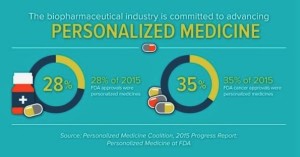
2015 was a record year for personalized medicine approvals, according to a new analysis from the Personalized Medicine Coalition. This news confirms the growing role of personalized medicine as an approach to treatment that can improve outcomes for patients and also create important efficiencies in the health care system. Personalized medicine is an emerging field of medicine that uses diagnostic tools to identify specific biological markers to help assess which medical treatments and procedures will be best for each patient. Personalized medicine also takes into account patients’ medical history, circumstances and values in developing targeted treatment and prevention plans...45 novel new drugs approved in 2015, the new analysis indicates that 28 percent of novel new drugs approved by the Food and Drug Administration...were personalized, or precision, medicines...Some of the personalized medicine highlights from 2015 include:
- Two new medicines for patients with different forms of non-small cell lung cancer;
- A new combination therapy for patients with cystic fibrosis;
- Two new medicines to help patients with a difficult-to-treat form of high cholesterol; and
- A new targeted therapy for melanoma.
- Medical publishers eye new ad viewability rules (mmm-online.com)
The Association of Medical Media plans to hold a meeting to establish an industrywide viewability standard...A group of medical publishers will attempt to develop a new industry standard for digital advertising viewability, a much debated topic that has vexed the broader advertising industry...Viewability—how long is long enough for a user to have viewed a digital ad successfully—has cropped up in recent years as one of the more challenging media issues, and one that needs to be addressed as the business of digital advertising matures. In healthcare, experts say, it's no different..."There's more pressure to account for dollars,"...The group's perspective is that professional medical content differs from other online advertisers..."It is distinguished from general web content in many ways, including in its scarcity and its value to the end reader...industry experts have been saying that drugmakers will likely put more emphasis on digital advertising as brand marketing becomes more targeted to certain patient populations and manufacturers lose direct access to physicians and other prescribers. That could expose more advertisers to the vagueness of viewability and highlight the need to find a solution that makes sense given the nuances of medical advertising, notably content aimed at healthcare providers.
- Venezuela needs urgent foreign medical aid, pharma group says (reuters.com)

With scores of medicines in short supply due to a severe financial squeeze, Venezuela is suffering a "humanitarian crisis" and requires rapid international assistance, according to a major pharmaceutical association...The Venezuelan Pharmaceutical Federation (Federación Farmacéutica Venezolana) listed 150 medicines, from those for hypertension to cancer, as well as basics such as prophylactics and antibiotics, which are scarce in the OPEC nation of 29 million people..."The national government must accept we are in a humanitarian crisis in the health sector, with patients dying across our territory for lack of medicines," said association president...The health ministry did not respond to a request for comment on the pharmaceutical association's statement, but Venezuela's socialist government has bristled at criticism of its health system...It accuses local groups of exaggerating problems and says the widespread shortages in Venezuela - of food as well as medicines - are due to an "economic war" by foes...Long lines form daily outside pharmacies, and doctors and patients constantly complain of lack of medicines and equipment.