
- Pharmacy Week in Review: January 8, 2016 (pharmacytimes.com)
Mike Glaicar, Business Development: Pharmacy Times...(PTNN) This weekly video program highlights the latest in pharmacy news, product news, and more. (video)
- Walgreens, CVS Want Doctors’ Medicare Pay To Vaccinate (forbes.com)Patient Access to Pharmacists’ Care Coalition (pharmacistscare.org)
As the nation’s retail pharmacies move deeper into the business of providing healthcare services, they now want pharmacists to be paid by Medicare to immunize the nation’s seniors....Under legislation that is gaining rare bipartisan support and momentum in the House and Senate, particularly for a Congressional health bill, pharmacists would be paid to administer vaccines under Medicare part B...The pharmacies have formed a coalition known as “The Patient Access to Pharmacists’ Care Coalition,” to push for the legislation, known as the Pharmacy and Medically Underserved Areas of Enhancement Act (S. 314/H.R. 592). The coalition includes retailers and grocery store chains with pharmacies such as Walgreens Boots Alliance , CVS Health, Wal-Mart, Kroger, Rite-Aid and Target...It could bring in hundreds of millions of dollars to the drugstore industry given the growing business of providing vaccinations.
- Maker of generic version of Nexium goes blue to settle litigation (statnews.com)

Dr. Reddy’s Laboratories is feeling blue over a purple pill...The generic drug maker last week agreed to change the color of its new version of the Nexium heartburn medicine from purple to blue in order to settle a lawsuit that was filed by AstraZeneca....For more than two decades, AstraZeneca has capitalized on a marketing campaign that labeled its two widely prescribed heartburn drugs — first, Prilosec and then Nexium — as “the Purple Pill.” But after Dr. Reddy’s last September began selling a lower-cost generic version, which resembled the brand-name drug, AstraZeneca claimed the Indian drug maker was ripping off its trademark look...
- Pharmacists recognised in 2016 New Year’s honours list (pharmaceutical-journal.com)

Several pharmacists and former pharmacists have been recognised in the New Year’s honours list, with four being made Officers of the Order of the British Empire...
- Bill Scott, Scotland’s former chief pharmaceutical officer ...recognised for services to healthcare.
- Norman Morrow, chief pharmaceutical officer for Northern Ireland...was recognised for his contribution to pharmacy.
- David Cowan, professor of pharmaceutical toxicology and director of the drug control centre at King’s College London...was recognised for services to anti-doping science.
- Alan Willson, who began his career as a pharmacist, was honoured for services to the quality and safety of healthcare in Wales.
- Zameer Choudrey — was made a Commander of the Order of the British Empire in recognition of his contribution to the UK wholesale industry.
- FDA sues to stop a wayward drug compounder (statnews.com)
After nearly three years of sparring with a recalcitrant compounder, the Food and Drug Administration has filed a lawsuit asking a federal court to prevent Downing Labs from continuing operations. And the compounder agreed to a consent decree, which requires the company to take various steps before operations can resume...In the lawsuit, the agency cited numerous violations of so-called good manufacturing practices and several issued warnings to the company...about its failure to comply with regulations. Most recently, the Dallas-based compounder, which in 2014 refused to an FDA request to recall some products, failed yet another FDA inspection...the FDA inspectors found unsanitary conditions, according to the lawsuit...tests...found traces of...bacteria which, “if introduced into the body, can cause septic shock, pneumonia, and urinary tract infections,” the lawsuit stated...the Drug Quality and Security Act was passed to, in part, bolster compounding oversight. In fact, the FDA cited the defiant posture taken by Downing as an example of why a new law was needed to allow the agency to bolster its oversight and pursue legal options when compounders refused to upgrade operations.
- American Emergency Rooms Are Facing Critical Drug Shortages (psmag.com)Longitudinal Trends in U.S. Drug Shortages for Medications Used in Emergency Departments (2001–2014) (onlinelibrary.wiley.com)
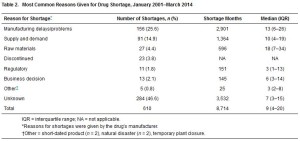
The shortfalls reveal deep problems in the market forces that control drug supply and demand...Over the past 14 years, American emergency rooms have faced more than 600 drug shortages, according to an analysis published last week in Academic Emergency Medicine. Among those shortages were lacks of life-saving, one-of-a-kind drugs such as naloxone...it's not just emergency rooms, though emergency medicine might be especially affected because production of injectable drugs is the most likely to come up short...the...analysis found that more than half of the missing emergency meds were for acute or life-threatening conditions. In most cases, doctors could substitute another drug for the missing one, but they were unable to do so five percent of the time...Why do these shortages occur? In the database the emergency-room researchers analyzed, the most commonly cited reason was a drug-plant shutdown due to quality control problems. But there are likely deeper causes. Those who buy injectable drugs for hospitals tend to choose the cheapest generics, without paying attention to quality...Another theory: The way hospital drugs are purchased encourages only a few companies to make generics, so when one company's factories go down, there's no one around to make up for the shortfall.
- Alibaba health care unit stumbles into 2016 as deal on online pharmacy business runs into delays (scmp.com)

The expansion plans of Alibaba Health Information Technology, the Hong Kong-listed health care subsidiary of e-commerce giant Alibaba Group, have stumbled out of the gate this year as the US$2.5 billion deal to acquire its parent’s online pharmacy business gets delayed...In a regulatory filing on Monday, Ali Health chief executive Wang Lei said “additional time is required for the relevant conditions” to complete that proposed acquisition...Beijing Chuanyun is an offshore holding vehicle that controls Alibaba’s online pharmacy operations, which is run under internet shopping platform Tmall.com...In April, Alibaba agreed to transfer that online pharmacy business to Ali Heath in exchange for US$2.5 billion worth of newly issued shares and convertible bonds...The delay in completing the online pharmacy acquisition could further challenge Ali Health with turning a profit as it continues in investment mode...Alibaba’s online pharmacy business on Tmall recorded a gross merchandise value of 4.74 billion yuan in the company’s fiscal year...There are 186 online-licensed pharmacies offering over-the-counter drugs, medical devices, contact lenses and other general health care products on Tmall...
- Optimizing Relationships Among Manufacturers and Providers (specialtypharmacytimes.com)
David D'Altorio, PharmD, senior vice president of health services at MedImpact Healthcare Systems, discusses methods to improve communication among drug manufacturers and health care providers.
- Grim Job Outlook for Retail Pharmacists, says BLS (drugchannels.net)
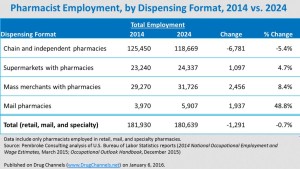
The New Year is here—let’s kick it off with some good news/bad news for pharmacists...According to our...analysis of the Bureau of Labor Statistics’ new Occupational Outlook Handbook, drugstores are projected to employ about 7,000 fewer pharmacists in 2024 than they do today...The good news? Pharmacists jobs in non-retail settings—hospitals, doctor’s office, and clinics—will add more jobs than the ones lost from retail...Employment will increase at other outpatient dispensing formats, with mail pharmacies experiencing the largest percentage increase..."Demand is projected to increase for pharmacists in a variety of healthcare settings, including hospitals and clinics. These facilities will need more pharmacists to oversee the medications given to patients and to provide patient care, performing tasks such as testing a patient’s blood sugar or cholesterol…Employment of pharmacists in traditional retail settings is projected to decline slightly as mail order and online pharmacy sales increase."
- Poor sales prompt Sanofi to pull plug on Mannkind inhaled insulin (reuters.com)
Sanofi is to stop selling an inhalable insulin developed by Mannkind, following disappointing sales of the product since its launch in February 2015...The decision to terminate the collaboration marks a blow for the idea of delivering insulin through an inhaler, rather than by injection...Rights to Afrezza will revert to Mannkind from Sanofi...Mannkind said it was reviewing strategic options for the product, although analysts questioned if the drug had any future...We can't imagine that another legitimate diabetes company would show serious interest in this asset...With little hope for resuscitating Afrezza and a dismal balance sheet (net debt), we see Mannkind in an increasingly precarious position...