
- Clinical technology is broken, so what is being done to fix it? (outsourcing-pharma.com)

The need to improve visibility, enable faster study execution, and improve study quality, is driving the industry to unify its "broken" clinical trial operating environments, according to a report...nearly all respondents reported a need to unify clinical trial operating environments, and 87% said they have or plan to have, an initiative in motion to fulfill this need and improve trial performance...The main challenge of siloed applications and processes is integrating multiple applications...The top drivers for unification are to improve visibility (75%), enable faster study execution (61%), and improve study quality (60%)...The majority of respondents (84%) reported “significant deficiencies” with their current clinical trial management system (CTMS) applications, with more than 85% citing the inability to fully support functions such as governance and oversight, resource management, as well as issue and task management...industry is recognizing the need for key performance metrics (KPIs) and reporting capabilities “to learn about how they operate so that they can improve...recognizing they need a unified technology...
- July 13 Pharmacy Week in Review: Coffee Linked to Decrease in Mortality Risk, Nutritional Pilot Program (pharmacytimes.com)

Nicole Grassano, PTNN, Pharmacy Week in Review, this weekly video program provides our readers with an in-depth review of the latest news, product approvals, FDA rulings and more.
- Drugmakers try evasion, tougher negotiations to fight new U.S. insurer tactic (reuters.com)

In the escalating battle over U.S. prescription drug prices, major pharmaceutical companies are scrambling to limit the economic damage from a new U.S. insurer tactic that coaxes patients away from expensive drugs...The latest move by insurers - which effectively forces drug companies to pay more to assist patients with their copays - is causing a decline in real U.S. drug prices this year, and is expected to become more widely adopted...Drugmakers are working on ways to counter copay accumulator programs, fearing that more employer health plans will adopt them...They include new payment options to evade detection by the pharmacy benefits managers so that a patient still benefits from the financial aid...Larger drugmakers may have the financial flexibility to monitor how these accumulator programs affect revenue over time, while those reliant on a small number of drugs may not be able to wait it out...Drugmakers are also taking a tougher stance when negotiating prices or new discounts for payers, according to insurance industry executives and pharmaceutical consultants...
- This Week in Managed Care: July 6, 2018 (ajmc.com)
Laura Joszt, Managing Editor at The American Journal of Managed Care. Welcome to This Week in Managed Care from the Managed Markets News Network
- NACDS RxImpact calls on Senate to support action on DIR fees (drugstorenews.com)

NACDS RxImpact pharmacy advocates are urging Senators to sign a letter to Health and Human Services Sec. Alex Azar that...describes the negative effects on Medicare patients and on pharmacies of the rapid expansion of the use of direct and indirect remuneration, or DIR, fees...urging Sec. Azar to not allow the current focus on drug prices to pass without taking meaningful action on this...issue...DIR fees were originally intended to capture and report rebate amounts paid by manufacturers at the end of the plan year during the reconciliation process in Part D. In recent years...the fees have become a catch-all category used increasingly by payers to include various pharmacy price concessions, such as fees related to performance-based programs or fees for participation in a preferred network. As a result, pharmacies find themselves in the untenable position of being paid by plan sponsors for prescription services, only to find out later that some of the payment must be returned...
- Las Vegas fares well in prescription drug price comparison (reviewjournal.com)Here are the Most, and Least, Expensive Cities for Prescription Medications (goodrx.com)
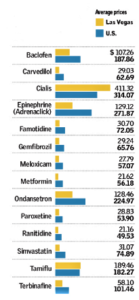
Las Vegas ranks near the bottom in many health care categories, but this time it’s a good thing...The prescription drug-tracking website GoodRx rated Las Vegas one of the least-expensive metropolitan areas in the country for out-of-pocket prescription drugs in a new report...The reason for the city’s No. 9 ranking is unclear...Las Vegas’ prices were 9.4 percent below the national average. Columbus, Ohio, had the lowest prices, with drugs costing 21.7 percent below the national figure on average...In some cities, higher cost of living corresponded to higher prices, but not so in Las Vegas, where the Council for Community and Economic Research reports the cost of living to be 2.5 percent above the national average...Leiana Oswald, associate professor of pharmacy practice at Roseman University of Health Sciences in Henderson, said tools like GoodRx can be useful for consumers and pharmacists. She said customers should also get in the habit of asking for coupons at the pharmacy counter, checking for discounts through the drug manufacturer and comparing a drug’s cash price to the cost after insurance...“I think that the best thing that patients can do is to be that squeaky wheel, to ask those questions,” she said.
- Trump administration halts billions in insurance payments under Obamacare (reuters.com)

The Trump administration...halted billions of dollars in payments to health insurers under the Obamacare healthcare law, saying that a recent federal court ruling prevents the money from being disbursed...The Centers for Medicare and Medicaid Services, which administers programs under the Affordable Care Act, said the action affects $10.4 billion in risk adjustment payments...President Donald Trump’s administration has used its regulatory powers to undermine Obamacare after the Republican-controlled Congress last year failed to repeal and replace the law. About 20 million Americans have received health insurance coverage through the program...The payments are intended to help stabilize health insurance markets by compensating insurers that had sicker, more expensive enrollees in 2017. The government collects the money from health insurers with relatively healthy enrollees, who cost less to insure...
- This Week in Managed Care: July 13, 2018 (ajmc.com)
Laura Joszt, Managing Editor at The American Journal of Managed Care. Welcome to This Week in Managed Care from the Managed Markets News Network
- What Does a Drug Cost? It Depends on Where You Live. (nytimes.com)Here are the Most, and Least, Expensive Cities for Prescription Medications (goodrx.com)

A new analysis finds the price of certain drugs varies widely depending on what city they are sold in...Thomas Goetz, the chief of research at GoodRx, said many factors are likely playing a role, like the prevalence in some areas of big-box stores like WalMart and Costco, which sell generic drugs at cheap prices...But that can’t entirely explain what’s going on. Much can still be chalked up to the “drug prices make no sense” theory, he said. Generic drug manufacturers often charge different prices for versions of the same drug, and pharmacies can then mark up the drug in a variety of ways...The study, which looked at 500 commonly used drugs in 30 American cities...differ significantly from coast to coast...
...average cash prices are at pharmacies in five major cities - Paroxetine - Generic for Paxil, used to treat depression
- Birmingham — $50.53
- Boston — $47.34
- Columbus — $20.87
- New York — $73.55
- San Francisco — $53.78
- Nevada State Board of Pharmacy – July 2018 Newsletter (bop.nv.gov)

- Return of Dispensed Drugs to a Pharmacy
National Pharmacy Compliance News
- DEA Launches New Tool to Help Distributors Make Informed Decisions About Customers
- PTCB Launches Certified Compounded Sterile Preparation Technician Program
- DEA Enables Mid-level Practitioners to Prescribe and Dispense Buprenorphine
- New CDC Training Offers CPE on Antibiotic Stewardship
- Walmart to Provide Free Solution to Dispose of Medications With Schedule II Prescriptions
- ASHP Research and Education Foundation Predicts Trends to Affect Pharmacy in 2018
- USP Encourages Pharmacists to Help Patients Find Quality Dietary Supplements
- New CPE Monitor Subscription Plan Helps Pharmacists Track Compliance Via Mobile App
Nevada State Board of Pharmacy News
- Controlled Substance Prescription DEA Number Requirement