
- June 1 Pharmacy Week in Review: New Hepatitis C Virus Guidelines and Lyme Disease Prevention (pharmacytimes.com)

Nicole Grassano, PTNN, Pharmacy Week in Review, this weekly video program provides our readers with an in-depth review of the latest news, product approvals, FDA rulings and more.
- This Week in Managed Care: May 25, 2018 (ajmc.com)

Samantha DiGrande, Welcome to This Week in Managed Care from the Managed Markets News Network
- May 25 Pharmacy Week in Review: FDA Issues Approvals for 2 Drugs, and a Safety Alert for HIV Medication (pharmacytimes.com)

Nicole Grassano, PTNN. This weekly video program provides our readers with an in-depth review of the latest news, product approvals, FDA rulings and more.
- Trump’s Drug Pricing Reform Proposals May Be Politically Tepid But Are Sensible Policy (forbes.com)The Trump Drug Pricing Plan: Short Term Reprieve, Long Term Disruption (drugchannels.net)
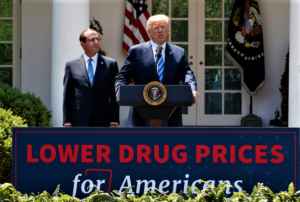
President Trump and Alex M. Azar II, the Secretary of Health and Human Services
With HHS Secretary Alex Azar by his side, President Trump...promised that “we are going to see prices go down, and it will be a beautiful thing.” Based upon the actual blueprint, which remains a work in progress, that may well be the case. But if it proves to be so, it will not be because the administration is wielding the metaphorical meat cleaver to cut prices by government edict and risk gutting our biomedical innovation engine...Instead...he appears to...endorse a series of incremental policy and market-based reforms that will eliminate many of the existing incentives that compel drug manufacturers to push list prices ever higher...These relatively modest proposals will not satisfy Democrats who remain fixated on adopting a single payer system where the Federal government can set prices, as is the case in western Europe. But then, it might be good to remember that risk capital and large drug companies are necessary to develop the compounds that are discovered in government and university research laboratories. If we wish to realize the promise of new medicines in treating rare diseases and in harnessing our immune systems to fight cancer, a thoughtful, cautious incrementalism is preferable to the harshness of the meat cleaver.
- Trump signs ‘right to try’ drug bill (thehill.com)

President Trump signed a bill...allowing terminally ill patients access to experimental medical treatments not yet approved by the Food and Drug Administration...Dubbed "right to try," the law's passage was a major priority of Trump and Vice President Pence, as well as congressional Republicans..."Thousands of terminally ill Americans will finally have hope, and the fighting chance, and I think it's going to better than a chance, that they will be cured, they will be helped, and be able to be with their families for a long time, or maybe just for a longer time," Trump said at a bill signing ceremony at the White House, surrounded by terminally ill patients and their families...Most Democrats and public health groups oppose the bill, arguing that it could put patients in danger...FDA oversight of access to experimental treatments exists for a reason — it protects patients from potential snake oil salesmen or from experimental treatments that might do more harm than good...Opponents also argue it gives “false hope” to patients, since drugmakers aren’t required to give unapproved medicines to patients who ask for them...Supporters say, however, it will provide new treatment opportunities for terminally ill patients who have exhausted existing options...
- Right to Try bill clears House, headed for Trump signature (biopharmadive.com)

The House of Representatives...voted....to pass Sen. Ron Johnson’s, R-Wis., Right to Try legislation, sending the bill to President Donald Trump’s desk. The vote is the culmination of a multi-year campaign...which aims to provide access to unapproved drugs under review at the Food and Drug Administration to patients facing life-threatening illnesses with no further options...The bill covers a much broader population than an earlier House-passed version. The president has been a vocal advocate...it may have unintended effects and potentially hinder FDA’s authority without changes...Conservative groups including Freedom Partners and Americans for Prosperity backed the effort, calling attention to the fact that 40 states have passed versions of Right to Try, a strategy employed by Goldwater to drum up momentum for the bill...The Senate version of the legislation is less safe than the pathway proposed in the House version and is dangerous compared to the current expanded access process...The Senate’s bill would allow unproven therapies to be given to patients without FDA notification for up to a full year and would not establish any standards for informed consent...
- May 18 Pharmacy Week in Review: Trump Takes On Drug Prices, Medical Cannabis Studied, FDA Approves Fingolimod (pharmacytimes.com)

Nicole Grassano, PTNN. This weekly video program provides our readers with an in-depth review of the latest news, product approvals, FDA rulings and more.
- Integrating medication management with its EHR helped one hospital beat CMS expectations (healthcareitnews.com)

King's Daughters Medical Center...found it challenging to provide an accurate, verifiable home medication record for its providers to trust as they made important decisions about existing medications both during an inpatient visit and after discharge...King's Daughters now uses external medication history from pharmacy fill data as well as insurance claims data, provided by vendor DrFirst, to complement verification and push the information to the providers...While it is not intended as a replacement for the patient/family interview, its integration into the electronic health record greatly augments the conversation and can prompt a patient to include easily forgotten information...This reduces the risk of prescription loss and makes the process more efficient for the patient while ensuring the health record is updated in advance of future visits...King's Daughters is required to report its performance on both medication reconciliation (with a threshold goal of 50 percent) and e-prescription (10 percent) to the Centers for Medicare and Medicaid Services...most recent reporting period, Q4 2017, our stats were 77 percent and 52 percent, respectively...integrating medication management tech into the EHR also helped King’s Daughters more effectively retrieve historical data and deliver that information to providers to facilitate new prescriptions in a trustworthy manner that both reduces errors and the abuse of controlled substances...
- Early 340B hospitals gave more uncompensated care than later participants (biopharmadive.com)

Hospitals that joined the 340B Drug Pricing Program at its onset provided more uncompensated care and low-profit services to patients than those who joined in its later years, according to a new research letter published in JAMA from researchers at Vanderbilt University and the University of Chicago...Allan Coukell and Sean Dickson...write...that policymakers would be "well served by greater transparency on hospitals' use of 340B revenues," but warn that reductions in 340B eligibility will lead to a transfer from Medicare spending on 340B hospitals to increased revenue for drug manufacturers...In January, a final rule went into effect that cut drug payments to 340B hospitals by almost 30%. The American Hospital Association and other groups are currently suing the U.S. Department of Health and Human Services over the rule. Earlier this month, the U.S. Court of Appeals for the District of Columbia Circuit heard oral arguments for the case...
- Why hospitals need to adopt a ‘retail mindset’ when it comes to analytics (healthcareitnews.com)

Dana Darger, Director of Pharmacy, Rapid City Regional Hospital.
Accountable care demands that data crunching these days be agile to enable quick pivots in strategy...With rising drug costs, value-based care, changes in reimbursement rules and more demanding consumers, there's no shortage of things that can change in a year. That means hospital IT departments need to employ quicker, more agile analytics that enable them to pivot in response to fast-changing conditions...And that’s why Dana Darger...director of pharmacy at Rapid City (South Dakota) Regional Hospital...said healthcare organizations need to think more like stores when it comes to issues of dollars and cents..."Hospitals have never behaved with what I'll call a retail mindset,” Darger said. “Retail stores can tell you what they make on everything."...As healthcare moves inexorably toward value-based reimbursement, entities are going to need to analyze data more quickly and make those retail-type business decisions..."If you look traditionally at the way pharmacy works, pharmacists tend to look at the world as expense-driven," said Darger. "They base things on what drugs cost, rather than what the margin is..."A lot of times, people are trying to get the data to say what they want it to say. You have to figure out how to let the data tell the story so you can make changes based on it."