
- This Week in Managed Care: May 12, 2017 (ajmc.com)

Laura Joszt, assistant managing editor at The American Journal of Managed Care. Welcome to This Week in Managed Care from the Managed Markets News Network
- MP group wants pharmacist prescribers and minor ailment scheme in England (pharmaceutical-journal.com)

All-party parliamentary group recommends community pharmacy play a bigger role in the NHS to take pressure off Gps...Giving all community pharmacists the opportunity to become prescribers by 2022 and introducing a minor ailment service throughout England are among a series of recommendations made in a report by the All-Party Pharmacy Group, following an investigation into the impact of government reforms...The APPG, which is made up of a cross section of MPs with an interest in pharmacy, has also called on NHS England to outline their strategy for implementing the recommendations of the Murray Review into "community pharmacy clinical services"…Community pharmacy is a highly valued, but an underutilised resource, the APPG said, and the profession needs to play a more integrated role in both primary care services, and the treatment of patients with long-term health conditions...The health service is facing huge challenges due to patient demand, and by working to develop services, community pharmacy can shoulder some of the burden facing GPs, and other parts of the NHS...
- Survey ranks Nevada last in US for children’s health care (reviewjournal.com)2017’s Best & Worst States for Children’s Health Care (wallethub.com)

Nevada lands at the bottom of a list, this time ranking the best and worst states for children’s health care...The state finished No. 51 in research by WalletHub, a credit services website. The findings continue a long, depressing tradition for Nevada, which is no stranger to performing poorly in measures of health. However, valley health care professionals say they’re optimistic that medical services for kids are improving in the state, even if it’s happening more slowly than anybody would like...Experts say Nevada’s challenges range from a relative dearth of pediatricians and family care physicians to a transience among residents that can make obtaining regular preventive care for kids a back-burner task...Nevada has the fewest number of physicians per capita in the United States...This has posed a significant challenge to our community in having access to care or preventive care...As a result, the emergency rooms in Las Vegas as well as the state serve in many ways as the sole access to care...So patients utilize emergency rooms for nonemergent care and to receive care that they’d normally receive in a pediatrician’s office or an internist’s office...
- This Week in Managed Care: May 5, 2017 (ajmc.com)

Laura Joszt, assistant managing editor at The American Journal of Managed Care. Welcome to This Week in Managed Care from the Managed Markets News Network
- Pharmacy Week in Review: May 12, 2017 (pharmacytimes.com)

Nicole Crisano, PTNN. This weekly video program provides our readers with an in-depth review of the latest news, product approvals, FDA rulings and more.
- Inside the ‘Scorpion Room’ Where Drug Price Secrets Are Guarded (bloomberg.com)

PBMs occupy a key crossroads of the health system, acting as a nexus among insurers, employers and drug companies. Through a complex web of agreements they help decide what drugs are covered by a patient’s insurance, and how much they’ll cost at the pharmacy counter. The problem, say critics, is that opacity makes it hard for employers to know how much the PBM is paying and profiting on each transaction -- an impression reinforced by restrictions on who can audit them and how.
- Swelling Costs - President Donald Trump has repeatedly complained about high drug prices
- Wrangling Rebates - The most carefully guarded secrets of the PBM industry involve tens of billions of dollars in rebates they collect from drug companies. Those payments help drugmakers secure favorable spots on medication menus that PBMs offer to millions of patients.
- Other Avenues - Rebates are only one way drugmakers pass money to PBMs. Others include fees for care management, administration and inventory procurement.
- Debate Intensifies Over Express Scripts Future As Standalone PBM (forbes.com)

A debate has emerged over the future of the standalone pharmacy benefit manager, putting Express Scripts at the center of an intensifying discussion over how best to manage drug costs for consumers, employers and the government...Pharmacy benefit managers are middlemen between drug makers and consumers when it comes to purchasing drugs and providing prescription coverage...PBM’s role has come under scrutiny lately as high priced drugs bust employer and government budgets for prescriptions. Critics are questioning whether PBMs operate in a transparent way and therefore don’t pass along all of the savings they can to consumers...insurers are closing ranks around a model that brings the PBM closer to the health insurer. UnitedHealth Group owns OptumRx, a rapidly growing PBM and Anthem is seeking requests for proposals from PBMs for a new contract that would begin in 2020. Anthem's current contract with Express Scripts runs out at the end of 2019...Express Scripts, however, says it has a track record of saving Anthem and its employer clients money and is committed to the standalone model...
- Scottish government backs new integrated five-year pharmacy degree for 2020 (pharmaceutical-journal.com)

A five-year integrated pharmacy degree, leading to pharmacist registration, is set to be introduced throughout Scotland in three years’ time. However, the detail of how the workplace learning will fit into the degree timetable and which model to adopt, has not yet been decided...Shona Robison, the Scottish secretary for health and sport, is backing the proposal from the special advisory group that...published its report, ‘Five-year integrated initial education programme for pharmacists in Scotland’…"Given our current focus on workforce planning and development and the extending role of pharmacists within multidisciplinary teams, this report provides a real opportunity to better prepare our new pharmacists for practice in Scotland by ensuring they are able to practice in the evolving NHS health and social care landscape."...there is also a need for more "enhanced experiential learning in clinical practice" and a recognition of the benefits of workplace learning which can reinforce confidence and professional competence...The new degree also supports the Scottish government’s priorities to strengthen the primary care workforce and its desire for every GP practice to have access to a pharmacist with advanced skills...
- What I Told HHS Secretary Tom Price About the 340B Drug Pricing Program (drugchannels.net)
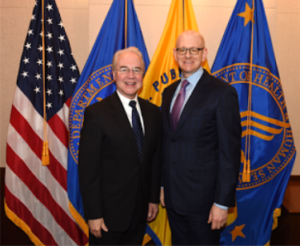
Tom Price and Adam Fein (left to right)
I (Adam Fein) had the privilege of meeting with Secretary of Health and Human Services Tom Price. I was invited to meet with Secretary Price for one of his listening sessions with industry experts and stakeholders. I appreciated the opportunity to share my perspectives...In our meeting, I highlighted four ways that the 340B Drug Pricing Program is raising drug costs. I then offered eight specific recommendations for improving the program by addressing the widespread channel distortions the program has caused.
HOW 340B RAISES DRUG COSTS
- Encouraging a shift in site of care from lower-cost physician offices to higher-cost hospital outpatient settings.
- Reducing manufacturers’ rebates to Medicare Part D and commercial payers.
- Raising out-of-pocket costs for uninsured patients.
- Reducing the generic dispensing rate and slowing the adoption of biosimilars.
HOW TO ADDRESS CHANNEL DISTORTIONS FROM THE 340B DRUG PRICING PROGRAM
- Require that covered entities share financial savings from the 340B program with uninsured and vulnerable patients.
- Revise hospital eligibility for the 340B program to create a clearer patient definition.
- Remove incentives for extraordinary hospital profits and site-of-care consolidations.
- Require HRSA and Apexus (the Prime Vendor) to report the size and scope of the 340B program.
- Mandate that contract pharmacies for 340B hospitals charge no more than the discounted 340B price to uninsured, underinsured, and vulnerable patients.
- Require contract pharmacies to identify 340B prescriptions at the time of adjudication (payer prescription approval).
- Require the disclosure of and transparency into the fees and profits generated by 340B contract pharmacies.
- Limit the number and geographic scope of contract pharmacy arrangements.
- Overcoming Opioids: When pills are a hospital’s last resort (ktvn.com)

The nation's opioid crisis is forcing hospitals to begin rolling out non-addictive alternatives to treatments that have long been the mainstay for the severe pain of trauma and surgery, so they don't save patients' lives or limbs only to have them fall under the grip of addiction...Doctors and hospitals around the country are searching for ways to relieve extreme pain while at the same time sharply limiting what was long considered their most effective tool. It's a critical part of the effort to overcome the worst addiction crisis in U.S. history...The new approach: Mixing a variety of different medications, along with techniques like nerve blocks, spinal anesthesia and numbing lidocaine, to attack pain from multiple directions, rather than depending solely on opioids to dampen brain signals that scream "ouch." It's known by the wonky name "multimodal analgesia."...Without the opioid side effects of nausea, vomiting and constipation, patients may find it easier to start eating solid food and walking around hours after surgery...