
- Europe’s new trade secrets rule sparks debate over drug safety (statnews.com)

...the European Parliament...formally approved new rules to help companies protect their trade secrets. The move creates a framework for the European Union in which companies can take legal action against someone who allegedly steals confidential information...The rules...were devised in response to longstanding complaints by corporations that Europe lacks a uniform approach to dealing with the theft of trade secrets...harmonization should allow the creation of a safe and trustworthy environment for European companies, which will see their intangible assets and know-how secured...the rules, known as the Trade Secrets Directive, are sparking sharp protest from numerous organizations that claim the effort may jeopardize the legal rights of whistleblowers and others that attempt to disclose alleged wrongdoing by corporations
- Scientists unveil the ‘most clever CRISPR gadget’ so far (statnews.com)

For all the hoopla about CRISPR (clustered regularly-interspaced short palindromic repeats), the revolutionary genome-editing technology has a dirty little secret: it’s a very messy business. Scientists basically whack the famed double helix with a molecular machete, often triggering the cell’s DNA repair machinery to make all sorts of unwanted changes to the genome beyond what they intended...On Wednesday, researchers unveiled in Nature a significant improvement — a new CRISPR system that can switch single letters of the genome cleanly and efficiently, in a way that they say could reliably repair many disease-causing mutations...Because of "the cell’s desperate attempts" to mend its genome..."what often passes as ‘genome editing’ would more appropriately be called ‘genome vandalism,’" as the cell inserts and deletes random bits of DNA where CRISPR cuts it...Because the new version of CRISPR avoids that mess, it "offers a huge step forward,"...
- Proposed legislation could heighten controversy over compounding pharmacies (statnews.com)FDA Issues Three New Draft Guidances (iacprx.org)

A congressional committee is proposing an amendment to a spending bill that may intensify the debate over the safety of compounded medicines...The House Appropriations Committee has introduced language that would alter a key requirement for pharmacists to make and dispense compounded medicines, which are generally customized for specific patient needs. And the language runs counter to a draft guidance that the US Food and Drug Administration released...that would govern compounding practices...Specifically, the amendment would allow pharmacists to compound medicines without needing prescriptions for individual patients. This has been a contentious issue in the wake of the 2012 outbreak of fungal meningitis that was tied to a compounding pharmacy and led to 64 deaths. The episode underscored confusion between federal and state oversight of compounders...the Drug Quality and Security Act went into effect to sort out enforcement authority...it...created two classes of compounders — traditional compounders who make medicines for individual patients, and others who resemble drug makers by making large amounts of a drug. These compounders must register with the FDA and are subject to greater federal oversight...The Pew Charitable Trusts...argued that the language proposed by the House committee would blur that distinction. And the nonprofit contended the change could jeopardize public safety...International Academy of Compounding Pharmacists..."The FDA continues to ignore clear congressional intent where the states have clearly indicated pathways in which pharmacies can participate in office-use compounding. The 2017 appropriations bill reinforces this intent."..."FDA’s draft guidance on anticipatory compounding is confusing at best and may ignore the clear language of bill when it comes to defining this practice,"…
- 2nd Year Pharmacy Student Wins USPHS Excellence in Public Health Pharmacy Award (blog.roseman.edu)
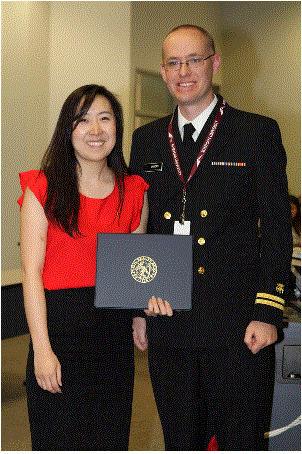
Donna Eom (PharmD candidate, Roseman University) and LT Scott Myers, PharmD
Donna Eom (PharmD candidate, Roseman University, College of Pharmacy) was this year’s recipient of the prestigious national United States Public Health Service Excellence in Public Health Pharmacy Award...Donna was recognized for her demonstrated commitment to public health and public health practice in the Greater Las Vegas Valley through her role as Student Alliance VP of Community Affairs...LT Scott Myers, PharmD, an Officer & Senior Clinical Pharmacist with the U.S. Public Health Service, traveled to the Roseman University of Health Sciences College of Pharmacy campus in order to present her with the award...Donna was specifically honored for exemplary service to public health through the organization and execution of over 50 public health screening events. Primarily targeted to the underserved populations of the Las Vegas Valley, Donna was the point person for helping to coordinate Student Alliance’s delivery of blood pressure screens, cholesterol screens and diabetic fingersticks, through coordination with public and private stakeholders.
- Express Scripts says Anthem negotiated in bad faith -court filing (finance.yahoo.com)

Pharmacy benefit manager Express Scripts Holding Co has accused Anthem Inc of negotiating their contract in bad faith and is seeking a court order that the health insurer has no right to demand lower drug prices...The allegations, made in a filing in federal court...in response to a lawsuit Anthem brought against Express Scripts last month seeking $13 billion in price cuts over the remaining four years of the companies' contract...Express Scripts said...the contract did not require it to offer any specific price cuts, but only to negotiate in good faith...Express Scripts said it had proposed five price cuts "within the range" of Swedish's projections last June, but that all were rejected, suggesting that Anthem was acting in bad faith when it brought its $13 billion lawsuit.
- Panel Would Make Insurers Help Contain Rising Drug CostsPanel Would Make Insurers Help Contain Rising Drug Costs (nytimes.com)

An influential federal advisory panel is calling for Congress to force private insurers to rein in rapid increases in prescription drug costs — by cutting some Medicare payments to insurance companies while shielding older Americans from higher out-of-pocket expenses...The recommendations by the nonpartisan Medicare Payment Advisory Commission would squeeze private insurers and drug makers alike, creating strong new incentives for insurance companies to manage the use of prescription medicines by beneficiaries and negotiate larger price discounts with pharmaceutical manufacturers...The recommendations will be included in a June report to Congress, which often heeds the panel’s advice...More than 40 million of the 56 million Medicare beneficiaries have drug coverage through Part D, and national surveys indicate that most are satisfied with the coverage. But out-of-pocket costs for some beneficiaries have increased in recent years as insurers require them to pay 25 percent or more of the cost for expensive specialty drugs to treat chronic or complex illnesses, including cancer, rheumatoid arthritis, multiple sclerosis and hepatitis C...Pharmaceutical companies and advocates for beneficiaries said some of the panel’s recommendations could harm patients’ access to certain medicines and raise costs for some low-income people...
- FDA pulls approvals on AbbVie’s ex-blockbuster heart meds (fiercepharma.com)

Years after two AbbVie cholesterol-fighting combos were approved, the FDA has decided they shouldn’t be on the market. The agency pulled approvals on combination pills Advicor and Simcor altogether, and revoked approvals for Niaspan (niacin) and Trilipix (fenofibric acid) alongside standard statin therapy...The agency said its decisions stemmed from "collective evidence from several large cardiovascular outcome trials." The combination therapies delivered no CV benefits in those trials... There is no evidence for any meaningful benefit for addition of niacin or fibric acid derivatives to statins...All four of the brands are off patent, and with generics in the mix, AbbVie’s lipid drug sales had already taken a big plunge. The dyslipidemia franchise brought in just $179 million last year, down from more than $1 billion in 2013, when Trilipix and Niaspan went off patent...We might ask, why were the indications for these drugs granted in the first place?...This shows how far we have come in the evaluation of lipid-lowering drugs. It is now firmly established that improvements in the simple lipid profile are not enough, and that clear evidence of benefit on clinical outcomes is needed for routine use of lipid-lowering drugs as add-on to statin therapy.
- FBI Recognizes Pharmacy Students for Generation Rx Work (pharmacytimes.com)University of New Mexico College of Pharmacy Receives FBI Director’s Community Leadership Award (fbi.gov)
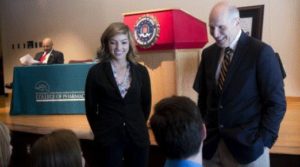
Nicole Perea, 2017 PharmD candidate ,University of New Mexico College of Pharmacy
The FBI has bestowed the Community Leadership Award to the University of New Mexico College of Pharmacy’s Generation Rx chapter in honor of its students’ work to fight prescription drug abuse...the student-led initiative is geared toward educating the community on the use and abuse of prescription medications. Its main goal is to provide accurate information and resources in order to help decrease the number of fatal drug overdoses...The students accomplish these goals by providing presentations to different groups in the community and promoting National Prescription Drug Take-Back Days in collaboration with local pharmacies, the Drug Enforcement Administration, and the New Mexico Board of Pharmacy. They also hand out prescription drug use and abuse information, plus stickers and magnets, at health fairs and other events...The FBI recognized the school’s chapter both in Albuquerque, New Mexico, and Washington, DC. Perea (Nicole Perea, 2017 PharmD candidate) accepted the award from FBI Director James Comey on behalf of the University of New Mexico team.
- Maine becomes second state to require electronic prescribing for controlled substances (healthcareitnews.com)

Maine Gov. Paul LePage has signed into law a bill that mandates electronic prescribing for controlled substances. Maine is the second state to do so. In New York the mandate took effect on March 27...An Act To Prevent Opiate Abuse by Strengthening the Controlled Substances Prescription Monitoring Program requires prescriber participation in the Prescription Monitoring Program and sets limits for the strength and duration of opioid prescriptions, beginning January 2017...also calls for prescribers to undergo addiction training every two years...The new law also makes Maine the third state in the nation to set a cap on the daily strength of opioid prescriptions
- MS patent challenges put billions in Biogen sales at risk (fiercepharma.com)Cost cutting helps Biogen top Wall Street estimates for quarter (reuters.com)

Biogen, already battling in a patent fight over multiple sclerosis star Tecfidera (dimethyl fumarate), has run into another challenge--this time with fellow MS treatment Tysabri (natalizumab). And with IP pressure mounting, the company may need to revamp its commercial lineup to ensure that the revenue keeps on flowing...India’s Swiss Pharma International has filed a petition for inter partes review of one of Tysabri’s patents--and another two petitions are on the way...The move could potentially put sales of the drug, which tallied $1.89 billion in 2015, in jeopardy... Swiss Pharma’s chances of upturning Biogen’s patents are "relatively modest." The product is "thoroughly protected" when it comes to its IP shields, and the safety flags it carries...Pharma patent challenger Kyle Bass has been trying to bat down Tecfidera’s patents for months now...the company needs to head to the dealmaking table...We believe a strategic acquisition of key products in the neurological diseases field, but outside MS, could potentially mitigate the looming threat to the MS franchise that is on the horizon...