
- DMD Student Wins 2016 Legislative Liaison of the Year Award (blog.roseman.edu)

Eddie Lee, DMD Class of ’17, Roseman University
Eddie Lee, DMD Class of ’17, was selected by his American Student Dental Association peers for the Legislative Liaison of the Year Award..."Roseman’s DMD program is producing leaders who are being recognized for their contributions to the profession and the public it serves," said William Harmon, College of Dental Medicine Associate Dean for Admissions and Student Services...The Legislative Liaison of the Year Award honors an outstanding legislative liaison for motivating and organizing his/her chapter in the legislative arena and getting the chapter involved in advocacy efforts and events...The award is presented at National Dental Student Lobby Day...held April 11 through April 12th in Washington, D.C. It was a chance for dental students to get involved in advocacy and help give a voice to the issues that they care about...meet with members of Congress and their staffs to impact policy decisions.
- Common medicines tied to changes in the brain (reuters.com)Association Between Anticholinergic Medication Use and Cognition, Brain Metabolism, and Brain Atrophy in Cognitively Normal Older Adults (abstract) (archneur.jamanetwork.com)
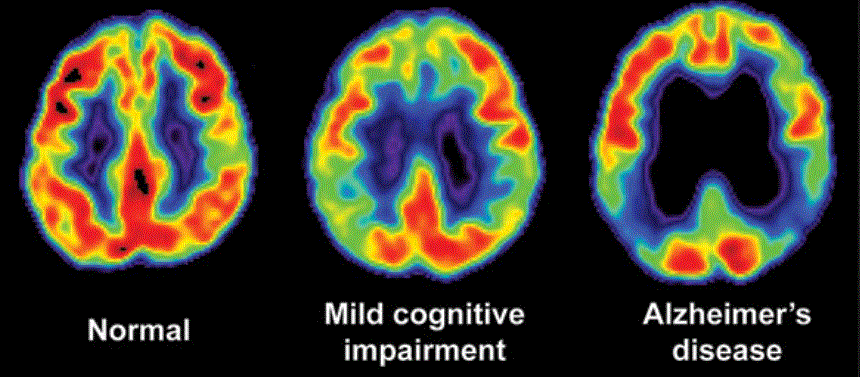
Commonly used drugs for problems like colds, allergies, depression, high blood pressure and heart disease have long been linked to cognitive impairment and dementia. Now researchers have some fresh evidence that may help explain the connection...anticholinergics, stop a chemical called acetylcholine from working properly in the nervous system...they...relieve unpleasant gastrointestinal, respiratory or urinary symptoms...The list of such drugs is long. Among them: Benadryl for allergies, the antidepressant Paxil and the antipsychotic Zyprexa, Dimetapp for colds and the sleep aid Unisom...brain scans of people who used anticholinergic drugs showed lower levels of glucose processing in the brain – an indicator of brain activity – in a region of the brain associated with memory that’s also affected early in the course of Alzheimer’s disease...There are definitely medical benefits to all of the anticholinergic medications we looked at, which could outweigh the cognitive risks...But if alternative therapies are available that provide effective treatment of these conditions, patients and doctors might want to consider avoiding anticholinergic medications...
- VA scandal: Average wait times up to 71 days for care (fiercehealthcare.com)

GAO report also finds inconsistent wait times at individual hospitals...Two years after a nationwide scandal prompted an investigation, unacceptably long wait times persist at Veteran Affairs facilities...An audit by the Government Accountability Office found the VA's method of calculating wait times often conceal the actual time it takes before a patient sees a clinician...The report found that according to the most generous estimate, the official VA wait times underestimate wait times by a factor of two...This report proves what we've long known: wait-time manipulation continues at VA and the department's wait-time rhetoric doesn't match up with the reality of veterans' experiences," said House Veterans Affairs' Committee Chair Jeff Miller, according to the Washington Post. "But given the fact that VA has successfully fired just four people for wait-time manipulation while letting the bulk of those behind its nationwide delays-in-care scandal off with no discipline or weak slaps on the wrist, I am not at all surprised these problems persist."
- America’s biggest health insurer UnitedHealth bails on Obamacare, citing big losses (washingtonexaminer.com)

UnitedHealth, the largest health insurer in the United States, is planning a widespread exit of the Obamacare market due to mounting losses from participating in the program...the Obamacare market has continued to show high risk...Next year we will only remain in a handful of states...UnitedHealth lost $425 million last year due to Obamacare...though United is the most prominent insurer to announce widespread exit from Obamacare, there has been a broader trend of participating insurers struggling to turn a profit...The program has suffered from lower-than-expected enrollment, particularly among younger and healthier customers who are necessary to offset the costs of covering older and sicker enrollees. If insurers start to exit, it will mean less competition, which will drive already rising premiums up even further.
- Roche sues Intas Pharma over Mircera anaemia drug patent (economictimes.indiatimes.com)

Swiss biotechnology giant Roche has sued Ahmedabad-based drug maker Intas Pharmaceuticals in Delhi High Court, alleging infringement of its patent rights over Mircera (methoxy polyethylene glycol-epoetin beta), an injectable brand used to treat patients with anaemia in chronic kidney-related ailments...Roche has sought an injunction order against the brand launched by Intas...Roche had close to $500 million in global sales for its Mircera brand...Intas...is contending a non-infringing stand on its product. "We also have strong grounds of invalidation for the enforced patent,"...Roche officials did not comment, saying the case is sub-judice. Intas launched its product under the brand name Erypeg in India at prices to retailer ranging from Rs 4,080 ($62) to Rs 8,200 ($124), depending on the strength of the injection. Roche's product is priced between Rs 5285 ($80) and Rs 10,621 ($160) per injection.
- Illinois says five more people with bacterial infection have died (reuters.com)

Elizabethkingia anophelis (G-neg rod, family Flavobacteriaceae)
The Illinois Department of Public Health said on Wednesday that five more people had died after being infected with Elizabethkingia, a disease linked to the deaths of 15 people in neighboring Wisconsin...The cause of death was not identified as Elizabethkingia because many of those people had underlying health conditions, the department said. Ten Illinois residents have been diagnosed with Elizabethkingia, and six have died...Symptoms of Elizabethkingia can include fever, shortness of breath and chills or cellulitis, but officials have said that the bacteria are rarely reported to cause illness in humans...Officials said the Illinois strain of Elizabethkingia differed from the Wisconsin one.
- Microbubbles, drawn by magnets, deliver chemo with ultrasound (fiercepharma.com)

Scientists in Singapore have developed magnetic micro-sized bubbles with cancer drugs on their surface that can be guided to gather around a tumor and then release their payload...Filled with gas, the microbubbles can be coated with particles of both cancer drugs and iron oxide. The iron gives them their magnetic characteristic, allowing a robotic surgeon to guide the bubbles to a tumor’s location and thereby cutting back side effects associated with free chemotherapy in the bloodstream...Once they have reached a tumor, the surgeon would then apply ultrasound to vibrate the microbubbles, shaking loose the drug, which is then close enough to enter the cancer cells more effectively.
- Detroit Area Doctor Charged with Illegal Distribution of Prescription Drugs and Fraud (dea.gov)

An indictment was unsealed today charging a doctor and three other individuals with conspiracy to illegally distribute prescription drugs...Charged in the indictment are: Dr. Michael Weiss, D.O., Edgarten Howard, Carlos Johnson, and Ricky Easley...The indictment alleges that...Weiss conspired with the other defendants to write a large number of prescriptions for highly addictive controlled substances for supposed patients, who did not have a legitimate medical need for the drugs. Weiss primarily prescribed Roxicodone and its generic equivalent, oxycodone, and promethazine cough syrup. He saw the purported patients in Howard’s home, where Howard, Johnson, and Easley paid Weiss cash for his services. Howard, Johnson, and Easley then obtained the drugs that Weiss authorized through the prescriptions, and sold them on the street...Weiss caused Medicare to pay more than $250,000, and Blue Cross almost $40,000, for the illegitimate prescriptions...also...Weiss submitted about 950 claims to Medicare and Blue Cross for providing services to the supposed patients...received about $65,000 through the fraudulent bills.
- US ‘foots the bill’ for global biopharma innovation, says ITIF (in-pharmatechnologist.com)How National Policies Impact Global Biopharma Innovation: A Worldwide Ranking (www2.itif.org)

US ranks first in terms of how its domestic policies contribute to global biopharmaceutical innovation, according to a recent analysis...The report , released by the Information Technology and Innovation Foundation, a nonprofit, nonpartisan research and educational institute focusing on the intersection of technological innovation and public policy, includes findings that assess 56 countries making up nearly 90% of the world’s economy...relative to its share of the global economy (22%), the US contributes twice the share (44%) of global R&D investment in the life sciences...it also pays closer to "the true cost of medicines developed...It means too many other nations aren’t doing their share to bear the costs of biomedical discovery and innovation...This underinvestment in biomedical research is one of the most significant factors slowing the pace of biomedical innovation. Moreover, there’s a game theory problem here where some nations are incented to free-ride off the investments of others...Countries must recognize that excessive price controls are actually damaging to long-term biopharmaceutical innovation...Strong intellectual property rights are vital for a robust life sciences innovation ecosystem; with biologic drugs the frontier of biomedical innovation, countries should implement strong IP protections for biologics, including biologics data exclusivity periods of at least 10 years or longer...
- Painkiller critics take aim at hospital surveys, procedures (hosted.ap.org)Joint Commission Statement on Pain Management (jointcommission.org)

Critics of how prescription painkillers are administered in the U.S. are calling on health officials to phase out hospital procedures and questionnaires used to manage pain...They say the current system inadvertently encourages the overprescribing of addictive drugs like Vicodin and OxyContin, fueling an epidemic of overdoses tied to the opioid medications. Deaths linked to misuse and abuse of prescription opioids increased to nearly 19,000 in 2014, the highest figure on record, according to the Centers for Disease Control and Prevention...More than five dozen nonprofit groups and medical experts sent a letter...to the Joint Commission, a nonprofit agency that accredits U.S. hospitals, asking it to revisit its standards for pain management...The letter specifically takes issue with guidelines instructing doctors to ask patients to assess their pain...Aggressive management of pain should not be equated with quality health care as it can result in unhelpful and unsafe treatment...a bipartisan group of senators introduced legislation that would eliminate the connection between pain survey questions and the payment rates hospitals receive from Medicare.