
- Biotech stocks too risky? (video.cnbc.com)
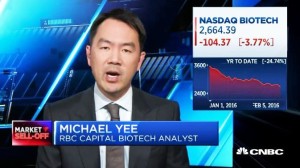
RBC Capital Markets BioTech Analyst Michael Yee and CastleArk Management President & CIO Jerry Castellini discuss the bull and bear cases for biotech stocks.
- ASHP and APhA agree on new PGY1 Community-based Pharmacy Residency Programs standards (americanpharmacynews.com)
The American Society of Health-System Pharmacists and the American Pharmacists Association recently agreed on a new archetype for PGY1 Community-based Pharmacy Residency Programs...ASHP and APhA collaborated to prepare the guidelines, which has been the practice since the two agencies partnered up in 1999. The partnership was formed to accredit community-based residency training programs...The new model mirrors current trends regarding how today’s pharmacies are conducting business...The Community-based Pharmacy Residency Accreditation Taskforce that is responsible for the augmentation of the standards will continue its work on associated Competencies, Goals and Objectives as well as the document as a whole. All of these documents will be released this year. Mandatory execution of the new guidelines is expected by July 2017.
- GPhA responds to Congressional hearing on BCPIA (drugstorenews.com)
The House Energy and Commerce Committee convened...to hold an oversight meeting about the Biologics Price Competition and Innovation Act of 2010...Among the stakeholders in the enactment of the law is the Generic Pharmaceutical Association’s Biosimilars Council...GPhA president...Chip Davis commented on the hearings, noting the need for more straightforward naming conventions for biologics and biosimilars and calling for price calculations that ensure sufficient reimbursement from the Centers for Medicare and Medicaid Services...Biosimilars Council...is concerned that different international nonproprietary names for biologics and biosimilars could lead to patient and provider confusion, increasing the likelihood of prescribing errors...The Council also urges [CMS] to provide non-interchangeable biosimilars with a unique average sales price calculation and billing code, to ensure a competitive reimbursement…
- NFL games are magnets for drug ads. But the Super Bowl isn’t. Here’s why (statnews.com)Ten Super Bowl Commercials You May See (forbes.com)

If you’re a football fan, you’re probably used to seeing ads for erectile dysfunction drugs. And arthritis drugs. And psoriasis drugs. Televised NFL games are magnets for prescription drug ads...So it’s curious that pharma companies tend not to play on the biggest stage of all — the Super Bowl...There was just one pharma ad in last year’s Super Bowl, and so far, none have been announced for this year. Here are three reasons why:
- The glare of the spotlight can be harsh
- It’s expensive
- The audience is too diluted
- Genomics for Precision Drug Therapy in the Community Pharmacy (bcpharmacy.ca)
Thirty-three community pharmacies have taken part in North America’s first research project that ultimately aims to bring the science of pharmacogenomics to patients using their community pharmacy. Pharmacogenomics uses a person’s genetics to uncover which drugs and in what dosage work best for them...The project, called "Genomics for Precision Drug Therapy in the Community Pharmacy", was funded by the BC Pharmacy Association and Genome British Columbia with research being done by a team at the University of British Columbia’s Faculty of Pharmaceutical Sciences...he project set out to position the pharmacist as the health-care provider through which patient genetic information can be acquired, assessed and used to guide drug therapy decisions...This is where the future of pharmacy is heading...We showed that pharmacy can be the gateway to personalized medication in our communities...Regardless of the location – urban or rural – patients had a consistent, quality experience with their community pharmacist as it relates to pharmacogenomics....
- New Ohio law expands pharmacists’ care (pharmacist.com)
Congratulations to our pharmacist colleagues in Ohio! Under a new bill that was recently signed into law, Ohio pharmacists will now have more responsibility and fewer restrictions in collaborative practice...HB 188 provides new consult agreement provisions that allow Ohio pharmacists to order blood and urine tests, analyze the results of those tests, and modify a patient’s drug therapy regimen. The law also allows pharmacists to order medication refills in a small amount for patients with life-threatening illnesses when a physician can’t be reached. It will also streamline consult agreement paperwork so that multiple pharmacists can have a collaborative agreement with multiple physicians to oversee medications for multiple patients...This is a huge win for pharmacists in Ohio and is an excellent example of how collaboration among pharmacists, physicians, patients, and legislators can expand our scope of practice...
- Medi-Cal Expands Access to Pharmacy-Based Immunizations (myemail.constantcontact.com)California Pharmacist Association - Payment for Pharmacist Services - White Paper (cpha.com)
Last week, the Department of Health Care Services announced the addition of a number of adult vaccines to the Medi-Cal fee-for-service outpatient drug benefit. This means that Medi-Cal beneficiaries in the statewide fee-for-service network can now receive coverage for adult immunizations when administered in a pharmacy. Newly added vaccines include those for Hepatitis A, Hepatitis B, HPV, MMR, and more. Coverage does contain vaccine-specific restrictions...CPhA (California Pharmacist Association) applauds this coverage change to improve patient access to pharmacists' services. "We are excited to see momentum in many areas of SB 493 implementation, including expanded immunizations," said CPhA President Sarah McBane, PharmD. "As more of SB 493's authorities gain recognition by Medi-Cal and other payers, pharmacists stand ready to assist our patients."
- SafeMed: Using pharmacy technicians in a novel role as community health workers to improve transitions of care (japha.org)
...the SafeMed program, which uses certified pharmacy technicians in a novel expanded role as community health workers (CPhT-CHWs) to improve transitions of care...The SafeMed experience demonstrates that...CPhT-CHWs are well suited for novel expanded roles to improve care transitions...can play a key role in care transition programs targeting superutilizing patients with complex medical and social needs. As CMS intensifies readmission penalties and providers bearing financial risk seek to reduce overall health care costs, low-cost CPhT-CHWs serving as pharmacist extenders may become an increasingly attractive component for health systems...CPhT-CHWs can assist with identification and reporting of potential DTPs identified during home visits and telephone follow-up and can coordinate with pharmacists in real time to enable patients to get targeted MTM when and where they need it. They can also assist pharmacists in scheduling outpatient CMRs and support sessions for the patients...In collaboration with state pharmacy boards, pharmacist associations, and regional community colleges, the SafeMed model can be successfully scaled to serve superutilizing patients in readmission hotspots throughout the country.
- Insurer Obamacare Losses Reach Billions Of Dollars After Two Years (forbes.com)
After two years offering uninsured Americans subsidized products on public exchanges, health insurance companies have been hard-pressed to find financial success in this segment of the Affordable Care Act with losses reaching billions of dollars for the industry...UnitedHealth Group lost more than $720 million on its public exchange business last year and United is a small player in this market compared to Anthem, which operates Blue Cross and Blue Shield plans in 14 states, and said money-losing Obamacare plans caused profits to fall 64 percent in the fourth quarter. Aetna, which hopes to finalize its acquisition of Humana later this year, said last week individual coverage sold under the health law "remained unprofitable" last year...For insurers, the problem has largely been a major increase in medical expenses from these new patients, who were previously uninsured. From an actuarial standpoint, the health plans say they didn’t know what they would be getting and therefore needed more healthy people to buy premiums to cover the costs of the sick.
- AmerisourceBergen fiscal 2016 Q1 revenue up 9.3% (drugstorenews.com)AmerisourceBergen and Publix Announce Distribution Agreement (businesswire.com)
AmerisourceBergen...reported a revenue increase of 9.3% to $36.7 billion for the fiscal 2016 first quarter...Our recent acquisitions, MWI Veterinary Supply and PharMEDium, as well as strong contributions from our specialty business and our international businesses helped overcome a challenging year over year comparison and a sharper than expected decline in generic inflation…AmerisourceBergen posted a 7% increase in Pharmaceutical Distribution revenue, which includes both AmerisourceBergen Drug Corporation and AmerisourceBergen Specialty Group...Pharmaceutical Distribution revenues were $35.2 billion. ABDC revenues increased 5%, due primarily to solid organic sales growth from the wholesaler's chain retail, independent pharmacy and health systems customers. ABSG revenues increased 15%, which was driven by strong performance in the company's oncology business and by sales growth in ABC's blood products, vaccine and physician office distribution businesses...