
- The Top 15 Pharmacies of 2015 (drugchannels.net)Largest U.S. Pharmacies Ranked by Total Prescription Revenues, 2015 (pembrokeconsulting.com)
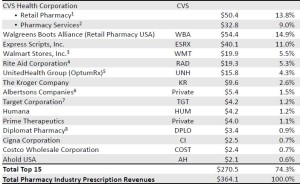
Next week, Drug Channels Institute will release our updated, revised, and expanded 2016 Economic Report on Retail, Mail, and Specialty Pharmacies...provides a sneak peek at the largest pharmacies, ranked by total U.S. prescription dispensing revenues for calendar year 2015…We estimate that total revenues of retail, mail, and specialty pharmacies reached $364.1 billion in 2015, up 12.1% from 2014. The top tier of dispensing pharmacies—CVS Health, Walgreens Boots Alliance, Express Scripts, Walmart, Rite Aid, and UnitedHealth Group’s OptumRx—accounted for about 64% of U.S. prescription dispensing revenues in 2015...many of the largest pharmacies are now central-fill, mail and specialty pharmacies operated by such PBMs and payers as Express Scripts, Caremark, and UnitedHealth. This reflects the growing role of specialty drugs in the pharmacy industry. We estimate that specialty drugs account for 35% or more of revenues at these pharmacies.
- Surgeon Receives 78 Months in Prison for Distributing Oxycodone (dea.gov)

Jeffrey Gundel...an orthopedic surgeon from Gansevoort, New York, was sentenced today to 78 months in prison for illegally authorizing the distribution of tens of thousands of oxycodone pills...Gundel pleaded guilty to one count of unlawful distribution of oxycodone...admitted that...he wrote over 200 prescriptions authorizing the dispensation of at least 59,520 30-milligram oxycodone tablets for no legitimate medical purpose. Gundel also admitted that he received cash kickbacks after co-conspirators filled the prescriptions and sold the oxycodone pills on the black market...
- AG calls on Gilead to lower price of hepatitis C medicines (bostonglobe.com)Does it break the law to charge a lot for a cure? (theincidentaleconomist.com)
Massachusetts Attorney General...opening a new front in the push to boost access to life-saving drugs, has warned the country’s biggest biotech company that it faces possible legal action unless it lowers the price of two popular hepatitis C medicines...In a letter to Gilead Sciences Inc., made public Wednesday, the attorney general wrote that the high price of the company’s Sovaldi drug, which costs $84,000 for a full 12-week course of treatment, and its Harvoni regimen, at $94,500, "may constitute an unfair trade practice in violation of Massachusetts law" because they are too expensive for many patients...While other state attorneys general have sued drug makers seeking larger Medicaid rebates or discounts, her office is believed to be the first to consider using a state consumer protection law to charge a company with overpricing its products...
- Nevada’s health insurance exchange nears 80,000 enrollees (reviewjournal.com)

With four days left in the sign-up period, Nevada's health insurance exchange is closing in on 80,000 customers...Nevada Health Link had enrolled 79,055 people by Saturday, the U.S. Department of Health and Human Services said Wednesday...The sign-ups include automatic renewals from 2015, though the federal government didn't break down numbers by existing versus new enrollments...With three days left until the Jan. 31 enrollment deadline, Nevada Health Link has already bested the 72,000 sign-ups it had a year ago.
- FDA finds Indian drug maker Wockhardt hid failed tests (reuters.com)

Indian drugmaker Wockhardt hid the results of failed tests and deleted data from its systems at a plant in western India, according to a report by the U.S. Food and Drug Administration...Issues around "data integrity", maintaining accurate and consistent databases, are key to the U.S. watchdog, which regulates the world's largest market for generics producers...Wockhardt is the latest of several major players in the $15 billion Indian drugs industry to be hit by U.S. regulatory action over the past few months...It makes around a fifth of its $670 million in annual revenues from the United States...FDA inspectors also reported finding pharmaceutical ingredients that were not stored or labeled properly. A rejected drug batch was stored in the "approved material" area, and some batches did not carry expiry dates, the report said.
- 10 trends in cyberattacks in healthcare, other industries, new survey shows (healthcareitnews.com)SPECIAL REPORT Worldwide Infrastructure Security Report (arbornetworks.com)
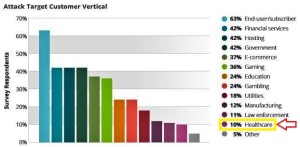
This year the top motivation wasn’t hacktivism or vandalism, but 'criminals demonstrating attack capabilities,' Arbor Networks report claims....Cyberattacks around the world are growing in size and complexity, according to Arbor Networks 11th Annual Worldwide Infrastructure Security Report...For the first time, nearly half of the respondents were from enterprise, government and educational organizations, with service providers at 52 percent. Healthcare is one of the verticals included in the enterprise category...This report provides broad insight into the issues network operators around the world are grappling with on a daily basis...The findings from this report underscore that technology is only part of the true story since security is a human endeavor and there are skilled adversaries on both sides.
Distributed Denial of Service trends:
- Change in attack motivation
- Attack size continues to grow
- Complex attacks on the rise
- Cloud under attack
- Firewalls continue to fail during DDoS attacks
Advanced threat trends:
- Focus on better response
- Better planning
- Insiders in focus
- Staffing quagmire
- Increasing reliance on outside support
- US insurers dragging feet on covering new drugs, Novartis says (reuters.com)

Getting U.S. government and commercial insurers to cover new medicines can now take longer than in Europe, Swiss drugmaker Novartis said on Wednesday, blaming U.S. delays for weaker than expected sales of a key heart failure treatment...Novartis said poor sales of one of those new drugs, its heart failure treatment Entresto - just $5 million for the fourth quarter, well off expectations of analysts as well as the company - resulted from delays in making new medicines available to insured patients...European insurers and governments were now faster to reimburse for medicines such as Entresto and Novartis's new psoriasis and arthritis drug Cosentyx than those across the Atlantic...They (in the U.S.) have really developed their tools extensively around introduction of new drugs, which creates a period of time where access is difficult...And that period of time is now longer than it is in Europe...
- Do Pharmacy School Deans Need to Be Pharmacists? (pharmacytimes.com)Should a Pharmacy Dean be a Pharmacist? (ajpe.org)Point/Counterpoint: Should a Pharmacy Dean be a Pharmacist? (ajpe.org)

Craig K. Svensson, PharmD, PhD, Dean of the College of Pharmacy, Purdue University
Is it necessary for a pharmacy school leader to be a practicing or former pharmacist?...current dean of the Purdue College of Pharmacy, argued that having a pharmacy school dean who lacks experience as a pharmacist is perhaps not the best option...It appears pharmacy is unique among health profession programs in its acceptance of being led by individuals inexperienced in the profession prior to their appointment…14% of accredited pharmacy schools have deans who are not pharmacists...While most non-pharmacist deans were long-standing faculty members in a pharmacy program prior to their appointment, some had no apparent experience within academic pharmacy or the profession overall...5 main reasons a pharmacy dean should ideally be a pharmacist were credibility, connectivity, breadth of knowledge, cheerleading, and foresight...professor and chairman of medicinal chemistry at the University of Michigan College of Pharmacy...gave his opposing views...pharmacy school deans need to be qualified to "provide leadership in pharmacy professional education."...pharmacy schools don’t just churn out pharmacists; some schools have a more "diverse mission" involving biomedical research and academic programming. So, a dean’s experience training students to become pharmacists would be just one of many useful skillsets...
- Ancient medicinal clay shows promise against today’s worst bacterial infections (worldpharmanews.com)Kisameet Clay Exhibits Potent Antibacterial Activity against the (mbio.asm.org)

Naturally occurring clay from British Columbia, Canada - long used by the region's Heiltsuk First Nation for its healing potential - exhibits potent antibacterial activity against multidrug-resistant pathogens, according to new research from the University of British Columbia...The researchers recommend the rare mineral clay be studied as a clinical treatment for serious infections caused by ESKAPE strains of bacteria (Enterococcus faecium, Klebsiella pneumoniae, Acinetobacter baumannii, Pseudomonas aeruginosa, and Enterobacter species) - cause the majority of U.S. hospital infections and effectively 'escape' the effects of antibacterial drugs...Infections caused by ESKAPE bacteria are essentially untreatable and contribute to increasing mortality in hospitals...After 50 years of over-using and misusing antibiotics, ancient medicinals and other natural mineral-based agents may provide new weapons in the battle against multidrug-resistant pathogens..
- Pharma tracks consumer lawsuit in Arizona for clues to future liability (statnews.com)

In a split decision for the pharmaceutical industry, the Arizona Supreme Court issued an opinion that has drug makers both encouraged and worried as they track the progress of a case that may have an outsized impact on consumer lawsuits filed in the state...The case was brought by Amanda Watts, a young woman who claimed she developed lupus and hepatitis after taking an acne treatment made by Medicis Pharmaceutical...She contended the company failed to provide proper side effect warnings. A state appeals court sided with Watts, which prompted Medicis to try to have the decision overturned...Watts has argued over two points that alarm drug makers...The loss of uniformity in liability standards for prescription medicines will subject pharmaceutical manufacturers to fundamentally different standards of liability in each state...(1) A key argument Watts made is that a long-standing industry defense against consumer lawsuits conflicted with another state law about deciding who may be at fault when there is harm. Known as the learned intermediary, this defense says drug makers cannot be held liable if a consumer suffers harm from a medicine — so long as all risk information was appropriately conveyed to the patient’s physician...The state Supreme Court gave drug makers a lift by deciding that the learned intermediary is a legitimate defense...(2) Meanwhile, the pharmaceutical industry will be watching whether Watts wins her argument over consumer fraud violations. Although drug makers argue their customers are actually physicians, the state Supreme Court opined that a direct transaction between a drug maker and a patient is not required for a consumer to claim fraud in the event that misrepresentation resulted in injury...It could be a game changer...