
- American Emergency Rooms Are Facing Critical Drug Shortages (psmag.com)Longitudinal Trends in U.S. Drug Shortages for Medications Used in Emergency Departments (2001–2014) (onlinelibrary.wiley.com)
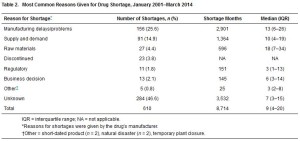
The shortfalls reveal deep problems in the market forces that control drug supply and demand...Over the past 14 years, American emergency rooms have faced more than 600 drug shortages, according to an analysis published last week in Academic Emergency Medicine. Among those shortages were lacks of life-saving, one-of-a-kind drugs such as naloxone...it's not just emergency rooms, though emergency medicine might be especially affected because production of injectable drugs is the most likely to come up short...the...analysis found that more than half of the missing emergency meds were for acute or life-threatening conditions. In most cases, doctors could substitute another drug for the missing one, but they were unable to do so five percent of the time...Why do these shortages occur? In the database the emergency-room researchers analyzed, the most commonly cited reason was a drug-plant shutdown due to quality control problems. But there are likely deeper causes. Those who buy injectable drugs for hospitals tend to choose the cheapest generics, without paying attention to quality...Another theory: The way hospital drugs are purchased encourages only a few companies to make generics, so when one company's factories go down, there's no one around to make up for the shortfall.
- Novartis agrees to settle sex discrimination suit for $8m (statnews.com)
After less than a year of litigation, Novartis has agreed to pay $8.2 million to settle a proposed collective class action lawsuit filed by more than a dozen female employees who claimed they were denied equal pay and promotional opportunities because of their gender...The settlement, which must still be approved by a federal court in New York, would involve much less than the $110 million that was initially sought by former and present employees at the company’s Alcon Laboratories eye product unit...the women claimed the company fostered “a boys’ club atmosphere and mentality” that is hostile to women and restricts access to leadership positions, according to court documents...The lawsuit also came nearly six years after the drug maker agreed to pay $152.5 million to settle a gender-discrimination class action lawsuit brought by several female sales representatives. In that case, the company reached a deal after a jury awarded $250 million to the sales reps.
- Alibaba health care unit stumbles into 2016 as deal on online pharmacy business runs into delays (scmp.com)

The expansion plans of Alibaba Health Information Technology, the Hong Kong-listed health care subsidiary of e-commerce giant Alibaba Group, have stumbled out of the gate this year as the US$2.5 billion deal to acquire its parent’s online pharmacy business gets delayed...In a regulatory filing on Monday, Ali Health chief executive Wang Lei said “additional time is required for the relevant conditions” to complete that proposed acquisition...Beijing Chuanyun is an offshore holding vehicle that controls Alibaba’s online pharmacy operations, which is run under internet shopping platform Tmall.com...In April, Alibaba agreed to transfer that online pharmacy business to Ali Heath in exchange for US$2.5 billion worth of newly issued shares and convertible bonds...The delay in completing the online pharmacy acquisition could further challenge Ali Health with turning a profit as it continues in investment mode...Alibaba’s online pharmacy business on Tmall recorded a gross merchandise value of 4.74 billion yuan in the company’s fiscal year...There are 186 online-licensed pharmacies offering over-the-counter drugs, medical devices, contact lenses and other general health care products on Tmall...
- 2015: Another Strong Year for Patients in Need of New Drug Therapies (blogs.fda.gov)Novel New Drugs Summary 2015 (fda.gov)
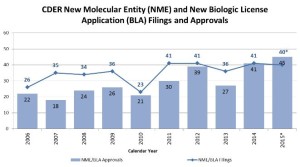 I’m (John Jenkins,Director of the Office of New Drugs) pleased to report another strong year for FDA approvals of novel new drugs, which offer many patients new treatment options for serious and life-threatening conditions. In 2015, FDA’s Center for Drug Evaluation and Research approved 45 novel new therapies – significantly more than the average of 28 we have approved during the previous nine years of this decade...During this past year, we approved many new drugs to treat various forms of cancer, including four to treat multiple myeloma, and others to treat lung, skin, breast, brain, colorectal, and other cancers. We also approved new drugs to treat heart failure, high cholesterol, cystic fibrosis, and irritable bowel syndrome, as well as the first approved reversal agent for a commonly-used blood thinner...Here are a few highlights of these approvals:
- More than one-third of the novel new drugs CDER approved in 2015 were identified by FDA as “first-in-class,” for example, drugs that use a new and unique mechanism of action for treating a medical condition;
- More than 40% of these new therapies were approved to treat rare or “orphan” diseases that affect 200,000 or fewer Americans–Americans who often have few or no drug treatment options;
- 60% of CDER’s novel new approvals for 2015 were designated in one or more categories of Fast Track, Breakthrough, Priority Review, or Accelerated Approval. Each of these designations helps speed the development and/or approval process and is designed to help bring important medications to the market as quickly as possible; and
- 64% of CDER’s novel new approvals were approved first in the United States before any other country.
- Grim Job Outlook for Retail Pharmacists, says BLS (drugchannels.net)
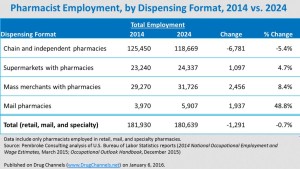
The New Year is here—let’s kick it off with some good news/bad news for pharmacists...According to our...analysis of the Bureau of Labor Statistics’ new Occupational Outlook Handbook, drugstores are projected to employ about 7,000 fewer pharmacists in 2024 than they do today...The good news? Pharmacists jobs in non-retail settings—hospitals, doctor’s office, and clinics—will add more jobs than the ones lost from retail...Employment will increase at other outpatient dispensing formats, with mail pharmacies experiencing the largest percentage increase..."Demand is projected to increase for pharmacists in a variety of healthcare settings, including hospitals and clinics. These facilities will need more pharmacists to oversee the medications given to patients and to provide patient care, performing tasks such as testing a patient’s blood sugar or cholesterol…Employment of pharmacists in traditional retail settings is projected to decline slightly as mail order and online pharmacy sales increase."
- Will U.K.’s Big 3 Health-Care Stocks Bounce Back in 2016?: Chart (bloomberg.com)
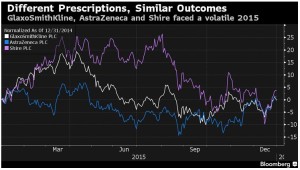
Here’s what lies ahead in 2016 for each company:
- GlaxoSmithKline: CEO Andrew Witty will attend both the J.P. Morgan health-care conference in San Francisco and the World Economic Forum in Davos this month. Shares of the U.K.’s biggest drugmaker have tumbled more than 20 percent since mid-2013. With generics snapping at the heels of its best-selling lung drug Advair, Glaxo has been touting new medicines while shunning large-scale M&A deals.
- AstraZeneca: After spurning a takeover by Pfizer Inc. in 2014, CEO Pascal Soriot has built the company up with small- to mid-sized acquisitions and licensing deals, focusing on drugs for cancer, respiratory disease and diabetes. Generic versions of its blockbuster cholesterol pill Crestor will hit the market in May. Results from several key cancer drug trials are expected in the second half of this year.
- Shire: The smallest of the three companies is said to be in advanced talks with Baxalta Inc. to become the world’s biggest maker of rare-disease drugs. Shares have dropped 21 percent since Aug. 3, the day before its $30 billion offer for Baxalta was made public. On the product front, Shire awaits U.S. approval of a key drug for dry-eye disease called lifitegrast, expected late this year.
- Poor sales prompt Sanofi to pull plug on Mannkind inhaled insulin (reuters.com)
Sanofi is to stop selling an inhalable insulin developed by Mannkind, following disappointing sales of the product since its launch in February 2015...The decision to terminate the collaboration marks a blow for the idea of delivering insulin through an inhaler, rather than by injection...Rights to Afrezza will revert to Mannkind from Sanofi...Mannkind said it was reviewing strategic options for the product, although analysts questioned if the drug had any future...We can't imagine that another legitimate diabetes company would show serious interest in this asset...With little hope for resuscitating Afrezza and a dismal balance sheet (net debt), we see Mannkind in an increasingly precarious position...
- Maker of generic version of Nexium goes blue to settle litigation (statnews.com)

Dr. Reddy’s Laboratories is feeling blue over a purple pill...The generic drug maker last week agreed to change the color of its new version of the Nexium heartburn medicine from purple to blue in order to settle a lawsuit that was filed by AstraZeneca....For more than two decades, AstraZeneca has capitalized on a marketing campaign that labeled its two widely prescribed heartburn drugs — first, Prilosec and then Nexium — as “the Purple Pill.” But after Dr. Reddy’s last September began selling a lower-cost generic version, which resembled the brand-name drug, AstraZeneca claimed the Indian drug maker was ripping off its trademark look...
- UNR student in end-of-life case dies in Reno (rgj.com)Fight over UNR student on life support back in court (rgj.com)
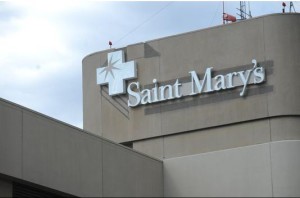
A 20-year-old woman at the center of an end-of-life court battle over her treatment at a Reno hospital has died while still on life support...Aden Hailu died about 4:30 p.m. Monday at Saint Mary’s Regional Medical Center, where she never awoke from anesthesia after surgery April 1, said David O’Mara, the attorney representing Hailu’s father and family...Hailu’s father, Fanuel Gebreyes, lost a bid in court last week to delay brain electroencephalogram, or EEG, tests that the hospital said would show she was brain dead and wouldn’t recover...Hailu was from Las Vegas and was a freshman at the University of Nevada, Reno...Doctors say she suffered severe low blood pressure and a lack of oxygen to the brain during surgery to remove her appendix and explore the cause of unspecified abdominal pain, according to court documents.
- Pharmacists recognised in 2016 New Year’s honours list (pharmaceutical-journal.com)

Several pharmacists and former pharmacists have been recognised in the New Year’s honours list, with four being made Officers of the Order of the British Empire...
- Bill Scott, Scotland’s former chief pharmaceutical officer ...recognised for services to healthcare.
- Norman Morrow, chief pharmaceutical officer for Northern Ireland...was recognised for his contribution to pharmacy.
- David Cowan, professor of pharmaceutical toxicology and director of the drug control centre at King’s College London...was recognised for services to anti-doping science.
- Alan Willson, who began his career as a pharmacist, was honoured for services to the quality and safety of healthcare in Wales.
- Zameer Choudrey — was made a Commander of the Order of the British Empire in recognition of his contribution to the UK wholesale industry.