
- FDA launches Web-based precision medicine platform for next-generation sequencing (healthcareitnews.com)FDA Launches precisionFDA to Harness the Power of Scientific Collaboration (blogs.fda.gov)

Food and Drug Administration...launched the beta version of precisionFDA, its new collaborative platform for the exploration of next-generation gene sequencing...First announced in August, the platform features more than 20 public and private sector participants…Next-generation sequencing enables researchers to compile a vast amount of data on a person's exact order or sequence of DNA...scientists can look for meaningful differences in DNA that can be used to suggest a person's risk of disease, possible response to treatment and assess their current state of health. Ultimately, what we learn about these differences could be used to design a treatment tailored to a specific individual...The hope is to grow this community and improve the usability of precisionFDA in the coming months and years...One way we'll achieve that is by placing the code for the precisionFDA portal on the world's largest open source software repository, GitHub, so the community can further enhance precisionFDA's features...
- It’s official: FDA shoots past 2014’s new drugs record with Roche lung cancer med nod (biopharmadive.com)
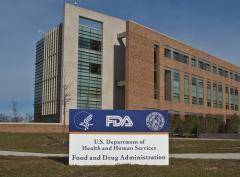
FDA last Friday approved Alecensa (alectinib) for the treatment of ALK-positive non-small cell lung cancer for patients with the disease refractory to therapy with Xalkori (crizotinib). The approval comes well before the drug's March 2016 PDUFA date...This marks the agency's 42nd newly approved medication this year, topping a banner 2014 that saw 41 new drug approvals...there will be a continuing flurry of drug approvals over the next four years (225, to be exact, and most of them in cancer-related therapeutic spaces).
- Hospitals launch specialty pharmacies to curb drug costs (modernhealthcare.com)
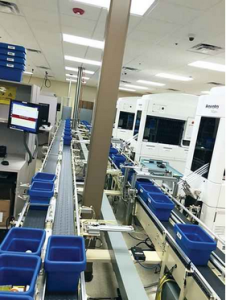
Banner Health spent $1 million on a drug-dispensing robot for its specialty pharmacy's home-delivery service.
With specialty drug spending soaring 60% in the past five years, large health systems have jumped into the specialty pharmacy business to assert some control over those costs by dispensing the drugs to their patients and covered employees...Health systems say those pharmacies help them better manage outpatient drug costs. A growing number of insurance contracts and Medicare initiatives tie payments to quality metrics that reach beyond hospital stays to hold providers accountable for patients' total medical costs, including drugs...Phoenix-based Banner Health started its own specialty pharmacy last year...hired three clinical pharmacists, three patient advocates and three staff members to support operations. The system also spent $1 million on a drug-dispensing robot for the specialty pharmacy's new home-delivery service...In the first year, Banner shaved about 1% off its specialty drug spending for about 1,200 workers and their families covered by the system's employee health plan...Health systems that own specialty pharmacies argue they can do a better job overseeing the use of the drugs they dispense. That's because their pharmacies can easily access medical records, laboratory results and physician notes, allowing pharmacists to closely monitor the effectiveness of the drugs prescribed and react quickly when something goes wrong or patients need help...They know if the patient is getting the value for the high-cost drug...Launching a specialty pharmacy does not require significant capital investment, and the high prices of the drugs—even sold at slim margins—make it possible to quickly see a return on that investment.
- Icahn: Change the international tax code, and Pfizer will drop its ‘travesty’ of a merger (fiercepharma.com)How to Stop Turning U.S. Corporations Into Tax Exiles (nytimes.com)

Carl C. Icahn is the chairman of Icahn Enterprises.
The tax benefits of buying Allergan are Pfizer's No. 1 reason for doing the $160 billion deal. In fact, some analysts see the $2 billion in potential tax savings as the merger's only substantial advantage...Activist investor Carl Icahn is one of those detractors, and on Monday, he amped up the criticism..."The Pfizer-Allergan deal is a travesty," Icahn wrote in a New York Times op-ed. "The point isn't to find corporate synergy. It is to leave behind our uncompetitive international tax system."...But what if those tax savings were moot?
- Survey: Employers taking action to cut specialty drug coverage (drugstorenews.com)
Employers are taking significant action to reduce their exposure to rising costs associated with specialty medicines...Although pharmacy represents approximately 20% of employer-sponsored medical benefits costs, it is increasing at a rate that accounts for roughly half of medical cost inflation and should be a top priority for employers...The price, utilization and delivery of specialty prescription drugs, many of which require special handling or delivery, are a top pain point for employers...employers are beginning to consider new aggressive approaches... employers have added new coverage and utilization restrictions for specialty pharmacy, such as requiring prior authorization or limiting quantities based on clinical evidence... employers plan to exclude compounds from their benefit coverage...the compounding process results in higher cost and their use may not be FDA-approved in compound form, health insurers increasingly will not cover them...
- Marsh Drugs extends free diabetes medicine program through 2016 (drugstorenews.com)
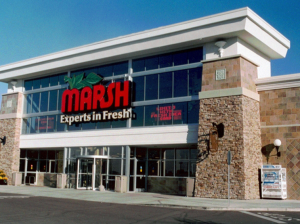
Marsh Drugs last week extended their Diabetes Care Program throughout 2016...Marsh Diabetes Care supplies seven different diabetes medications for free to any Marsh Drugs patients in Indiana...There is no limit on the number of prescriptions that can be filled and the program covers new prescriptions and refills...The free diabetes medications include:
Glipizide - Glipizide ER - Metformin - Metformin ER - Glimepiride - Glyburide - Glyburide Micronized
As part of the program, Marsh Drugs also provides a free 100-count box of universal lancets with a prescription.
- The promise and peril of Ted Cruz’s plan to overhaul the drug approval process (vox.com)
Republican presidential candidate Sen. Ted Cruz and Sen. Mike Lee just introduced a new bill that would completely overhaul the Food and Drug Administration...The main idea: The senators want to expedite approvals for lifesaving drugs, give Congress space to intervene in FDA decisions lawmakers don't like, and expand the drugs and devices Americans have access to by allowing products approved in other countries onto the market...here's what the Reciprocity Ensures Streamlined Use of Lifesaving Treatments Act...would do:
- Allow for "reciprocal approval of drugs, devices and biologics" from "trusted, developed countries" like the European Union, Israel, Australia, Canada, and Japan. This means that if a drug or device is approved in one of these countries, citizens here could access it — and vice versa.
- Create a 30-day window for FDA review of lifesaving drug and device applications, in order to speed them up.
- Instruct the Health and Human Services secretary to approve a drug, device or biologic if "the FDA confirms the product is lawfully approved for sale in one of the listed countries; not a banned device by current FDA standards; there is a public health or unmet medical need for the product."
- Give Congress the power to overrule FDA decisions about promising applications for lifesaving drugs that the FDA rejected.
Right now the FDA is actually the fastest regulatory system in the world, with several expedited approval pathways for important drugs...the agency had approved 96 percent of the applications that came its way in 2015. So, again, how this new legislation — which further speeds up approvals — will solve the real reason better medicines aren't getting to patients remains to be explained.
- Nonprofit vows to lower generic drug costs (bostonglobe.com)
...in this Central Massachusetts town (Blackstone Valley), a small team of drug industry veterans has launched a startup (Drew Quality Group) to counter...price gougers by making affordable generic medicines to treat critical diseases. And they’re doing it as a nonprofit...We want to create a competitor to stabilize the prices...When you end up with a single-source manufacturer, they can charge any price they want...typically have only a single producer, are in short supply either because their manufacturer is grappling with safety problems or there is no domestic supplier and an overseas producer no longer finds it profitable to make drugs to treat small numbers of patients...By operating as a nonprofit, Drew Quality won’t have to pay the same taxes a drug company does. Nor will it have to focus on cost-cutting by sending work overseas...The group wants to employ people close to home and make sure patients get access to therapies they need without being squeezed financially...And while it plans to underprice companies that have boosted prices substantially, Drew Quality will still charge enough to pay its employees and plow some money back into the business...the cost of its generic drugs will be closer to the discounted prices that were charged before companies pushed them higher.
- What’s next for Valeant? (video.cnbc.com)Valeant in new distribution deal with Walgreens (modernhealthcare.com)Walgreens and Valeant Devise a New Twist on Preferred Pharmacy Networks (drugchannels.net)
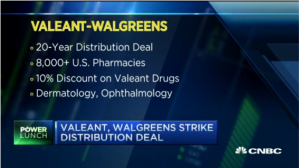
CNBC's Meg Tirrell talks to Valeant CEO J. Michael Pearson about the company's new distribution deal with Walgreens...
- FDA approves first chemo antidote (pharmatimes.com)FDA Approval of VISTOGARD®, the First Antidote to Treat Overdoses and Early-Onset Severe Toxicities Due to 5-Fluorouracil and Capecitabine Chemotherapies (wellstattherapeutics.com)
US regulators have issued a speedy green light for the first and only drug able to treat chemotherapy overdose or severe allergic reactions...The decision allows doctors to use Wellstat/BTG’s Vistogard (uridine triacetate) to treat patients following an overdose of 5-fluorouracil or capecitabine, or in patients exhibiting early-onset, severe or life-threatening toxicity affecting the cardiac or central nervous system...In combination with other drugs or radiation, 5-FU is a mainstay of chemotherapy across various solid tumours, and capecitabine is a prodrug of the chemotherapy that is enzymatically activated within the body and transformed into 5-FU...The approval of Vistogard is important because it represents the first treatment with a demonstrated track record of efficacy and, just as important, it allows some patients to resume chemotherapy sooner following the resolution of the toxicity...