
- Ohio takes steps toward resolution of opioid litigation (pharmacist.com)

Ohio Attorney General Mike DeWine reports the state has begun settlement talks with opioid-makers it has sued alleging illegal marketing, and will meet with a federal judge urging settlement of hundreds of similar suits, in early steps toward resolution of the litigation. DeWine's staff held separate settlement discussions with Johnson & Johnson and Teva Pharmaceutical Industries..."We outlined with them where we feel Ohio needs help—in prevention, education and treatment, as well as the huge problem we’re having with our foster-care system because so many of the parents are addicted," says DeWine. Teva said in a statement, "We appreciate the opportunity to meet with representatives of the Ohio AG’s office to discuss this important public health issue." Johnson & Johnson said: "While we consider the specifics of our discussions with state attorneys general to be confidential, we continue to maintain that allegations made in lawsuits against our company are baseless and unsubstantiated. ... At the same time we recognize that opioid abuse and addiction are serious public health issues that must be addressed...we look forward to being a part of the ongoing dialogue."
- Venezuela $5 Billion In Debt To Pharmaceutical Companies Offers Gold, Diamonds For Medicine (ibtimes.com)

The cash-strapped government of Venezuela offered to trade gold, diamonds and coltan, a rare metal used in cell phones, to pharmaceutical companies the country owes $5 billion in exchange for medicine...Venezuela’s health minister Luis López offered several pharmaceutical companies the goods as an alternative payment for medicine to help stock the bare shelves of the country’s hospitals. Venezuela is $5 billion in arrears to pharmaceutical companies. Tito López who heads, Venezuela’s Pharmaceutical Industry Chamber told the paper that up to 95 percent of medicines available in the country three years ago are no longer there...It’s unclear whether any pharmaceutical company accepted the offer...The attempt at bartering for medicine showcased the dismal economic situation in Venezuela that could be up to $150 billion in debt. Financial mismanagement and a drop in oil prices, a commodity the country relied on, have led to the humanitarian crisis the country now finds itself in. The country also faces U.S. financial sanctions because of the country’s restrictive communist government which the U.S. has called corrupt.
- Laughter: The Medicine That Has a ‘$0 Copay and Unlimited Refills’ at This Funny Man’s Pharmacy (pharmacytimes.com)What its like to be a pharmacist in a bad neighborhood (youtube.com)

Maurice Shaw is a pharmacist/comedian who sees the funny side of pharmacy life. A pharmacy manager, he attended Chicago State University College of Pharmacy, and completed a Community Pharmacy PGY1 residency with the University of Iowa Hospitals and Clinics. He also makes hilarious videos portraying what pharmacists go through every day, from complaining customers to disorderly technicians. Maurice was happy to talk to Pharmacy Times about his videos
- Philippines fines Sanofi, suspends clearance for Dengvaxia (reuters.com)Families target Philippine officials and Sanofi executives with request for criminal charges (fiercepharma.com)
The Philippines has fined Sanofi $2,000 and suspended clearance for the French drug maker’s controversial dengue vaccine Dengvaxia, citing violations on product registration and marketing, its health secretary said on Thursday...Concerns over the dengue immunization of nearly 734,000 children aged nine and above resulted in two Philippine congressional inquiries and a criminal investigation as to how the danger to public health came about...The country ordered Sanofi to stop the sale, distribution and marketing of Dengvaxia after the company last month warned the vaccine could worsen the disease in some cases...The Food and Drugs Administration of Philippines found Sanofi violating post-marketing surveillance requirements...
- Pharmacy Week in Review: January 12, 2018 (pharmacytimes.com)

Nicole Crisano, PTNN. This weekly video program provides our readers with an in-depth review of the latest news, product approvals, FDA rulings and more.
- Trump’s pick to head HHS balks at having government negotiate drug prices (cnbc.com)
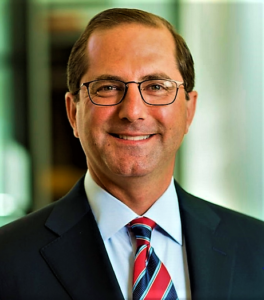
Alex Azar, Secretary of Health and Human Services,
While President Donald Trump has repeatedly expressed support for allowing the government to negotiate drug prices, his pick to head the U.S. Health and Human Services Department, Alex Azar, says he doesn't think it would be the magic bullet that would bring costs down..."Where we can do so that preserves innovation, that preserves access for patients, I want anything that's going to help us with drug pricing…I think that we should be looking at those approaches," said Azar..."If the government is the purchaser, let's say for instance, we are going to be buying (drugs) as part of the opioid crisis program, and we're directly buying that and supplying it out to states and first responders, there's absolutely nothing wrong with the government negotiating that,"...But when it comes to allowing the Medicare program to negotiate drug prices, that's where Azar splits with Trump. Under current law, private Medicare Part D drug plans administered by insurers do negotiate drug discounts, but the traditional Medicare program is prohibited from doing so...
- Pharmacy Week in Review: January 5, 2018 (pharmacytimes.com)

Nicole Crisano, PTNN. This weekly video program provides our readers with an in-depth review of the latest news, product approvals, FDA rulings and more.
- Drug Charity Sues U.S. Over Restrictions on Donor Communications (ptcommunity.com)

DOJ is investigating drug-makers’ financial support of patient-assistance charities...A U.S. charity offering assistance to patients for their out-of-pocket drug costs has sued the federal government over restrictions on its ability to communicate with drug-makers who donate to it...The charity, Patient Services, Inc., filed the lawsuit in federal court in Richmond, Virginia. It comes amid a Justice Department investigation into drug-makers’ financial support of patient-assistance charities...Drug-makers are prohibited from subsidizing copayments for patients enrolled in Medicare, but they may donate to nonprofits providing copay assistance as long as the charities are independent. Amid increased attention to rising drug prices, concern has arisen that drug-makers’ donations to such charities may be contributing to price inflation.
- Telepharmacy at rural hospitals provides big savings, quality improvements (healthcareitnews.com)

Grand River Hospital and Medical Center, a 13-bed critical access hospital in Western Colorado which sees an average of seven patients a day, has saved about $300,000 in staffing costs by using telehealth tools to establish a round-the-clock pharmacy...Telehealth products and services is on the rise among small and rural hospitals...for instance, NewYork-Presbyterian forged a pact to provide emergency physicians via Walgreens in-store kiosks...Cleveland Clinic inked an arrangement with CVS to use American Well’s telemedicine platform to make clinicians accessible for visits from CVS Minute Clinics in Ohio...Telepharmacy has become its own specialty among tech vendors, including CPS TELEpharmacy, eVisit, PipelineRx, ScriptPro Telepharmacy and TelePharm...Nancy McClew, PharmD, director of pharmacy at Grand River Hospital and Medical Center, said the investment in the telemedicine technology is well worth it compared with the cost of staffing the pharmacy 24/7...“Grand River also has generated savings through tele-pharmacist interventions, the majority of which are safety related – clarifications, QI, prevention, renal assessment, therapeutic,” McClew said. “In Q3 2017, pharmacists documented more than 350 interventions, representing more than $50,000 in cost savings.”
- Australia to permit medicinal cannabis exports in bid to capture lucrative market (reuters.com)
Australia said on Thursday it planned to become the fourth country in the world to legalise medicinal marijuana exports in a bid to score a piece of the estimated $55 billion global market...Cannabis cultivation in Australia is still relatively small, as recreational use remains illegal. But the government hopes domestic medicinal use, legalised last year, and exports will rapidly boost production...“Our goal is very clear: to give farmers and producers the best shot at being the world’s number one exporter of medicinal cannabis,” Health Minister Greg Hunt told reporters in Melbourne...Shares in the more than a dozen Australian cannabis producers listed on the local exchange soared after the announcement...The Australian government’s proposal needs to pass federal parliament when it returns to session in February. The country’s main opposition Labor Party has signalled it would support the move.