- U.S. Proposes Deep Cuts to Some Drug Payments Under Medicare (bloomberg.com)The Booming 340B Contract Pharmacy Profits of Walgreens, CVS, Rite Aid, and Walmart (drugchannels.net)The 340B Program Hits $16.2 Billion in 2016; Now 5% of U.S. Drug Market (drugchannels.net)What I Told HHS Secretary Tom Price About the 340B Drug Pricing Program (drugchannels.net)
The U.S. Medicare program...proposed deep cuts to how much it reimburses hospitals to buy drugs under a policy that gives some health facilities access to cheaper medicines...The proposal...by the Centers for Medicare and Medicaid Services, would change the rate paid to hospitals for drugs under what’s known as the 340B program. The program gives hospitals who serve many poor patients access to deep discounts on some drugs. The new proposal would significantly cut the payments hospitals receive for those medications...Medicare would essentially be clawing back most of the discount from hospitals, (without any impact to payment made to drug manufacturers)…Medicare would pay hospitals for drugs purchased through the 340B discount program at a price more consistent with the actual cost hospitals and other providers pay to acquire those drugs. Seniors would see those savings passed on to them in the form of lower copays...The changes would cut seniors’ drug costs in Medicare by $180 million a year...Currently, hospitals are reimbursed for the drugs at their average sales price, plus 6 percent. The proposed rule would pay average sales price, minus 22.5 percent. The proposal would selectively hurt hospitals serving the poor, said Tom Nickels, executive vice president of the American Hospital Association.
- This Week in Managed Care: July 14, 2017 (ajmc.com)
Kelly Davio, Welcome to This Week in Managed Care from the Managed Markets News Network
- Biosimilar Uptake Challenges: Low-Cost Specialty Drugs Reduce Provider Profits (specialtypharmacytimes.com)

Biosimilars are heralded as an affordable alternative to expensive biologic medications. Despite their potential to reduce the overall cost of treatment, prescriber uptake has been slow. The primary barrier points towards the current reimbursement model: "buy-and-bill."...CMS incentivizes biosimilar use through differential reimbursement, but private payers generally do not use this approach...In new study...investigators examined the dynamics across provider types to determine the impact of provider setting and payer mix on biosimilar adoption...The health care system uses the "buy-and-bill" reimbursement model because biosimilars are administered by injection or infusion. Under this structure, providers are reimbursed for biologics with an additional percentage of the product price added to cover acquisition, storage, and dispensing costs associated with care...This environment disincentives providers from favoring lower-cost biosimilars because reimbursement for biologics typically ranges from 6% of the drug’s average sales price under Medicare coverage to a more robust 9% to 10% reimbursement from typical commercial plans…In designing this coverage model, CMS...mandated that physicians who dispense biosimilars will be reimbursed at ASP plus 6% of the...price,"..."While this mandate was enacted to remove a disincentive for prescribing biosimilars for patients on Medicare, it does not address considerations for patients covered by commercial insurers."...Patients with commercial insurance represent the majority of billings for most providers in the United States…
- The Booming 340B Contract Pharmacy Profits of Walgreens, CVS, Rite Aid, and Walmart (drugchannels.net)
Pharmacies continue to ride the 340B Drug Pricing Program’s explosive growth...Our latest...analysis finds that nearly 20,000 pharmacy locations now act as a contract pharmacy for the hospitals and other healthcare providers that participate in the 340B Program. Fewer than 3,000 pharmacy locations were in the program in 2010...Large retail pharmacy chains' rapid expansion into 340B suggests superior profits...How many prescriptions do contract pharmacies provide at discounted prices to uninsured, underinsured, and low-income patients? Are pharmacies engaged in profit-sharing agreements with 340B hospitals? Are they earning fees that far exceed fair market value standards? Who is really benefiting from the contract pharmacy boom?...For instance, an Office of Inspector General study of 340B contract pharmacies found that two out of three hospitals did not offer the 340B discounted prescription price to uninsured patients via these pharmacies…we...have no transparency into the behavior of these 340B contract pharmacies. None of the public companies reports any information about its participation in the 340B program.
- Big-Data Analysis Points Toward New Drug Discovery Method (technologynetworks.com)Reversal of cancer gene expression correlates with drug efficacy and reveals therapeutic targets (nature.com)
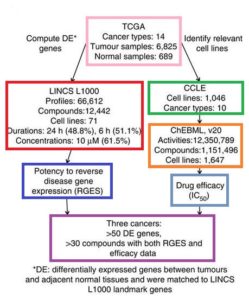
A research team led by scientists at UC San Francisco has developed a computational method to systematically probe massive amounts of open-access data to discover new ways to use drugs, including some that have already been approved for other uses...The method enables scientists to bypass the usual experiments in biological specimens and to instead do computational analyses, using open-access data to match FDA-approved drugs and other existing compounds to the molecular fingerprints of diseases like cancer. The specificity of the links between these drugs and the diseases they are predicted to be able to treat holds the potential to target drugs in ways that minimize side effects, overcome resistance and reveal more clearly how both the drugs and the diseases are working...Our hope is that ultimately our computational approach can be broadly applied, not only to cancer, but also to other diseases where molecular data exist, and that it will speed up drug discovery in diseases with high unmet needs...I’m (Bin Chen, PhD) most excited about the possibilities for applying this approach to individual patients to prescribe the best drug for each...
- Updating drug labels would greatly help patients — but few companies do it (statnews.com)
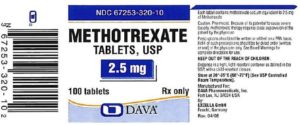
Unfortunately, information contained in the label often lags far behind the evolution of a drug’s use. Drug makers can update product labels to include additional uses when new data supports such modifications. In many cases, though, they don’t do this because there’s little incentive to do so, especially when a drug is no longer being actively marketed or when its patent has expired and it faces generic competition...The problem is widespread...Friends of Cancer Research, found that leading oncologists recommended additional uses beyond those listed on product labels for 79 percent of cancer drugs approved between 1999 and 2011. This means that a large number of well-accepted uses of cancer drugs that emerge over time are completely absent from drug labels...Take the drug methotrexate. Despite being the standard of care for a large number of rheumatologic conditions, the drug label lists only three. When labels are missing critical information like this, particularly regarding diseases other than cancer, insurers often refuse coverage, putting added strain on patients...In the long run, letting labels fall out of date will do a lot of damage by undermining reliance on the drug approval process, which was put in place to protect patients and safeguard public health…
- Doctors, nurses among hundreds charged with defrauding U.S. health programs (reuters.com)Sessions to Unveil Health-Care Fraud Crackdown This Week, Sources Say (bloomberg.com)

A total of 412 people, including almost 115 doctors, nurses and other medical professionals, have been charged in the sweeping enforcement action, the biggest ever by the multi-agency Medicare Strike Force, the Justice Department said...More than 120 people were accused of illegally prescribing and distributing opioids and other dangerous narcotics...Amazingly, some have made their practices into multi-million-dollar criminal enterprises...Those charged participated in schemes that billed Medicaid, Medicare and TRICARE...for unneeded drugs and treatments that were often never provided...In many cases, healthcare providers paid cash kickbacks to patients and others in exchange for medical data that would allow them to file fraudulent bills to Medicare...In addition to the hundreds charged, the Department of Health and Human Services has launched suspension procedures against almost 300 medical service providers, including doctors, nurses and pharmacists...
- Study Indicates 75% of Human Genome is Non-functional (technologynetworks.com)

An evolutionary biologist at the University of Houston has published new calculations that indicate no more than 25 percent of the human genome is functional. That is in stark contrast to suggestions by scientists with the ENCODE project that as much as 80 percent of the genome is functional...In work published online in Genome Biology and Evolution, Dan Graur reports the functional portion of the human genome probably falls between 10 percent and 15 percent, with an upper limit of 25 percent. The rest is so-called junk DNA, or useless but harmless DNA…this new study...will help to refocus the science of human genomics...“We need to know the functional fraction of the human genome in order to focus biomedical research on the parts that can be used to prevent and cure disease,” he said. “There is no need to sequence everything under the sun. We need only to sequence the sections we know are functional.”
- Desperate for addiction treatment, patients are pawns in lucrative insurance fraud scheme (statnews.com)

Drug users, desperate to break addictions to heroin or pain pills, are pawns in a sprawling national network of insurance fraud...They are being sent to treatment centers hundreds of miles from home for expensive, but often shoddy, care that is paid for by premium health insurance benefits procured with fake addresses...Patient brokers are paid a fee to place insured people in treatment centers, which pocket thousands of dollars in claims for each patient. They often target certain Blue Cross Blue Shield plans, because of their generous benefits and few restrictions on seeking care from out-of-network treatment programs...The fraud is now so commonplace that brokers use a simple play on words to describe how it works: "Do you want to Blue Cross the country?"...Patients from across the United States have been taken in by these profiteers capitalizing on the surge in opioid addiction..
- Pharmacy Week in Review: July 13, 2017 (pharmacytimes.com)
Nicole Crisano, PTNN. This weekly video program provides our readers with an in-depth review of the latest news, product approvals, FDA rulings and more.