
- FDA Issues Guidance to Reduce Medication Errors (pharmacytimes.com) Safety Considerations for Product Design to Minimize Medication Errors (fda.gov)
A pair of FDA final guidance documents may help drug manufacturers reduce the risk of deadly medication errors...Both guidance documents are part of the FDA’s efforts to meet the goals of the 2007 Prescription Drug User Fee Act, which include establishing "measures to reduce medication errors related to look-alike and sound-alike proprietary names, unclear label abbreviations, acronyms, dose designations, and error-prone labeling and packaging designs."...In its first guidance document, the FDA recommended that submissions from applicants or sponsors include the following components to help the agency more thoroughly review the proprietary name appropriately:
- Primary or alternative proposed proprietary name
- Intended pronunciation of that name
- Derivation of the name
- Intended meaning of the name’s modifiers
- Pharmacologic/therapeutic category
- Proposed label and labeling, and what should be included when a product does not yet have a proposed label and labeling
- Information about product dispensing and delivery
- Feds issue new standards for Medicaid insurance plans (medicalxpress.com)
The Obama administration...set new standards for Medicaid private insurance plans, which in recent years have become the main source of coverage for low-income people...The rules apply to insurers operating as Medicaid middlemen in 39 states and Washington, DC. Each state runs its own program, although the federal government pays most of the cost. Private insurers now provide coverage to about two-thirds of the more than 70 million Medicaid recipients...the rules specify that insurance companies must guarantee access to certain types of service providers, and that at least 85 percent of what insurers get paid must be spent on medical care. They also envision a quality rating system to help Medicaid recipients pick a plan...The regulation issued Monday is more than 1,400 pages long, and it will take time for states, consumer advocates, and insurers to assess all its implications. The changes start to take effect next Jan. 1, and will take years to fully put into place.
- Pharmacy Industry Healthcare Policy Trends (pharmacypodcast.com)
Latest Pharmacy Industry Healthcare Policy Update Review with Ron Lanton – Government Affairs Strategist for the Pharmacy Podcast Show and President of True North Political Solutions. (podcast 30 min)
- London Drugs announces oral health screenings after successful pilot (drugstorenews.com)
London Drugs announced...that it would be holding 15 oral health screening clinics in the Vancouver metro area between April 25 and May 18. The clinic initiative follows a successful pilot...which featured what the chain said was the first oral cancer screening in a pharmacy..."What began as a three clinic trial with a dental professional in collaboration with our pharmacists in April 2015, quickly grew to 12 clinics in a matter of weeks, during our first ever attempt at this program,"..."There is clearly demand for the oral screening and continued need for awareness of oral cancer and oral cancer prevention."...the sixth most-common cancer in the world..."London Drugs' clinics bring incredible awareness to oral cancer screening and the importance of early detection,"..."The best way to monitor your oral health is to work with your dental care provider either at the dental office or at a screening clinic such as the one offered at London Drugs. This program is especially popular among individuals who might not regularly visit a dentist."...Screenings are done by appointment and cost $25, with $5 being donated to the BC Oral Cancer Prevention Program.
- Pharmacists Can Manage Some Chronic Conditions Effectively, Study Suggests (realclearhealth.com)Pharmacist-led Chronic Disease Management: A Systematic Review of Effectiveness and Harms Compared With Usual Care (abstract) (annals.org)
Pharmacists may do a better job than doctors helping chronically ill patients manage their blood pressure, cholesterol and blood sugar levels if they're allowed to direct people's health care, a new evidence review suggests...The review also found that pharmacists could manage chronic diseases with about the same efficiency as doctors...current evidence doesn't show whether pharmacists can actually improve a patient's overall health if they take over someone's care from a doctor...The reason for the interest in pharmacist-driven care is that some areas of the United States don't have enough doctors. Due to these shortages, other types of health care workers, such as nurse practitioners or physician assistants, are being called on to help fill the gaps...New legislation introduced in Congress would establish pharmacists as health care providers, and pay them accordingly through Medicare in communities where there aren't enough doctors...Pharmacists are paid less than physicians, and having them handle day-to-day chronic disease care would free up doctors to see patients with more serious and complex health problems...
- Hospital Replaces Pharmacists with “Narcotic Sommeliers” (gomerblog.com)

“You will love this vintage 1995 Benadryl…”
A Bay Area hospital is making a bold move to improve patient satisfaction, as last week its staff pharmacists were laid off and replaced with exhaustively educated and highly-trained "narcotic sommeliers." Administration at Our Lady of Chronic Neuropathic Pain...did extensive research on patient satisfaction prior to taking action in the name of improving its scores..."Here in wine country, we appreciate a well-versed guide to help us decide which mind-numbing substance best fits our meal, scenery, and state of mind. Why should this boon be limited to refreshments in restaurants? We wanted to ‘think outside the box’ and encourage synergy as it relates to value-based purchasing, as we continue our mission to promote a patient-centered experience. Shouldn’t a patient with biliary pancreatitis on clear liquids be visited TID by a tuxedo-wearing handsome dark-haired man with a towel draped over his forearm who has the knowledge to recommend the 2004 Dilaudid produced in a peaceful Laotian poppy field over an ’11 Morphine sure to anger the Sphincter of Oddi…
- Walgreens combats drug abuse with installation of medication disposal kiosks across California (drugstorenews.com)
Walgreens...announced that it has installed 50 safe medication disposal kiosks in Walgreens drug stores across California, representing the first of two programs in California to combat drug abuse...By making safe medication disposal kiosks available in select California stores and expanding to other states this year, Walgreens is taking an important first step to curb the misuse of medications throughout the country...As a pharmacy, we are committed to playing a role in what must be a comprehensive solution to prevent prescription drug and opioid abuse…To kick off the launch of the safe medication disposal program in California, Walgreens will host a series of events with local lawmakers working to fight the drug abuse crisis in the state leading up to the U.S. Drug Enforcement Administration’s National Prescription Drug Take Back Day on Saturday, April 30…Walgreens also is working to make naloxone, a potentially lifesaving opioid antidote, available without requiring a prescription from an individual’s physician at California pharmacies. The medication is currently available with a prescription in California and can be used in the event of an overdose to reverse the effects of heroin or other opioid drugs, and is administered by injection or nasal spray.
- China Eases Path for Foreign Drugmakers’ Hepatitis C Treatments (nasdaq.com)

China will grant four global drug companies priority-review status to launch groundbreaking new hepatitis C treatments in China, a rare move to open the lucrative market to foreign players...China's Food and Drug Administration expedites domestic drug applications to encourage innovation. But its lengthy drug-approval process for foreign companies means none of the direct-acting antiviral agents that have been shown to cure more than 90% of hepatitis C patients within a few months have been approved in China, which has among the highest rates of the disease in the world with an estimated 10 million people infected...It shows that the CFDA is serious about prioritizing important new innovative medicines that address real unmet medical need or improve substantially on what's currently available, whether they originate in domestic or [global] pharma companies...The policy also encourages foreign companies to manufacture drugs in China, saying companies will qualify for priority treatment if they submit applications for approvals in China simultaneously with U.S. and European Union approvals and use the same production standards as in those markets.
- Vaccines are among big pharma’s best-selling products (ft.com)
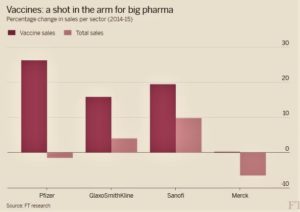
Ask people to name Pfizer’s best-selling product and many would opt for one of its most famous drugs: Viagra, for erectile dysfunction, or Lipitor, to reduce high cholesterol. People more familiar with the US pharma group might suggest a more recent blockbuster such as Lyrica, for pain...But they would all be wrong. The top-seller is not a drug but a vaccine: Prevnar, which prevents pneumonia, meningitis and other infections caused by pneumococcus bacteria...Prevnar generated revenues of $6.25bn last year — almost three times as much as Viagra. This was up 40 per cent from the year before...While vaccines play a big role in frontline healthcare, they are often an afterthought for a pharmaceuticals industry more focused on treating diseases than preventing them...There are several factors driving this growth. One is the expansion of immunisation programmes in newly industrialised countries such as China...In rich countries, growth relies on either finding more diseases to immunise against...or widening the reach of existing products...the complexity of vaccines, and the fact they are given to healthy individuals rather than to treat the sick, makes quality and reliability especially challenging. "The hurdles are a bit higher than in other parts of the pharma industry."
- MSC, SinfoníaRx team to bring patients on-demand pharmacist access (drugstorenews.com)

A new partnership between savings program company Medical Security Card’s ScriptSave WellRx app and medication management company SinfoníaRx will bring on-demand pharmacist access to users of the savings program app...ScriptSave WellRx app users can use a click-to-call feature that will connect them to one of SinfoníaRx’s on-call pharmacist, who will answer patients’ questions about their prescriptions, medication interactions and OTC drugs...Our ability to help patients by leveraging the latest technology makes this partnership with MSC a natural fit...Our companies share the same goal — to ensure patients follow their prescribed medication regimens to achieve better health outcomes. The ScriptSave WellRx app also gives patients the ability to reduce their out-of-pocket drug costs, which can be a huge barrier to medication adherence and improved health...SinfoníaRx's pharmacists bring an important component to ScriptSave WellRx, offering medication information to our members if they have a question about drug interaction, dosage or alternatives...