
- Drug approvals at 19-year high belie industry challenges (reuters.com)
2015 was a good year for innovation in medicine with the Food and Drug Administration approving 45 novel drugs, four more than in 2014 and the most since the all-time record of 53 set in 1996...the European Medicines Agency recommended 93 new products, including generics, up from 82 in 2014...the prospect for further progress in 2016, the pharmaceuticals industry faces challenges, with increased political focus on drug pricing having punctured both biotech and specialty pharma valuations in recent months...The rapid pace of new approvals reflects accelerated review times by regulators, who want to get life-saving treatments to patients, especially in cancer, as well as an improved scientific understanding of diseases...Full drug pipelines at many companies suggest the strong rate of new drug launches is likely to continue for a while yet, with IMS Health forecasting a total of 225 new drug approvals between 2016 and 2020.
- 18 must-follow Twitter accounts about health and medicine (statnews.com)
At this time of year, “best of” lists abound: the top-selling books; the highest-impact papers; the 10 biotech stocks that most exceeded expectations...This is not one of those lists...Here at STAT, we’ve compiled a list of Twitter feeds to follow for insights into the worlds of health, medicine, and science. These aren’t necessarily the biggest names in social media. Or even the most important voices. They are simply people whose tweets we value. (We’ve put all these names into a Twitter list you can follow. Please note, you must be logged into Twitter to see this list.)...It’s just that Twitter is an amazing smorgasbord. Here are some accounts to sample:
- The BS detector: @CaulfieldTim
- The Twitter scientist: @kejames
- The science sentinel: @greg_folkers
- The end-of-life guru: @DianeEMeier
- The health care insider: @kevinmd
- The connected patient: @epatientdave
- The DeathXpert: @drlindseyfitz
- The pharma watchdogs: @RxPricing
- The techie: @halletecco
- The Ignobel Mind: @MarcAbrahams
- The med school dean: @jflier
- The digital health evangelist: @EricTopol
- The patient’s friend: @vmontori
- The financier: @John_LaMattina
- The critical eye: @hmkyale
- The brain guy: @sapinker
- The hip-hop evolutionist: @DNLee5
- The zombie expert: @aetiology
- Moving Pharmacy Forward, By Looking Back (aacp.org)
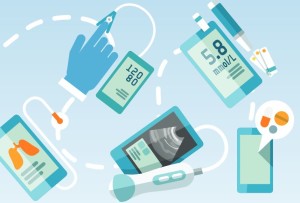
‘Pharmacy of the future’ redefines the relationship between the patient and pharmacist...Northeast Ohio Medical University and Ritzman Pharmacy are bridging the chasm between higher education and pharmacy practice, to create a “pharmacy of the future.”...Set in a healthcare ecosystem on the NEOMED campus, next to a medical fitness facility and primary care physician office, the pharmacy will use technology to engage the tech savvy— individuals wearing Fitbits or smartwatches, using social media or apps to track their fitness — and the use of these digital tools will open up time for pharmacists to cultivate relationships and engage with patients who are fond of vintage-inspired, face-to-face care...This...will allow the pharmacy to help with medication adherence or medication management, whether it’s on campus or in someone’s home...the heart of this innovative practice model rests small-town, vintage care. If you look back 30 or 40 years...Everyone knew their pharmacist and they were integral to patients’ care...I think we lost our way in pharmacy for awhile and became solely focused on the production of the prescription...What we’re trying to do is bring that philosophy back into the present...we call that pioneering vintage care...This innovative pharmacy will be using novel technologies to alleviate administrative burdens behind the counter, bringing the pharmacist back in front of the community.
- Smokers more likely to get antibiotics prescriptions than others (reuters.com)Abstract - Tobacco Smoking as a Risk Factor for Increased Antibiotic Prescription (sub. req.) (ajpmonline.org)

Doctors are more likely to give smokers antibiotics for an infection, a bad habit that may endanger public health by promoting antibiotic resistance...Smokers were 20 percent to 30 percent more likely than non-smokers to get an antibiotic prescription when they were diagnosed with infections...If smokers are being prescribed antibiotics...if not indicated, it’s going to contribute to that antibiotic resistance...and bacteria are going to become more and more resistant...You would think that the number of bacterial infections where antibiotics are clinically indicated should be evenly distributed among smokers and non-smokers...The study can't say why smokers are more likely to get antibiotics for infections...it may be due to an inaccurate belief among doctors that people who smoke are more susceptible to infections.
- Data Breaches In Healthcare Totaled Over 112 Million Records In 2015 (forbes.com)Top Pharmacy Chains Revealed as Repeat HIPAA Violators (pharmacytimes.com)
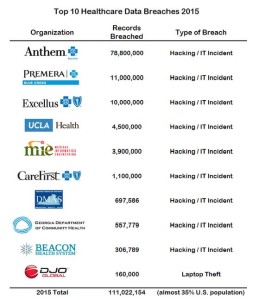
Healthcare’s “wall-of-shame” for 2015 officially ends tonight at midnight. It’s not really a “wall,” it’s just a website, but it’s the online mechanism for the Office of Civil Rights under Health and Human Services to publish data breaches as reported to them and required by HIPAA. The numbers this year are just staggering...According to OCR, there were 253 healthcare breaches that affected 500 individuals or more with a combined loss of over 112 million records...The Top 10 data breaches alone accounted for just over 111 million records that were lost, stolen or inappropriately disclosed...A recent data breach study estimates that breaches cost the healthcare industry about $5.6 billion annually. As healthcare moves toward connected care, the amount of data exchanged between organizations will only grow. So what does this mean? It means that in 2016, we’re going to see a huge movement towards encryption in hospitals and other healthcare facilities in order to protect EHRs and other vulnerable PHI...Healthcare IT security will continue to fall further and further behind the rest of the industry verticals despite the increase in spending on technology and human resources. The industry is focusing on functionality for patient care and security is an afterthought. Many organizations are also overly dependent on antiquated hardware and software...I wish we could look back on 2015 as the year that healthcare took data security and patient privacy more seriously...In a data-driven world, medical information is just too lucrative and too easy to steal at scale. As long as that’s the case...we should reasonably expect more of the same for 2016.
- Pharmacists should check hospital discharge letters for children after discrepancies found (pharmaceutical-journal.com)
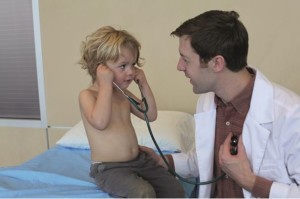
Medicines information contained in a third of hospital discharge letters for paediatric patients contained “discrepancies” that were picked up by a pharmacist, according to research...the study supports the role of pharmacists to routinely check discharge medication letters and carry out medicines reconciliation when children are sent home from hospital...Our study suggests that pharmacists’ screening and review of discharge medication letters prevents one in five potentially harmful discrepancies from leaving the hospital...researchers say their prospective study is the first to examine the accuracy of discharge letters in paediatric patients. They looked at electronically generated medication discharge orders written by hospital doctors that were then checked by a pharmacist... pharmacists, and preferably paediatric-trained pharmacists for paediatric patients, should routinely check discharge orders. “We pick up a lot of mistakes and clarify misleading instructions by doing so,”...“It is nice to have this backed up by evidence.”
- How Platelet Aggregation Inhibitors Fit into the ACS Management Picture (pharmacytimes.com)
Alexander Kantorovich, PharmD, BCPS, clinical assistant professor of pharmacy practice at Chicago State University College of Pharmacy, discusses how platelet aggregation inhibitors fit into the acute coronary syndrome management picture.
- Your health records are supposed to be private. They aren’t. (washingtonpost.com)
The federal law that protects health information is violated often and easily, and it's hardly ever enforced...After spending the past year reporting on loopholes and lax enforcement of the Health Insurance Portability and Accountability Act, the federal patient-privacy law known as HIPAA, I’ve come to realize that it’s not just celebrity patients who are at risk. We all are...I’ve talked to hundreds of people who say their medical records were hacked, snooped in, shared or stolen...In each story, a common theme emerged: HIPAA wasn’t working the way we expect. And the agency charged with enforcing it, the HHS office for civil rights, wasn’t taking aggressive action against those who violated the law...We all know HIPAA... It’s what requires us to stand behind a line, away from other customers, at the pharmacy counter or when checking in at the doctor’s office...It is used to scare health-care workers, telling them that if they improperly disclose others’ information, they could pay a steep fine or even go to jail...But in reality, it is a toothless tiger...And even though the civil rights office can impose large fines, it rarely does: It received nearly 18,000 complaints in 2014 but took only six formal actions that year. A recent report from the HHS inspector general said the office wasn’t keeping track of repeat offenders, much less doing anything about them...Making matters worse, HIPAA does not allow patients to sue health providers for damages if they violate the law. So if the federal government doesn’t enforce the law, there are often no consequences for breaking it...Moreover, the government needs to write regulations to implement provisions of a 2009 law that would give patients whose privacy has been violated a share of the money HHS recovers. Finally, the government has yet to submit to Congress a report due in 2010 with recommendations for how to deal with the privacy of health information not covered by HIPAA.
- Critics continue pounding 21st Century Cures Act for threatening patient safety (fiercehealthcare.com)The last word: Will 21st Century Cures Act harm patient safety? (medicaleconomics.modernmedicine.com)21st Century Cures: What You Need to Know (energycommerce.house.gov)
Opponents argue that drugs, devices will be less safe if legislation eases FDA approval rules...Opponents of the 21st Century Cures Act, which is intended to accelerate the transfer of scientific advances in genetics into treatment for patients, say the legislation will threaten patient safety by easing FDA rules intended to protect patients from unproven therapies...Critics argue looser FDA rules will result in drug approvals without the level of rigorous testing currently required...new drugs and medical devices will be less safe and effective and cost more, and that the bill sacrifices long-term value to public health.
- 8 Interesting Pharmacy Facts (pharmacytimes.com)
 Are you familiar with the following interesting facts about pharmacy?
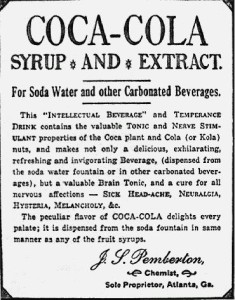
- Coca-Cola was invented by a pharmacist named John Pemberton. He carried the jug of the new product down the street to Jacob's Pharmacy where it was sampled and pronounced "excellent" and placed on sale for 5 cents a glass as a soda fountain drink...Another pharmacist, Charles Alderton, invented Dr. Pepper. Pepsi was also invented by a pharmacist, as was Vernor’s Ginger Ale by Detroit pharmacist James Vernor.
- The first licensed pharmacist set up shop in the French Quarter. Louis Dufilho Jr. of New Orleans became American’s first licensed pharmacist in the early 1800s. Prior to then, you did not need a license to become a pharmacist.
- The global pharmaceuticals market is worth $300 billion.
- Benjamin Franklin was a pharmacist, while Agatha Christie was a pharmacy technician.
- Lipitor is the best-selling drug of all time. It was introduced in 1997 and its patent expired in 2011, making about $125 billion.
- Insulin is one of the most common medications that cause adverse events.
- Hydrocodone/acetaminophen is the most commonly prescribed medication in the United States. Lisinopril is No. 2, as of 2014.
- The most expensive drug is Glybera (alipogene tiparvovec) at a wholesale cost of $1.21 million per year. It is a gene therapy that helps restore lipoprotein lipase enzyme activity in those with familial lipoprotein lipase deficiency. Only 1 million patients have this extremely rare condition.