
- Commonwealth Fund releases its 2015 state-by-state health system scorecard (healthcareitnews.com)Aiming Higher - Results from a Scorecard on State Health System Performance (commonwealthfund.org)
 The good news? More states improved than worsened...The Commonwealth Fund has released "Aiming Higher," its 2015 scorecard measuring the performance of health systems state by state...Forty-two indicators are examined to arrive at the scores, measuring rates of children or adults who are uninsured, hospital patients who get information about how to handle their recovery at home, hospital admissions for children with asthma and breast and colorectal cancer deaths, among many others...The top states? Minnesota, Vermont, Hawaii, Massachusetts, Connecticut, New Hampshire and Rhode Island...Louisiana, Tennessee, Kentucky and Oklahoma ranked in the bottom quartiles, but they were among those that improved on the greatest number of indicators... key findings:
- There are wide variations in performance, with up to an eightfold difference between top- and bottom-ranked states.
- National attention may be encouraging better quality of care in hospitals and home health care settings and to more appropriate medication use in nursing homes and doctor's offices. However, declining rates of preventive care in several states signal the need for greater attention to prevention.
- Reductions in hospital readmissions accelerated in 2012, when the federal government began financially penalizing hospitals with high rates of readmissions. Rates of potentially preventable admissions to the hospital continued to fall in several states.
- Opinion: The AMA is wrong about banning drug ads (statnews.com)
...American Medical Association recently called for a ban on advertising prescription drugs and medical devices directly to consumers. The effort is largely symbolic...But doctors resent the increasing pressure the ads place on them to write prescriptions out of concern patients will switch physicians...they argue that many ads aimed at consumers promote more expensive medicines...and pushes patients to ask for products that either they may not need or is not right for them. This approach is, at best, misguided, and, at worst, ignores the benefits of direct-to-consumer advertising for patients...DTC advertising increases awareness of health problems and leads to a better informed and educated patient who can engage their physician in a dialogue rather than a monologue...So what’s really going on here?...insurers are taking more prescription writing power away from doctors. They first want patients to try generic medications which now make up 88 percent of all available prescription drugs. Second, higher patient copayments for office visits and insurance mean consumers are “shopping” for health care and health care treatments...This makes doctors very uncomfortable. Even with all these changes, research continually validates the notion that patients view their doctors as the gatekeepers to their prescription medicines...DTC advertising leads patients to their health care providers and, depending on the health condition, does not lead to high-priced unnecessary scripts. The AMA should reach out and work with pharma to improve DTC marketing, not request a ban on all DTC ads.
- What’s Next? The Year in Preview 2016, A Sneak Peek at 11 Developments that will Shape the Future of Health Care (managedcaremag.com)

We’re unwrapping the future. Here’s our list of 11 developments in the next 12 months that will change the course of American health care for many years to come.
- On or off track? 2016 could be the year that value-based payment arrives–or maybe not
- Sagging sign-ups: Slowing enrollment may mean big trouble for the ACA
- Sticker shock waves: Players to respond to drug priciness
- Slimming too fast: New rules coming for narrowing networks
- Picking up the tab: Out-of-network bills will be a hot issue
- The 2016 election season: Democrats to play D while GOP devises a game plan
- The hunger gains: Appetite for quality to grow
- Cyberthievery: Will health care companies respond in 2016?
- Too much of a good thing: Overdiagnosis to get its due
- Doing the MACRA-ena: Will the celebrations continue in 2016?
- Growing testiness: Disagreements between insurers, labs about new molecular tests
- Many medications actually became cheaper this year — but that doesn’t mean Americans are paying less overall (washingtonpost.com)

Skyrocketing drug costs became the stuff of congressional hearings and presidential campaign speeches in 2015...The federal government announced this month that prescription drug spending hit $297.7 billion last year -- up more than 12 percent...A new generation of specialized drugs and price hikes on existing medications helped to drive that spike...If there's a bright spot amid the troubling rise in the cost of prescription drugs, perhaps it is this: Many of the most widely used generic drugs actually were cheaper at the end of 2015 than when the year began, according to an analysis released...by...GoodRx...The reality is that about 85 percent of drugs taken in this country are generic...Those are surprisingly inexpensive and getting less expensive, in many cases...For [many] generic drugs, there's a lot of competition...while the retail price of some drugs decreased by 30 percent or more, some generic drug products had...extraordinary, price increases...the rate of generic price declines has been slowing for the past decade, indicating that the era of consistent generic drug price decreases may be coming to an end...it's a complicated...exercise to determine what any person, company or insurer pays for a particular drug...The system is opaque...Between changing insurance premiums, greater overall health-care costs, the arrival of new high-priced therapies and the ongoing possibility of price spikes in once-cheap drugs, many patients can count on continuing worries about the impact on their pocketbooks.
- WellCare makes CVS Health its pharmacy benefit manager (reuters.com)

Health insurer WellCare Health Plans said it would change its pharmacy benefit manager to CVS Health Corp from UnitedHealth Corp's Optum Rx, effective Jan. 1...About 3.8 million WellCare members enrolled under its Medicaid, Medicare and prescription drug plans will be able to access CVS' pharmacy network, WellCare said on Thursday...CVS is the second-largest U.S. pharmacy benefit manager and drugstore.
- University of Wisconsin-Madison School of Pharmacy C.E. Programs (pharmacypodcast.com)

Guest host Blair Green Thielemier, PharmD interviews Dr. Alan L Hanson, Division Chair and Professor at Melvin H. Weinswig University of Wisconsin-Madison School of Pharmacy.
- Few Consequences For Health Privacy Law’s Repeat Offenders (propublica.org)HIPAA Helper - Who is Revealing Your Private Medical Information? (projects.propublica.org)HHS - OCR - Breach Portal: Notice to the Secretary of HHS Breach of Unsecured Protected Health Information (ocrportal.hhs.gov)
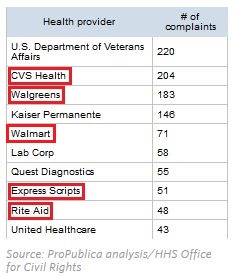
Repeat HIPAA Violators - These health providers have the most privacy complaints that resulted in corrective-action plans or “technical assistance” being provided by the OCR from 2011 to 2014.
Regulators have logged dozens, even hundreds, of complaints against some health providers for violating federal patient privacy law. Warnings are doled out privately, but sanctions are imposed only rarely. Companies say they take privacy seriously...CVS is among hundreds of health providers nationwide that repeatedly violated the federal patient privacy law known as HIPAA between 2011 and 2014...Other well-known repeat offenders include the U.S. Department of Veterans Affairs, Walgreens, Kaiser Permanente and Walmart...I don’t like the idea of repeat offenders not being called to task for that behavior and I would like to see us doing more in this regard...The number of health information privacy complaints submitted to the Office for Civil Rights within the Department of Health and Human Services has increased dramatically in recent years, in part because of the introduction of an online complaint portal...Using data provided by OCR under the Freedom of Information Act, ProPublica is launching a new tool, HIPAA Helper, which allows users to look up reports of privacy violations by provider for the first time. OCR’s material often referred to the same entities by multiple names. CVS was listed as “CVS,” “Pharmacy, CVS,” “Caremark, CVS,” “CVS Caremark”...We have standardized organizations’ names to make searching easier.
- Cadila Healthcare shares plunge after FDA warns of violations (reuters.com)

Cadila Healthcare Ltd (Zydus Cadila)has received a U.S. Food and Drug Administration warning letter for violating manufacturing standards at two of its production facilities, the latest in a series of Indian companies to face such action....The warning letter cites issues with Cadila's plants in Gujarat, including at the Moraiya facility, which makes up about 60 percent of the company's total sales in the United States, its largest market...Dozens of Indian drug plants have faced warnings and bans in recent years, as the FDA improved inspections of foreign facilities. More than 40 percent of the generic and over the counter medicines available in the United States comes from Indian facilities such as Cadila's Moraiya plant...Cadila Managing Director Pankaj Patel told analysts...the FDA, during an inspection of the Moraiya plant...found deficiencies with the way the company investigated market complaints about a medicine made there...The company is working on a response to the warning letter and will then ask the FDA to reinspect both facilities...It has 15 days to respond to the FDA, as per standard procedures, after which the FDA will decide its response including whether to impose an import ban.
- KaloBios, formerly led by Shkreli, files for bankruptcy (finance.yahoo.com)

After Shkreli arrest, 2 drugmakers are upended, 1 seeking bankruptcy protection...KaloBios, the troubled drugmaker taken over by Martin Shkreli last month, is seeking bankruptcy protection less than two weeks after his arrest for securities fraud...It is the second pharmaceutical company with ties to the former hedge fund manager now in turmoil following his indictment on charges unrelated to his involvement with them, though the drugmakers are not lacking for problems of their own...Turing Pharmaceuticals Inc., is cutting jobs and seeking a new CEO after Shkreli resigned the position because of his arrest...Trading in KaloBios shares has been suspended for two weeks and it was notified one week ago that it would be delisted from Nasdaq because of Shkreli's arrest, as well as the arrest of the company's outside counsel...In a Chapter 11 filing...with the U.S. bankruptcy court...the company listed assets and liabilities in the range of $1 million to $10 million...KaloBios' largest creditors include the University of Miami, Ernst & Young and Lonza Sales Ltd.
- Opinion: Stop giving antibiotics to cows, pigs, and chickens now (statnews.com)

Antibiotic resistance has been blamed for at least 2 million illnesses and 23,000 deaths in the US. Researchers are especially concerned about the widespread use of antibiotics in raising cattle, pigs, and other animals for food production. The drugs help the animals bulk up, which boosts their value, but experts warn that they can also promote antibiotic resistance....The recent discovery in China of a new gene found in bacteria in both pigs and humans...The gene is called mcr-1, and it is responsible for a new, specific type of bacterial antibiotic resistance...many antibiotics, which once easily cured infections, have stopped working....Bacteria have...the ability to transfer genetic information via plasmids...which easily carry genes from one bacterium to another, even if the two are unrelated...exposure of bacteria to subclinical doses of any antibiotic will generate bacteria that are resistant to that drug. But, worse still, sometimes this can result in resistance to multiple, unrelated antibiotics simultaneously...Studies in Europe have shown that bringing animals to market, without the use of growth-promoting antibiotics, is no costlier than doing so with them, so using these drugs actually provides little benefit...