
- The Most Profitable Industries In 2016 (forbes.com)
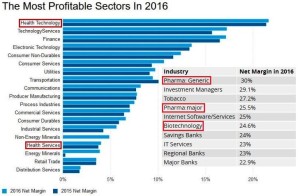
Health technology is projected to be the most profitable sector in 2016 again with a 21.6% net profit margin.If you drill down within the more granular categories within the broad sectors listed above, healthcare, tech and finance still stand out. Biotech, generic and major pharmaceutical companies rank among top 10 – same with major banks and investment managers. ...Here are the top 10 most profitable industries according to Factset:
- The biosimilars are coming. But how long will it be till they can make their mark? (fiercepharma.com)

Biosimilars have made a splash in Europe, Australia and India, and now they're gaining steam stateside. That's sure to continue, with Citigroup analysts estimating innovative biologics will lose $110 billion in sales to copycats by 2025. And with one biosim already on the U.S. market, and more poised for a 2016 liftoff, next year will give drugmakers and payers a taste of the biosim contest to come...One question for next year is pricing. For years, experts have suggested that biosimilars would sell for a modest discount to the original med, but in Europe, Remicade knockoffs have been undercutting Merck & Co.'s branded version by 40% or more, and gaining big market share in the process...Another question: How quickly will doctors flock to biosimilars once they launch? Some research suggests that initially, it won't be fast at all. U.S. doctors don't know much about biosimilars...Plus, doctors may be reluctant to prescribe without flawless data on biosims….
- Drug pricing will continue to loom large for pharma in 2016 (statnews.com)
As the year winds down, STAT reporters are taking a look at the stories they’re most eager to track in 2016...Of all the health care issues that loomed large this past year, none was more controversial — and compelling — than pharmaceutical pricing...Wall Street may have cheered the added revenue, but pricing strategies were increasingly under attack. Poll after poll found most Americans believe prices are too high. And more lawmakers — and presidential candidates — are listening...At the center of it all was Martin Shkreli, the 32-year-old “pharma bro” who single-handedly created a furor by jacking up the cost of an old, life-saving drug and repeatedly taunting his critics. Shkreli was arrested this month for securities fraud and ousted from the two drug companies that he ran. But while he may be out of the picture, pricing will remain a flashpoint in the year ahead...Here’s a look at what to expect on pricing — and on other key issues that are likely to engulf drug makers, regulators, and patients in 2016.
- Count the cost
- New commish
- Read the label
- Big deals
- Figure of speech
- 3 Population Health Drivers Pharmacists Should Know (specialtypharmacytimes.com)
As population health management becomes increasingly critical, health-system pharmacists should reacquaint themselves with the factors driving patient outcomes...American Society of Health-System Pharmacists Foundation identifies population health management as one of the key trends that will define the scope of health-system pharmacy practice over the next 4 years...Optimizing population health requires health systems to recognize that their role has moved beyond providing immediate sickness care and now involves evaluating many aspects of a patient’s lifestyle in order to be proactive about preventing the need for hospital admissions and readmissions...researchers at the University of Wisconsin Population Health Institute studied various factors driving health outcomes...following 3 factors were areas where pharmacist intervention can play a larger role in enhancing population health care:
- Modifiable Patient Behaviors
- Medication Management
- Social and Economic Environments
- Pharma marketers steer through changing tides (fiercepharmamarketing.com)

In some ways, the more pharma marketing changes, the more it stays the still rule in sales. Despite significant growth in pharma's digital advertising, television captures the lion's share of ad spending, and that's not likely to change soon...And those forward-looking folks frustrated with the industry's reluctance to take big risks or break new ground--they're likely to remain frustrated in 2016, too...Payer pressure is forcing drugmakers to rethink their pricing and negotiation strategies, and though some attempts at performance-based payments fell flat in 2015, we'll see marketers reorienting toward outcomes, services and payer relationships...Technology is spurring pharma marketers toward new ventures, too...Marketing intelligence and patient engagement are part of that, and more pharma-plus-tech teams will form...data-gathering and data-crunching and predictive modeling will remake pharma marketing just as it's remaking R&D...drug industry's reputation has taken a major hit this year, as a couple of high-profile pricing scandals spawned questions for all drugmakers...Is 2016 the year that drugmakers get jiggy with their advertising and marketing?...AstraZeneca became the first drugmaker to actually win a Health Lion at Cannes in 2015...Finally, we have a fairly long list of inescapable, no-doubt-about it shifts in pharma marketing for 2016, in the form of new drug approvals and launches…
- Price and reputation are indubitably, inexorably intertwined (fiercepharmamarketing.com)In a riff on the old real estate adage of "location, location, location," we'd like to offer a pharma trend for 2016 that's all about "reputation, reputation, reputation."...With proper credit to former Turing CEO Martin Shkreli and Valeant Pharmaceuticals for price hikes and poorly managed "secret" relationships that put pharma in the headlines and onto politicians' radar, we're also quite confident the pharma reputation onslaught will continue--whether the gripes are legitimate or not...What's a pharma to do?
- Step one, don't panic. Pharma's reputation had actually stabilized before the Turing scandal and political one-upmanship began...While that has likely changed by now, thoughtful response is always better than knee-jerk reactions.
- ...the next step should be to address it. Big Pharma held back in the fall as the bad news swelled, but saying nothing was the wrong approach…The problem is that silence gives consent...Staying silent looks like you're OK with it...more CEOs have stepped up since then to denounce Shkreli's antics...pharma needs to keep reminding consumers and physicians about the good things they like about the industry...
- ...third step...Patient advocacy groups and communities sponsored by pharma aren't new, but going directly to individual e-patients for advice, engagement and conversation is becoming more common...Take a page from the consumer marketing where word of mouth is one of the best sources for awareness, referrals and reputation.
- Big Pharma gets data for discounts (politico.com)
Attention patients! The side effects of your discounted drugs may include drowsiness, nausea — and a loss of privacy...Drug companies are increasingly offering price discounts and subsidies to patients in exchange for their medical data. The details of that exchange can be easy to miss: They're in the fine print...As the frequency of such arrangements grows, along with the price of certain drugs, the deals are causing discomfort about the uses of intimate health details by drug companies...Such programs are part of a growing appetite for patient data in the health care sphere among pharmacies, pharmacy benefit managers, app makers and others. Walgreens and CVS both have begun offering customer goodies in exchange for personal data...Pharmacies across the US are dangling perks to coax their customers to relinquish all sorts of personal data about their health...Companies use data to understand how a drug is performing across a population, but also to gain insight for marketing to, or communicating with individual patients...
- Think different? Pharma turns to tech partnerships for beyond-the-pill moves (fiercepharma.com)
Beyond the pill. It's a catchphrase that cropped up a few years ago, when pharma's patent-cliff suffering was intense, drug development lagged and, facing budget constraints, payers in various countries were putting the screws to pharma prices. The idea was--and is--that drugmakers would need to move beyond pushing products to delivering outcomes...There's not going to be a beyond-the-pill revolution in 2016. Frankly, pharma doesn't yet have the technology to upend the status quo. But drugmakers are teaming up with major technology players like Google and IBM Watson Health--Novartis, Sanofi and Novo Nordisk among them--in deals that marry Big Data record-sifting with cutting-edge patient-monitoring gadgetry, and that's the kind of infrastructure necessary for big moves beyond the pill...Pharma has realized that if it doesn't hook up with giants like Google, Apple, IBM and others, those companies will innovate right past drugmakers. Turf that pharma might otherwise claim would be ceded to the tech industry. With the pace of tech developments ramping up, pharma's work will, too.
- Outcome-based healthcare needs outcome-based marketing (fiercepharmamarketing.com)
Pharma can no longer put off the inevitable when it comes to outcome-based models in healthcare. In 2016, drugmakers will begin to engage more not only when it comes to pricing models, but also when it comes to marketing...But what is outcome-based marketing? In mainstream marketing, it usually refers to linking ad campaigns to quantifiable results. Did the ads or marketing draw more customers or an increase in web traffic?...pharma companies are largely already doing that...We're taking a broader view of the outcome model...and looking for outcome marketing that aligns with outcome pricing models. That is, creating advertising, promotions and lifestyle tool communications that clearly relay to patients, caregivers, doctors and healthcare providers exactly what they get for their money...While widespread changes may take years to play out, we think that with some drugmakers already on board, this year could be a bellwether for even more transparent and direct communications, along with the chance for more and better customer connections.
- Should Pharmacy Staff Have Optional Breaks? (pharmacytimes.com)Minnesota Board of Pharmacy REQUEST FOR COMMENT (mn.gov)

Pharmacists in Minnesota are fighting for the rights to take breaks and refuse to work more than 12 hours in a row...Since September 2015, the Minnesota Board of Pharmacy has received...comments for and against a work conditions rule that would prohibit pharmacies from denying breaks and requiring pharmacy staff to work more than 12 consecutive hours.
- ...those opposing the work condition rule tended to be from trade and professional associations, health systems, pharmacy owners, and pharmacy managers.
- ...National Association of Chain Drug Stores and the Minnesota Retailers Association submitted comments that suggested limitations on hours and uninterrupted breaks could “go against the professional judgment of a pharmacist for certain situations.”
- ...CVS Health “strongly believes that a pharmacist should continue to manage their own work schedule and not rely on a board rule to dictate work conditions,” a company spokesperson commented.
- ...opposition to the rule said they feared consequences related to their schedule.
- ...Nearly all those in favor of the rule were pharmacists.