
- Device makes single doses of drugs on demand (upi.com)Synthetic biology and microbioreactor platforms for programmable production of biologics at the point-of-care (nature.com)
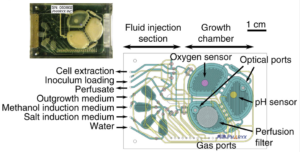
A portable device may allow doctors to create single doses of biopharmaceutical medications on demand, potentially speeding the treatment of diseases that include diabetes and cancer...The portable production system was developed by scientists at the Massachusetts Institute of Technology, with funding from the U.S. Defense Advanced Research Projects Agency, expecting the device could be useful for the battlefield and remote areas to produce treatments immediately at the point of care...The system...can currently produce two biologic drugs from a single yeast strain in the device, creating near-single-dose production in less than 24 hours with limited infrastructure...The production system uses a programmable strain of yeast, Pichia pastoris, which produces two proteins used for disease therapy...The strain of yeast, which can grow at very high densities when exposed to carbon sources, expressed recombinant human growth hormone when exposed to estrogen β-estradiol and expressed the protein interferon when exposed to methanol...The potential use for the device is significant, as it can be used for everything from treatments on a battlefield where immediate care is required to prevention of a disease outbreak in a remote village...
- Precision medicine market to skyrocket past $87 billion (healthcareitnews.com)

Cancer treatments, drug discovery, genome sequencing...are all driving big spending for personalized and precision medicine...Driven by demand for personalized medicine in cancer treatments and advancements in new healthcare technologies, the precision medicine market is expected to reach $87.79 billion by 2023, according to a report by Global Market Insights...Revenue growth will be sustained by favorable government regulations and standards...The trend toward an individualized diagnosis approach is growing thanks to large-scale biologic database development, efficient methods for patient characterization, and computational tools to analyze large data sets...Recent research advances have helped expand benefits to various aspects of healthcare by enabling better understanding of disease mechanisms, assessment of disease risks and prediction of optimal therapy...A large number of investments in diagnostic research will further accelerate the shift from treatment to preventive medicine in healthcare...
- Medicare Delays Mandate on Claims for Unused Part of Drug Doses (ashp.org)

Hospital clinics and outpatient departments that bill Medicare for unused portions of certain medications recently gained six additional months to meet newly mandated documentation and billing requirements...the Centers for Medicare and Medicaid Services announced that Medicare administrative carriers must delay until January 1, 2017, implementation of a policy requiring the use of the "JW" modifier on Part B claims for appropriately discarded leftovers from single-use vials or packages...CMS introduced the JW modifier—a code that essentially enables itemized billing for the unused portion of certain medication vials—in 2007. But the agency allowed each MAC to decide whether to require the use of this billing mechanism or, instead, reimburse for wasted medication without separately itemizing it...Hospitals aren't required to bill for wasted medications, but those that don't are missing out on full reimbursement for eligible products...The...communication from CMS did not specify the reason for the implementation delay.
- Many Well-Known Hospitals Fail To Score High In Medicare Rankings (npr.org)

The federal government released its first overall hospital quality rating...slapping average or below average scores on many of the nation's best-known hospitals while awarding top scores to many unheralded ones....The Centers for Medicare & Medicaid Services rated 3,617 hospitals on a one- to five-star scale, angering the hospital industry, which has been pressing the Obama administration and Congress to block the ratings...Hospitals argue that the government's ratings will make teaching hospitals and other institutions that treat many tough cases look bad. They argue that their patients are often poorer and sicker when admitted, and so are more likely to suffer further complications or die, than at institutions where the patients aren't as sick...Rick Pollack, president of the American Hospital Association, called the new ratings confusing for patients and families..."We are especially troubled that the current ratings scheme unfairly penalizes teaching hospitals and those serving higher numbers of the poor."..."Hospitals cannot be rated like movies," Dr. Darrell Kirch, president of the Association of American Medical Colleges..."We are extremely concerned about the potential consequences for patients that could result from portraying an overly simplistic picture of hospital quality with a star-rating system that combines many complex factors and ignores the socio-demographic factors that have a real impact on health."
- Gold Stars for Stellar Adherence (pharmacytimes.com)

Medicare Advantage and other supplemental Part D plans encourage medication adherence to achieve higher star ratings... This rating system measures insurance plan quality, as higher quality plans improve patient outcomes and minimize costs. Adherence represents 10.9% and 29.5% of Medicare Advantage and supplementary plans’ star ratings, respectively...Community pharmacies...have initiated automatic refill programs to improve adherence. These programs have the added benefit of boosting insurance plans’ star ratings...(CMS) confidently assumes that patients of brick-and-mortar pharmacies use their refills if they pick up the prescriptions...researchers reported that an automated prescription refill program improved medication adherence of Medicare Part D patients...Easing barriers to refilling prescriptions enhances adherence, and reinforced adherence enhances pharmacy sales directly and indirectly. Insurance companies prefer pharmacies that strengthen their star ratings; they’re less likely to engage with pharmacies with mediocre adherent patient populations from coverage, and they provide bonuses to pharmacies for high adherence...Future studies assessing the impact of automatic refill programs should develop a superior method of measuring actual medication intake.
- This Week in Managed Care: July 30, 2016 (ajmc.com)

Justin Gallagher, associate publisher of The American Journal of Managed Care. Welcome to This Week in Managed Care...
- Major global partnership to speed antibiotic development launched (washingtonpost.com)Antibiotics funding splurge gets mixed reception (nature.com)

U.S. and British officials announced an ambitious collaboration...designed to accelerate the discovery and development of new antibiotics in the fight against one of the modern era’s greatest health threats: antibiotic resistance...CARB-X, for Combating Antibiotic Resistant Bacteria Biopharmaceutical Accelerator, will create one of the world’s largest public-private partnerships focused on preclinical discovery and development of new antimicrobial products...The undertaking includes two agencies within the U.S. Health and Human Services Department that focus on biomedical research and Britain’s Wellcome Trust, a London-based global biomedical research charity. It also includes academic, industry and other nongovernmental organizations...The partnership is committed to providing $44 million in funding in the first year and up to $350 million in new funds over five years to increase the number of antibiotics in the drug-development pipeline. The ultimate goal...is to move promising antibiotic candidates through the critical early stages so they can attract enough private or public investment for advanced development and win approval by U.S. and British regulatory agencies...
- Nevada State Board of Pharmacy Newsletter – July 2016 (bop.nv.gov)

- Must I Get an ID on My Patient? - ChaoFen (Stacy) Tan, PharmD Candidate
- Prescription Over-the-Counter Products
- FDA Calls for Review of Opioids Policy, Announces Action Plan
- More Selected Medication Safety Risks to Manage in 2016 - ISMP
- Manufacturer Drug Labeling, Packaging, Nomenclature - Per Liter Electrolyte Content on Various Sizes of Manufacturers' IV Bags
- Patient Education - Discharging Patients Who Do Not Understand Their Discharge Medications
- Compliance News
- USP Publishes Chapter on Handling Hazardous Drugs in Health Care Setting
- FDA Provides Training Video on Keeping Medications Safe in Emergency Situations
- FDA Requires Class-Wide Labeling Changes for IR Opioid Analgesics
- FDA Issues Alert Regarding All Unexpired Sterile Drug Products Produced by Medaus Pharmacy
- E-Prescribing - Who Can Send Electronic Prescriptions? - Melissa Hampton, PharmD Candidate
- Controversial rating system gives six Nevada hospitals one star (reviewjournal.com)

Five Southern Nevada hospitals were among six statewide that received only one star in a controversial five-star rating system unveiled...by the Centers for Medicare &Medicaid Services....Two Nevada hospitals got four stars: Mesa View Regional Hospital in Mesquite and Renown South Meadows Medical Center in Reno...The ratings, which use stars to denote the overall quality of hospitals, are meant to "help individuals, their family members and caregivers compare hospitals in an easily understandable way,"...The results, available on the Hospital Compare portion of the Medicare website, have been met by opposition by many hospitals locally and across the country who say the ratings use unreliable information and punish teaching facilities as well as hospitals that serve low-income patients...The five Southern Nevada hospitals receiving one-star ratings were: University Medical Center, St. Rose Dominican Hospitals-Siena Campus, Desert Springs Hospital Medical Center, Valley Hospital Medical Center, and Sunrise Hospital and Medical Center...UMC CEO Mason VanHouweling took issue with the rating system, saying the measure treats all facilities the same, despite differences in the patients they may see..."In other words, the rating system fails to account for unique, multifaceted or high-acuity patients that may come through a trauma, burn or transplant center," he said.
- Gilead hep C drug prices blamed for England’s health service rationing treatment (statnews.com)

Faced with budgetary constraints, England’s National Health Service took several controversial steps to delay coverage of Gilead Sciences’s pricey hepatitis C treatments, but did so at the expense of patients, according to an investigation by the BMJ (British Medical Journal)...Specifically, the agency’s moves caused delays in providing treatment to many of the estimated 160,000 hepatitis C patients, while others were unable to obtain the medications due to rationing. As a result, some people are now traveling out of the country to receive treatment. Meanwhile, Gilead has been blamed for igniting the problem due to its pricing practices...Gilead has regularly maintained that the high cure rates will eventually lead to lower health care costs by reducing the need for hospitalizations and other treatments for liver cancer and liver transplants. The NICE recommendations acknowledged such calculations. But such savings are only recognized later and, meanwhile, a growing number of payers in various countries complained the drugs were budget busters..."It is truly ironic that NHS England should choose to start rationing drugs that are so effective they cure almost everyone who is treated," The Hepatitis C Trust, a patient group in the UK, told the BMJ. The group is seeking a judicial review of the decision to ration the drugs, which...could have "repercussions for other patients as more new drugs increasingly become available at higher prices."