
- CMS Seeks to Improve Access to Preferred Cost Sharing Pharmacies (specialtypharmacytimes.com)

Centers for Medicare Medicare & Medicaid Services is prioritizing an effort to make preferred cost sharing pharmacies available in geographical areas that have little access...we heard concerns that some beneficiaries did not have ready geographic access to preferred cost-sharing pharmacies...Increasingly, Part D plans are creating smaller networks of pharmacies within their larger networks and offering lower cost-sharing arrangements to beneficiaries who use these preferred cost-sharing pharmacies...Although plans are marketed with lower cost-sharing arrangements, there are some areas that do not have pharmacies accessible to beneficiaries...In order to address this issue, CMS laid out a plan to help in these areas...The plan includes measures such as:
- Working with outlier plans that addressed concerns regarding marketing and access
- Require the discloser in marketing material of plans offering less access to preferred cost-sharing pharmacies
- Publish access levels that offer a benefit structure for each plan.
- 340B Purchases Hit $12 Billion in 2015—and Almost Half of the Hospital Market (drugchannels.net)
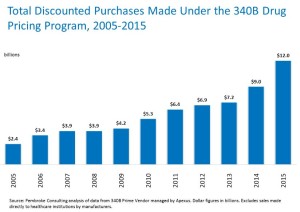
According to new data...discounted purchases made under the 340B Drug Pricing Program hit $12 billion in 2015. That’s a whopping 67% higher than the 2013 figure. I estimate that the undiscounted value of these purchases exceeds $17 billion...Most 340B purchases are made by hospitals. My...number-crunching below reveals that hospitals now receive 340B discounts on more than 44% of their drug purchases...two years ago, the 340B program is taking over the hospital market...How much of this money goes to uninsured and needy patients? No one knows, and the hospitals aren’t saying much...340B purchases have been growing much, much more quickly than have hospitals’ total drug purchases. From 2005 to 2015, total hospital drug purchases grew by 31%, compared with the 400%+ growth in the total 340B purchases...340B has infiltrated almost half of the hospital market...The 340B program is highly controversial, partly because the 340B legislation does not specify or restrict how covered entities should utilize funds generated by the program. Hence, it’s troubling to see that uncompensated care as a percentage of hospitals’ total expenses has remained at about 6% for many years, despite booming 340B purchases...Defenders of the 340B status quo argue that covered entities should be able to use discounts to reduce their cost of operations, without any transparency or accountability...The Office of Inspector General has documented how 340B-eligible hospital outpatient departments earn tremendous profits from the Medicare Part B program. Gross profit margins are about 60% compared with 3% to 4% for a non-340B outpatient program...
- Most drug makers report incomplete side effects to the FDA (statnews.com)
The regulatory system for reporting side effects caused by prescription drugs is producing its own kind of side effect — incomplete information about injuries that patients may have suffered. And the reason for the lack of data is that many drug makers are filing patchy reports...At issue is the Adverse Event Reporting System...The database is the key method for collecting side effect data. Both doctors and consumers can voluntarily report problems to the agency or a drug maker. But drug companies are also required to investigate and report side effects that may be attributable to their products...drug makers generally fail to include key data that the FDA might use to assess future warnings. For this reason...there are still wider implications...With increasing pressure for the FDA to approve drugs fast but with less clinical testing, it is a major concern that postmarket surveillance has major problems that are not being addressed…It is time for the FDA, the medical community, and industry to start work on a badly needed modernization" of this "critical tool" for monitoring safety…reports involving patient deaths offered the least amount of complete information for all of the key data points...the reporting system has not kept pace with changes in pharmaceutical marketing...interactions between patients and physicians, and patients and drug companies, have evolved, partly thanks to the Internet. This means a report may not be based on spontaneous information.
- Novartis offices in South Korea raided over bribery concerns (statnews.com)

In the latest sign that global drug makers remain under scrutiny for their dealings with health care providers, South Korean authorities raided Novartis offices in search of evidence the company provided bribes to local doctors…Seoul Western District Prosecutors’ Office confiscated various documents, including account books, in order to determine whether rebates the drug maker offered physicians may have actually been bribes...The probe appears to be at an early stage, but is likely to be closely watched for signs that global drug makers continue to stumble in their practices in various foreign markets…
- How should FDA revamp its off-label marketing rules? An expert panel backs big changes (fiercepharma.com)
After a series of court decisions put its regulatory approach in question, the FDA promised new guidance on off-label drug promotions. That was more than a year ago. Now, a group of health policy wonks and legal experts has come out with some suggestions...The recommendations from the Duke-Margolis Center for Health Policy include one big change that might simplify the free-speech debate over off-label marketing. The agency could revamp its approach to official labeling to include clinical data on off-label uses, graded for evidence quality, and even post-marketing data generated through the agency's own Sentinel surveillance system…Changing official FDA labeling...the Duke-Margolis Center suggests using pilot programs...One might use the Sentinel system. Another might allow provisional off-label use claims based on evidence that's not enough for a new indication, contingent on Sentinel keeping watch on the new use. Overall, the idea would be to develop a tiered labeling system, with the strongest supporting data on the highest tier, and lesser quality evidence farther down...more radical suggestion? Setting up a third-party data-review organization with the FDA's involvement...[That] would assess new off-label promotional material and give it a quality-control score based on the quality of evidence backing it up…The FDA clearly wants to roll out its own guidance, rather than letting the courts decide. In December, the agency settled an off-label marketing dust-up with Pacira over its Exparel marketing, and it's on the verge of a deal in Amarin's off-label lawsuit involving its cardiovascular med Vascepa.
- Some doctors slow to sign up for electronic death certificate filing (reviewjournal.com)
Nevada's Office of Vital Statistics issued a call this month for relevant physicians to sign up as quickly as possible for a system that allows doctors to fill in required information for death certificates electronically. That system became mandatory statewide Jan. 1...Some doctors did not sign up after the state began notifying them of the change in fall because they have had issues registering or have outright refused to participate, vital records program officer Jason Lewis said...Karen Massey, chief administrative officer at Northern Nevada Emergency Physicians, said physicians have struggled with some requirements of the system, including its incompatibility with Windows 10 and Apple computers. The changeover has been time-consuming...I'm dismayed when it sounds like physicians haven't been responsive about it...Physicians have raised several concerns and have been working with the state to get them resolved...
- Petition set up to target prime minister over pharmacy cuts, as PSNC warns against strikes (pharmaceutical-journal.com)Launch of new petition to the Prime Minister (npa.co.uk)

The National Pharmacy Association will be launching a petition for pharmacy contractors in an attempt to combat the government’s proposed 6% cuts to the community pharmacy contractual framework...This is going to be a petition aimed at the prime minister and this is going to be a petition where we mobilise contractors… and patients...The NPA wanted a paper petition so customers at pharmacies could sign it...It is to complement the parliamentary e-petition which has already gathered 42,000 signatures...Mike Smith...at Walgreen Boots Alliance, said he believed the cuts will go ahead regardless of efforts to counter them. "I personally think the £170m is gone, despite the consultation process, but we have to change and work with the Department of Health,"...It almost makes the Pharmaceutical Services Negotiating Committee’s job role defunct… because if [the Department of Health] is going to bulldoze what it wants onto us, there is no negotiating going on...Sharpe (chief executive of the PSNC) said: "Would I say to people at this stage to start investing to deliver more services from their pharmacies? No, I think that would be premature. We need to understand exactly what they want from us before we would responsibly tell people to start investing more."...She added that pharmacists should not stop delivering existing services until they "really have to", warning that if pharmacists withdraw services or go on strike, they may lose the support of their patients.
- The biosimilar ploy that could save billions in health care costs (statnews.com)

As drug makers race to develop cheaper versions of complicated biologic medicines, some companies are pursuing a tactic that could prove a win for themselves, patients, and the health care system as a whole...They are running studies designed to convince doctors and insurers that patients can be easily switched from expensive biologics...to so-called biosimilars, which are almost identical variants. Their goal is to encourage these kinds of switches without waiting for the Food and Drug Administration to decide whether a particular biosimilar has the exact same clinical benefit as its expensive, brand-name counterpart...Standard FDA approval is good enough for physicians to write prescriptions, but only an "interchangeable" designation will enable pharmacists to substitute a biosimilar for a brand-name biologic without contacting doctors for permission first...more and more companies are eyeing switching studies as a shortcut to expanded market share...drug makers are pursuing this workaround that, as an upshot, could bring lower-cost medicines to more people...
- Senate confirms Dr. Robert Califf to lead FDA (reuters.com) New FDA head Robert Califf vows to use ‘bully pulpit,’ better explain agency decisions (washingtonpost.com)

The Senate voted overwhelmingly...to confirm Dr. Robert Califf as head of the Food and Drug Administration, an agency that regulates everything from food and drugs to tobacco, cosmetics and dietary supplements...Califf...a well-regarded cardiologist and researcher, takes the helm at the FDA when lawmakers are pressuring it to speed the approval process for drugs and medical devices and to finalize a proposed rule giving it authority to regulate e-cigarettes...He said one of his first priorities is to strengthen the workforce by reaching out to academic and other centers to attract new talent...Another priority...is improving surveillance systems to monitor for safety...We're not proposing to do away with the adverse event reporting system that currently exists...but we are acutely aware that it is not enough...Tools to monitor the safety of medical devices also need to be modernized...and though it will not happen overnight...we have to do the hard work of making it happen...
- Toward saner drug pricing (washingtontimes.com)
If the FDA acts more quickly, lower costs and better patient outcome will follow...In a January hearing, Sen. Hatch queried Dr. Janet Woodcock, director of the Food and Drug Administrations’s Center for Drug Evaluation and Research, whether the agency’s backlog of some 3,500 lower-cost generic drugs awaiting approval was contributing to the cost consumers pay for drugs...Dr. Woodcock conceded that...slow-paced drug approvals contribute to high costs...Eighty-eight percent of all prescriptions in the U.S. are generics. If the FDA acted more quickly with both generics and new drugs, overall health costs would go down and patient health outcomes would improve...By quickly approving generics, lower cost versions would be available without unfairly infringing on profits (and thus stifling innovation) that pharmaceutical companies need to recoup the high costs to bring new drugs to market...Ms. Warren (Sen. Warren, Mass, Democrat) said...She’d like us to believe that Mr. Shkreli is representative of the broader industry and only government price controls can protect consumers from what appear to be an ever-rising cost of drugs...Rep. Stephen Lynch, Mass. Democrat, proposed what he amusingly called a "poison-pill amendment," which would allow Congress to decide when drug prices are too high, and then just eliminate patent exclusivity and "contract with DARPA — our government research labs — to produce your drugs at no cost to the consumer. That’s what we can do."...The Lynch and Warren approach will do one thing for sure. It will have a chilling effect on much needed private-sector investment in pharmaceutical research...the "market-failure, price control" argument would translate to higher overall treatment costs...