
- Drugmaker Settles Free Speech Dispute as FDA Agrees on Label (bloomberg.com)

U.S. regulators have backed off an attempt to limit Pacira Pharmaceuticals Inc.’s promotion of its pain drug, striking an agreement that’s likely to fan the flames of debate over free speech and drug marketing...After the drugmaker filed suit citing its constitutional rights to free speech, the Food and Drug Administration agreed to let Pacira broadly promote the medication Exparel (bupivacaine), rather than limiting its sales team to talking only about its use after bunion and hemorrhoid surgeries...The painkiller, a non-narcotic shot, hadn’t been studied for use with other surgeries, such as dental or orthopedic procedures. While its FDA-approved label notes that fact, it doesn’t explicitly say the medication can only be used for surgeries that have been studied. Pacira argued that meant it could market the treatment for broader use...FDA has faced difficulty in its efforts to police drug marketing. In August, a court ruled the agency couldn’t bar Amarin Corp. from talking to doctors about unapproved uses of its fish-oil pill. While doctors are already allowed to prescribe drugs off-label, drugmakers have been restricted on promoting such uses...Drugmakers are able to give doctors information about unapproved uses if doctors specifically request it. The Amarin ruling allows pharmaceutical companies to hand out the information more widely without a request…
- The testing of new drugs is on the rise. Why that worries some people. (washingtonpost.com)
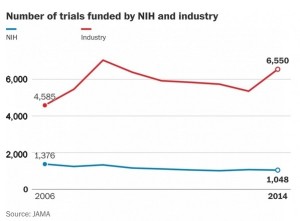
As the budget for the National Institutes of Health, the nation's largest funder of biomedical research, has flatlined over the past decade, the number of clinical trials funded by the federal agency has dramatically declined, a new study has found. At the same time, the number of trials funded by the pharmaceutical industry has exploded...Meanwhile, the number of NIH-sponsored trials fell from 1,376 registered on a website in 2006 to 1,048 by 2014, according to the study, which was published in the Journal of the American Medical Association. Industry-sponsored trials grew by about 2,000 over the same period, reaching 6,550 registered in 2014...More trials is generally a good thing...because it means that more new drugs, devices or other treatments are being tested. But the decline in federally funded trials concerns public health researchers, because federally funded trials are independent, often intended to compare drugs or other treatments instead of simply to show that a product works and should gain federal approval…there are many areas of deserving research...there may need to be a formal discussion of how research dollars are spent. A reasonable way to begin...is to look at the burden of a particular disease and allotting research dollars to those that have the greatest effect on mortality and disability...
- It’s official: FDA shoots past 2014’s new drugs record with Roche lung cancer med nod (biopharmadive.com)
FDA last Friday approved Alecensa (alectinib) for the treatment of ALK-positive non-small cell lung cancer for patients with the disease refractory to therapy with Xalkori (crizotinib). The approval comes well before the drug's March 2016 PDUFA date...This marks the agency's 42nd newly approved medication this year, topping a banner 2014 that saw 41 new drug approvals...there will be a continuing flurry of drug approvals over the next four years (225, to be exact, and most of them in cancer-related therapeutic spaces).
- Icahn: Change the international tax code, and Pfizer will drop its ‘travesty’ of a merger (fiercepharma.com)How to Stop Turning U.S. Corporations Into Tax Exiles (nytimes.com)

Carl C. Icahn is the chairman of Icahn Enterprises.
The tax benefits of buying Allergan are Pfizer's No. 1 reason for doing the $160 billion deal. In fact, some analysts see the $2 billion in potential tax savings as the merger's only substantial advantage...Activist investor Carl Icahn is one of those detractors, and on Monday, he amped up the criticism..."The Pfizer-Allergan deal is a travesty," Icahn wrote in a New York Times op-ed. "The point isn't to find corporate synergy. It is to leave behind our uncompetitive international tax system."...But what if those tax savings were moot?
- SEC, in complaint against Shkreli, alleges ‘widespread’ fraud over nearly 5 years (cnbc.com)Shkreli, CEO Reviled for Drug Price Gouging, Arrested on Securities Fraud Charges (bloomberg.com)

Martin Shkreli...was arrested by the FBI...after a federal investigation involving his former hedge fund and a pharmaceutical company he previously headed...The securities fraud probe of Shkreli, who is now chief executive officer of Turing Pharmaceuticals and KaloBios Pharmaceuticals, stems from his time as manager of hedge fund MSMB Capital Management and CEO of biopharmaceutical company Retrophin...SEC alleged that Shkreli engaged in "widespread fraudulent conduct" from at least October 2009 to March 2014... "made material misrepresentations and omissions to investors and prospective investors,"...once Shkreli took Retrophin public, he "fraudulently induced" the company to fund settlements with individuals who had claims against Shkreli from their investments in his hedge funds...
- FDA launches Web-based precision medicine platform for next-generation sequencing (healthcareitnews.com)FDA Launches precisionFDA to Harness the Power of Scientific Collaboration (blogs.fda.gov)

Food and Drug Administration...launched the beta version of precisionFDA, its new collaborative platform for the exploration of next-generation gene sequencing...First announced in August, the platform features more than 20 public and private sector participants…Next-generation sequencing enables researchers to compile a vast amount of data on a person's exact order or sequence of DNA...scientists can look for meaningful differences in DNA that can be used to suggest a person's risk of disease, possible response to treatment and assess their current state of health. Ultimately, what we learn about these differences could be used to design a treatment tailored to a specific individual...The hope is to grow this community and improve the usability of precisionFDA in the coming months and years...One way we'll achieve that is by placing the code for the precisionFDA portal on the world's largest open source software repository, GitHub, so the community can further enhance precisionFDA's features...
- The promise and peril of Ted Cruz’s plan to overhaul the drug approval process (vox.com)
Republican presidential candidate Sen. Ted Cruz and Sen. Mike Lee just introduced a new bill that would completely overhaul the Food and Drug Administration...The main idea: The senators want to expedite approvals for lifesaving drugs, give Congress space to intervene in FDA decisions lawmakers don't like, and expand the drugs and devices Americans have access to by allowing products approved in other countries onto the market...here's what the Reciprocity Ensures Streamlined Use of Lifesaving Treatments Act...would do:
- Allow for "reciprocal approval of drugs, devices and biologics" from "trusted, developed countries" like the European Union, Israel, Australia, Canada, and Japan. This means that if a drug or device is approved in one of these countries, citizens here could access it — and vice versa.
- Create a 30-day window for FDA review of lifesaving drug and device applications, in order to speed them up.
- Instruct the Health and Human Services secretary to approve a drug, device or biologic if "the FDA confirms the product is lawfully approved for sale in one of the listed countries; not a banned device by current FDA standards; there is a public health or unmet medical need for the product."
- Give Congress the power to overrule FDA decisions about promising applications for lifesaving drugs that the FDA rejected.
Right now the FDA is actually the fastest regulatory system in the world, with several expedited approval pathways for important drugs...the agency had approved 96 percent of the applications that came its way in 2015. So, again, how this new legislation — which further speeds up approvals — will solve the real reason better medicines aren't getting to patients remains to be explained.
- Under pressure, CDC delays release of opioid prescribing guidelines (statnews.com)Draft CDC Guideline for Prescribing Opioids for Chronic Pain, 2016: Summary of Constituent Comments and CDC Response (freepdfhosting.com)Painkiller politics: Effort to curb prescribing under fire (hosted.ap.org)

Under mounting criticism, the Centers for Disease Control and Prevention has delayed plans to...release controversial opioid prescribing guidelines for primary care physicians. Instead, the guidelines will now be issued sometime later in the year...The delay was first signaled yesterday when the CDC unexpectedly disclosed that public comments on its proposal would be accepted through Jan. 13. However, the agency will also tap the National Center for Injury Prevention and Control’s Board of Scientific Counselors, a federal advisory committee, to review the guidelines and public comments...The postponement follows complaints from representatives of other federal agencies and consumer advocacy groups that the CDC guidelines were based on weak evidence and would unfairly restrict some patients from obtaining needed pain relief. The agency was also chastised for using a “secretive” process to formulate the guidelines, which some critics argued had violated federal law...the CDC delay apparently reflects a desire to comply with the Federal Advisory Committee Act, which governs how expert groups are formed to provide official advice.
- Survey: Employers taking action to cut specialty drug coverage (drugstorenews.com)
Employers are taking significant action to reduce their exposure to rising costs associated with specialty medicines...Although pharmacy represents approximately 20% of employer-sponsored medical benefits costs, it is increasing at a rate that accounts for roughly half of medical cost inflation and should be a top priority for employers...The price, utilization and delivery of specialty prescription drugs, many of which require special handling or delivery, are a top pain point for employers...employers are beginning to consider new aggressive approaches... employers have added new coverage and utilization restrictions for specialty pharmacy, such as requiring prior authorization or limiting quantities based on clinical evidence... employers plan to exclude compounds from their benefit coverage...the compounding process results in higher cost and their use may not be FDA-approved in compound form, health insurers increasingly will not cover them...
- FDA approves first chemo antidote (pharmatimes.com)FDA Approval of VISTOGARD®, the First Antidote to Treat Overdoses and Early-Onset Severe Toxicities Due to 5-Fluorouracil and Capecitabine Chemotherapies (wellstattherapeutics.com)

US regulators have issued a speedy green light for the first and only drug able to treat chemotherapy overdose or severe allergic reactions...The decision allows doctors to use Wellstat/BTG’s Vistogard (uridine triacetate) to treat patients following an overdose of 5-fluorouracil or capecitabine, or in patients exhibiting early-onset, severe or life-threatening toxicity affecting the cardiac or central nervous system...In combination with other drugs or radiation, 5-FU is a mainstay of chemotherapy across various solid tumours, and capecitabine is a prodrug of the chemotherapy that is enzymatically activated within the body and transformed into 5-FU...The approval of Vistogard is important because it represents the first treatment with a demonstrated track record of efficacy and, just as important, it allows some patients to resume chemotherapy sooner following the resolution of the toxicity...