
- Vaccines are among big pharma’s best-selling products (ft.com)
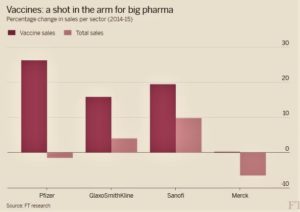
Ask people to name Pfizer’s best-selling product and many would opt for one of its most famous drugs: Viagra, for erectile dysfunction, or Lipitor, to reduce high cholesterol. People more familiar with the US pharma group might suggest a more recent blockbuster such as Lyrica, for pain...But they would all be wrong. The top-seller is not a drug but a vaccine: Prevnar, which prevents pneumonia, meningitis and other infections caused by pneumococcus bacteria...Prevnar generated revenues of $6.25bn last year — almost three times as much as Viagra. This was up 40 per cent from the year before...While vaccines play a big role in frontline healthcare, they are often an afterthought for a pharmaceuticals industry more focused on treating diseases than preventing them...There are several factors driving this growth. One is the expansion of immunisation programmes in newly industrialised countries such as China...In rich countries, growth relies on either finding more diseases to immunise against...or widening the reach of existing products...the complexity of vaccines, and the fact they are given to healthy individuals rather than to treat the sick, makes quality and reliability especially challenging. "The hurdles are a bit higher than in other parts of the pharma industry."
- UnitedHealth Group plans to remain in Nevada (reviewjournal.com)
UnitedHealth Group Inc., which announced...it would limit its participation to a handful of Affordable Care Act insurance exchanges in 2017, will remain in Nevada’s exchange...so far is expected to halt participation in exchanges serving Arkansas, Georgia, Louisiana, Michigan and Oklahoma, had expanded its participation to 34 states this year...the insurer had unfavorable experiences and performances in the individual exchange market, citing the smaller overall market size and shorter-term, higher-risk profile of clients as indicators they couldn’t effectively service the market...UnitedHealthcare and OptumCare both fall under the UnitedHealth Group umbrella, and in Nevada, the former includes Health Plan of Nevada, Senior Dimensions and Sierra Health and Life...OptumCare...is a separate company that includes Southwest Medical Associates...Before the official announcement of a United Health Foundation grant to UNLV early this month, Robert McBeath, president and CEO of Southwest Medical, described United as having a "significant commitment" to Nevada.
- US ‘foots the bill’ for global biopharma innovation, says ITIF (in-pharmatechnologist.com)How National Policies Impact Global Biopharma Innovation: A Worldwide Ranking (www2.itif.org)

US ranks first in terms of how its domestic policies contribute to global biopharmaceutical innovation, according to a recent analysis...The report , released by the Information Technology and Innovation Foundation, a nonprofit, nonpartisan research and educational institute focusing on the intersection of technological innovation and public policy, includes findings that assess 56 countries making up nearly 90% of the world’s economy...relative to its share of the global economy (22%), the US contributes twice the share (44%) of global R&D investment in the life sciences...it also pays closer to "the true cost of medicines developed...It means too many other nations aren’t doing their share to bear the costs of biomedical discovery and innovation...This underinvestment in biomedical research is one of the most significant factors slowing the pace of biomedical innovation. Moreover, there’s a game theory problem here where some nations are incented to free-ride off the investments of others...Countries must recognize that excessive price controls are actually damaging to long-term biopharmaceutical innovation...Strong intellectual property rights are vital for a robust life sciences innovation ecosystem; with biologic drugs the frontier of biomedical innovation, countries should implement strong IP protections for biologics, including biologics data exclusivity periods of at least 10 years or longer...
- Spending On Drugs Will Drop As Top Sellers Go Generic (forbes.com)

...IMS Health disclosed that total spending on prescription drugs in 2015 rose 12.2% to almost $425 billion. Since drug pricing continues to be a major topic of discussion...What is striking about the newly released data are the drugs Americans spend the most on... cholesterol-lowering drug Crestor, with sales of $6.3 billion...this will soon become moot as Crestor will lose patent protection and become a generic drug, an event that will likely drive down its cost by as much as 90%...rheumatoid arthritis drug, Amgen’s Enbrel, with U.S. sales of $6.6 billion last year. The FDA is now reviewing a biosimilar version of Enbrel which was filed by...Sandoz...Given that Zarxio was launched at a 15% discount to Neupogen, a similar discount could be anticipated for a biosimilar Enbrel...rheumatoid arthritis, Humira (adalimumab) from AbbVie . Many analysts believe that Humira’s $10.6 billion in 2015 revenue will be severely impacted by biosimilars being developed by Merck, Amgen, Pfizer and others...one might expect even larger discounts than 15%...the top drug with respect to spending in the, the hepatitis C drug Harvoni from Gilead, weighing in at $14.3 billion. It is unlikely that the sales of this drug will decrease any time soon. However, the use of hepatitis C drugs to cure this infection will reduce the incidence of liver cancer, thereby lowering overall costs to the healthcare system over the coming years...there will be new–and expensive–breakthrough drugs emerging from the pipelines of the biopharmaceutical industry. But let’s not lose sight of the fact that these same drugs that save lives or alleviate the suffering of millions, eventually will become a lot cheaper.
- What’s California’s Prescription For Rising Drug Costs? (khn.org)

Hepatitis C drugs are not the only part of California’s troubling drug spending picture. Despite recent cost-cutting measures, such as putting tighter controls on which patients get coverage for which drugs and when, California’s spending on pharmaceuticals has gone up, and so has the number of pricey drugs it is covering. It’s not clear state agencies have the means to balance drug cost pressures in a way that serves the best interests of patients, taxpayers and public health...California voters are expected to decide in November on a measure to put a ceiling on what the state pays for drugs, and lawmakers have proposed drug price transparency requirements on pharmaceutical manufacturers and health insurers...Medi-Cal (Medicaid) says pharmaceutical costs are kept under control by a strong push toward generic drug use for the 10 million enrollees who get health services through health plans. Up to 95 percent of the prescriptions dispensed by these plans are lower-cost generics...The Department of Health Care Services, which manages Medi-Cal, says it has a 20-year practice of controlling drug costs by negotiating deep discounts with drugmakers...Health consumer advocates and economists argue that paying a lot for some drugs that only treat a limited population may not serve larger public health interests, or be the best use of taxpayer dollars...Are we going to have a sustainable (pharmaceutical) industry where we are making sure the drug companies make enough money where they can bring great new products to the marketplace, yet we control cost well enough that people — all people, even the most vulnerable, have access to the drugs they need?...State Medi-Cal administrators say it’s too soon to assess the sustainability of current prescription drug spending trends. If more high-cost drugs come on the market and treat small populations, it won’t have a major budget impact...
- Europe’s new trade secrets rule sparks debate over drug safety (statnews.com)
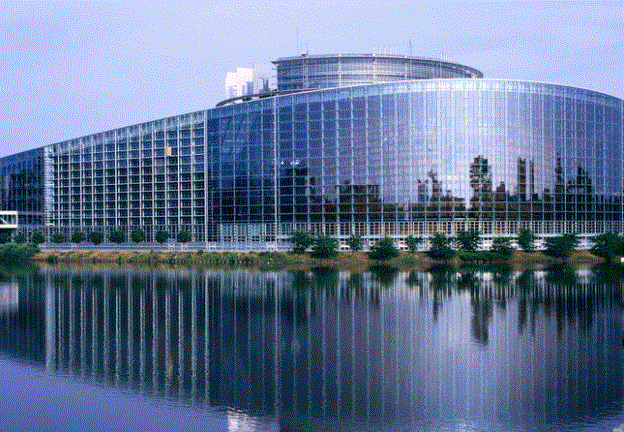
...the European Parliament...formally approved new rules to help companies protect their trade secrets. The move creates a framework for the European Union in which companies can take legal action against someone who allegedly steals confidential information...The rules...were devised in response to longstanding complaints by corporations that Europe lacks a uniform approach to dealing with the theft of trade secrets...harmonization should allow the creation of a safe and trustworthy environment for European companies, which will see their intangible assets and know-how secured...the rules, known as the Trade Secrets Directive, are sparking sharp protest from numerous organizations that claim the effort may jeopardize the legal rights of whistleblowers and others that attempt to disclose alleged wrongdoing by corporations
- Nurofen maker deserves $6m fine for false claims, court told (theguardian.com)

The Australian consumer watchdog says manufacturer Reckitt Benckiser profited substantially and should be fined accordingly...Nurofen’s manufacturer Reckitt Benckiser should be fined $6m for misleading consumers over a range of “targeted” pain products that cost twice as much as its standard painkillers despite all products in the range having the same active ingredient and effect, the Australian Competition and Consumer Commission has found...the federal court found the British company...had engaged in “misleading conduct” by representing that its Nurofen Specific Pain products targeted a type or area of pain despite being identical, and ordered they be removed from supermarket shelves...There needs to be some serious taking away of profit...Targeted painkillers zero in on one vital organ – the wallet...Nurofen did not set out to mislead consumers. Nurofen has cooperated with the ACCC in relation to these proceedings and will fully comply with the court order….
- More drug makers are taking hefty price hikes on more drugs (statnews.com)
If you thought drug makers might hunker down in the face of public outrage over pricing, think again...Given the clamor over the cost of prescription drugs, most manufacturers were expected to avoid drawing attention to themselves by boosting price tags. But several companies have been hiking prices for their medicines at a rate that one Wall Street analyst found surprising...Johnson & Johnson took cumulative price hikes on more than a dozen drugs ranging from 5 percent to 28 percent. The biggest boost was for Simponi, which is used to treat rheumatoid arthritis. Amgen raised prices on seven different drugs from 7.6 percent to 28 percent. The largest was for Enbrel, which is used to treat psoriasis and rheumatoid arthritis, among other ailments...Celgene increased price tags between 10.3 percent and 27.9 percent on four medicines, while Gilead Sciences raised prices between 10 percent and 16.5 percent on five drugs...Biogen boosted prices for five drugs anywhere from 9.8 percent to 18 percent; the biggest price hike was for the Tysabri multiple sclerosis treatment.
- Express Scripts says Anthem negotiated in bad faith -court filing (finance.yahoo.com)

Pharmacy benefit manager Express Scripts Holding Co has accused Anthem Inc of negotiating their contract in bad faith and is seeking a court order that the health insurer has no right to demand lower drug prices...The allegations, made in a filing in federal court...in response to a lawsuit Anthem brought against Express Scripts last month seeking $13 billion in price cuts over the remaining four years of the companies' contract...Express Scripts said...the contract did not require it to offer any specific price cuts, but only to negotiate in good faith...Express Scripts said it had proposed five price cuts "within the range" of Swedish's projections last June, but that all were rejected, suggesting that Anthem was acting in bad faith when it brought its $13 billion lawsuit.
- Shire building $400M biologics plant, adding 400 jobs in Ireland (fiercepharma.com)
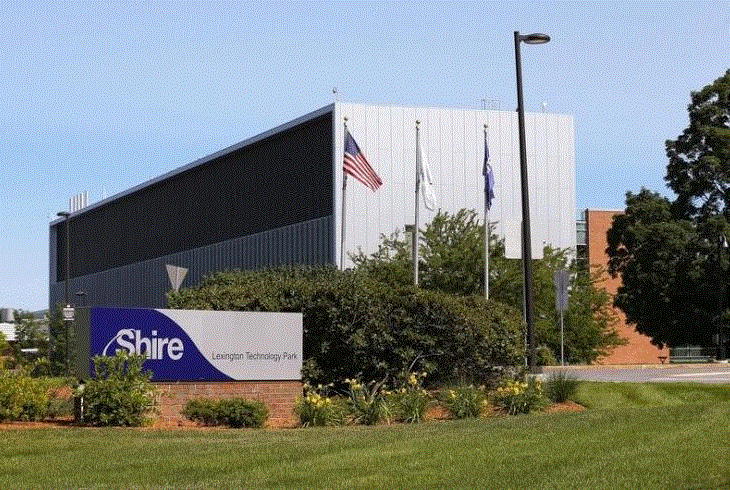
Rare disease drug specialist Shire has been on a buying streak lately, culminating with its $32 billion deal for Baxalta. Now the company says it is time to build something...The...company intends to invest $400 million to erect a biologics plant in Ireland, its first manufacturing facility in its adopted home country. Shire's only other manufacturing is in the U.S...Construction is expected to begin this summer in Piercetown...it will add 400 jobs when the project is completed in 2019...Shire says it needs the new plant to meet growing demand for its products. It saw good growth last year, underpinned by its ADHD and binge eating treatment Vyvanse (lisdexamfetamine), as well as strong sales from hereditary angioedema products, Cinryze (complement C1 esterase inhibitor) and Firazyr (icatibant). With Baxalta, Shire gets products for treating hemophilia. Some analysts are unsure why Shire is so hot for Baxalta, given the competitive hemophilia market where new drugs could decimate the business going forward...